 By:
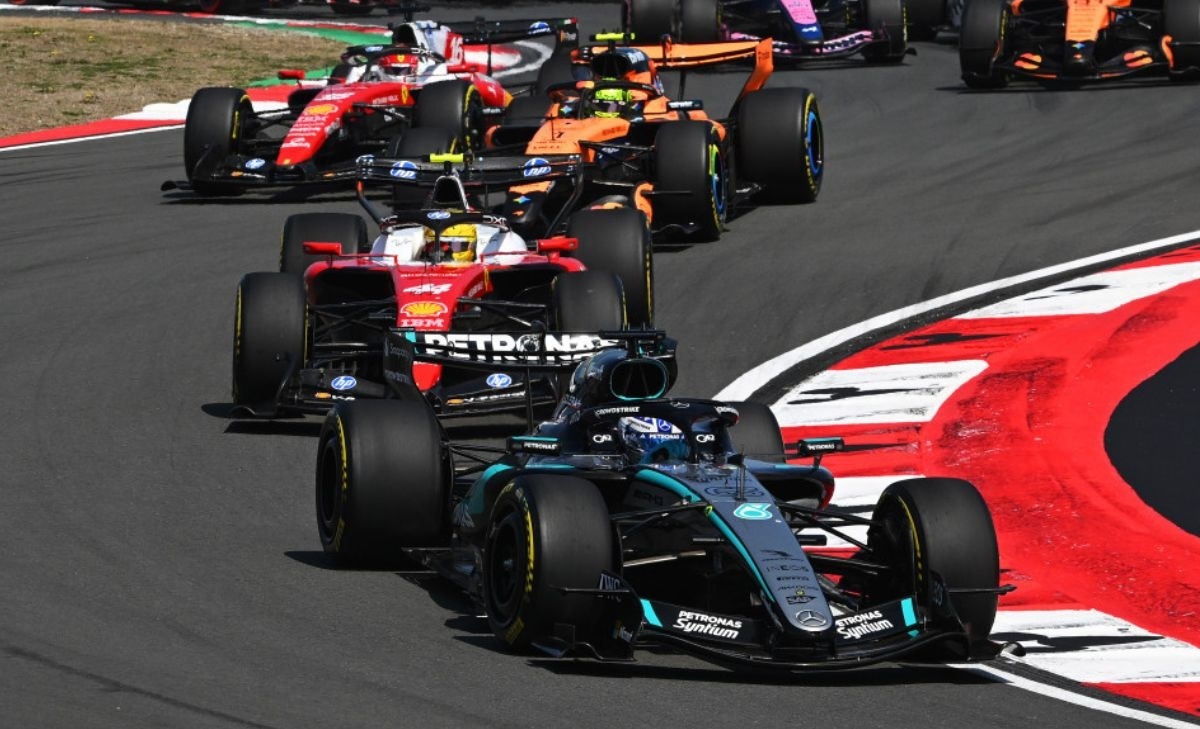
By: Comparison of power units. Those that allow George Russell, Andrea Kimi Antonelli, Lewis Hamilton and Charles Leclerc to compete for the most coveted positions in the standings, at least as seen in the first two races of the world championship.
Mercedes is undoubtedly the team/producer to beat. At the end of the Chinese GP, Ferrari team principal Frédéric Vasseur spoke of a 5-tenths gap to close with the Stuttgart-based manufacturer. At least as far as race pace is concerned. It's hard to say whether this shortcoming is just about the engine, but it's clear that from a power unit perspective they found something more at Brixworth.
Comparison between the two power units that are leading in F1
The question now is: what? And especially in which area? To try to understand this, we decided to compare the data sheets of the two power units. Obviously we didn't expect to reveal the ‘’trick’’ through this simple operation, but something interesting still emerged.
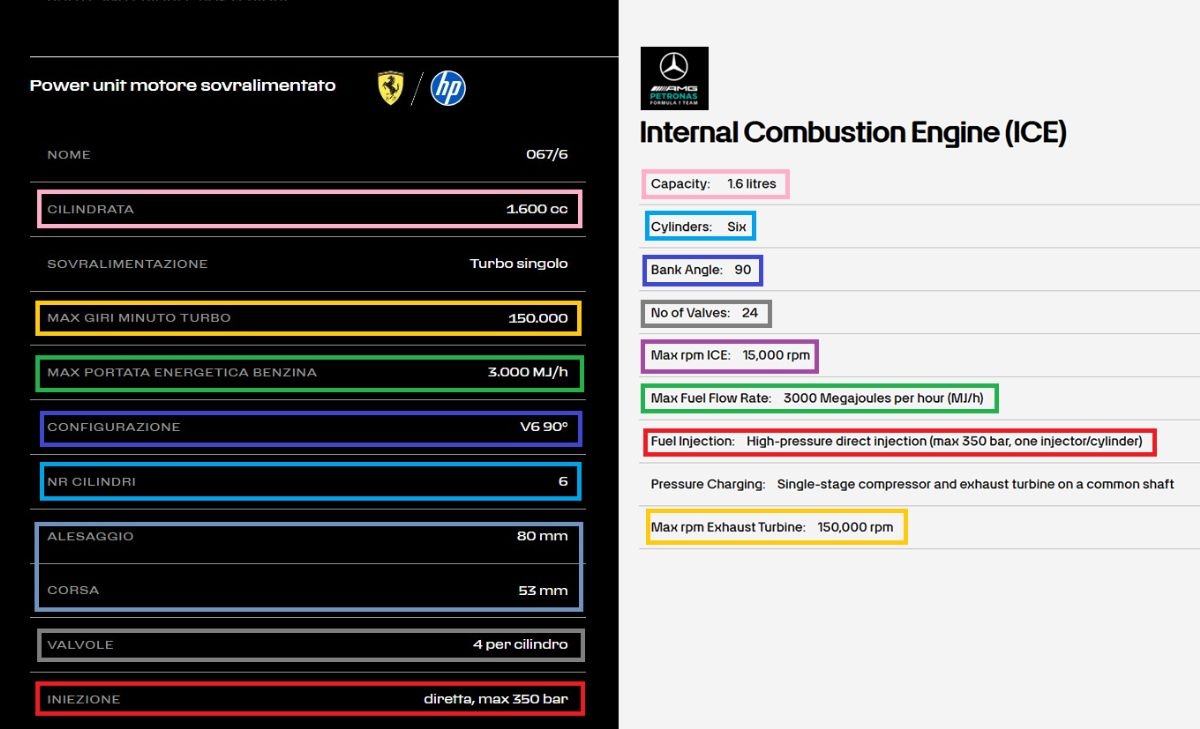
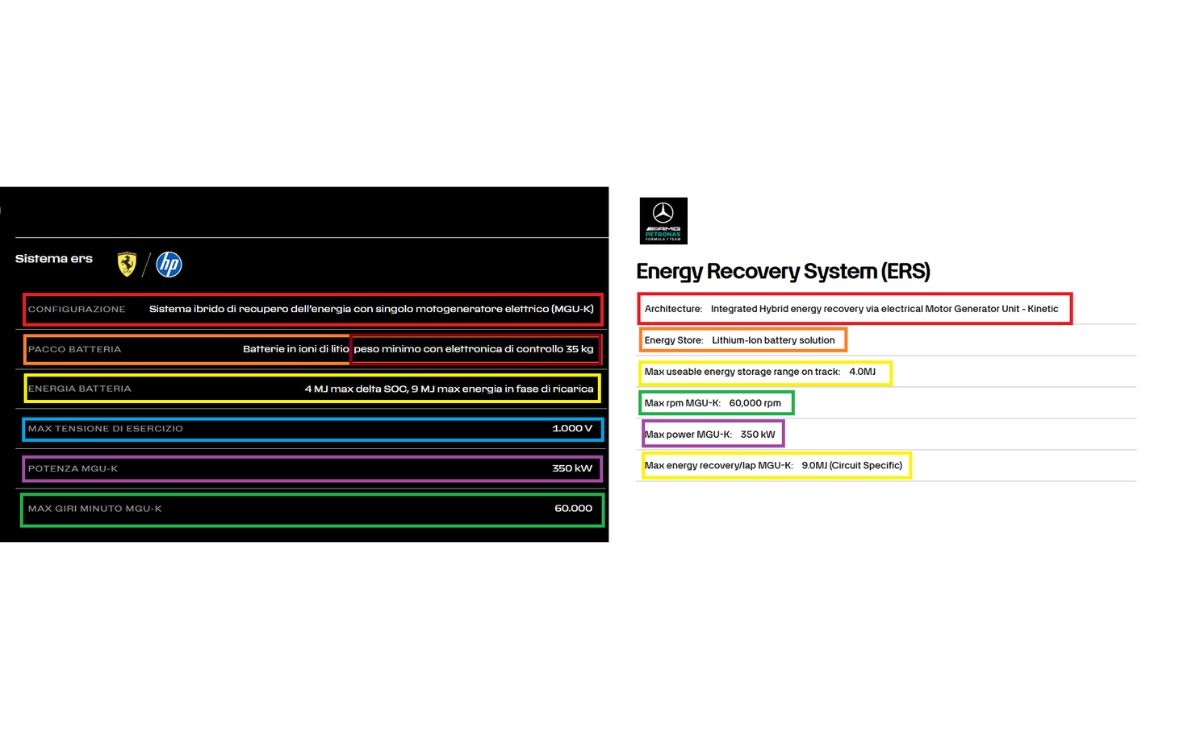
First of all, if we combine the two cards, both the ICE and ERS cards, it would appear that we are talking about two completely identical power units! If we were to exchange data, at least at the level of the stated technical characteristics, we would be dealing with the same power unit. Clearly this is not the case.
Both declare additional data and more are born. On the Mercedes website we find that ICE manages to reach 15,000 rpm, an entry absent on the Ferrari website. While the italian team claims bore and piston stroke, which Brixworth was careful not to disclose.
Builders mask ICE's power figure, that's where the 2026 challenge is played out
If they look like two identical power units, where can Mercedes make a difference? Only in energy management? Mmmm… Although the MGU-K is designed to recover up to 9MJ per lap, drivers only use part of it in race and qualifying (values that the FIA is changing from race to race, in Melbourne for example they were 8 MJ during the GP and 7 MJ in qualifying, data from Australia). With an extra 0.5 MJ in the race if they are within 1 second of those in front.
The missing data, if we look at the two technical data sheets of Ferrari and Mercedes, is the actual power of ICE! That has not been declared by either manufacturer and that is, incidentally, the value that will be taken into consideration in order to carry out the ADUO assessments. The only actual power value we have available is the 350 kW declared for the ERS.
The interesting thing, however, is that the data regarding the power of the heat engine are not that it is not there, they have simply been masked, masked. By the way, from both Mercedes and Ferrari. Both manufacturers speak of a maximum fuel energy flow rate of 3000 MJ/h. A fact expressed in this form can say a lot and say nothing. Those who pay more attention to units of measurement will notice that this value is nothing more than an indicator of the maximum power that homes can extract from fuel at its maximum energy flow rate. Pure power, free from all loss. Not to be confused with useful power.
Starting from this consideration, by carrying out a rapid conversion, we deduce that the fuel could reach the value of 830 kW at its maximum energy flow rate. A very high value which, however, due to the losses of the Otto cycle system, absolutely must be reduced. In the past it regulated the efficiency of ICE was around the value of 50%. Extremely high efficiency for a combustion engine, achieved over time and which therefore no one is yet able to achieve at the moment.
The disarming aspect of this story is to have understood, from the rumors circulating these days, that the Mercedes engine is already working at values close to that efficiency.
Halving that 3000 MJ/h by 50% would mean reaching about 415 kW of power from ICE. This shows why the FIA has limited the power of the internal combustion engine to 400 kW for the 2026 season (i.e. an efficiency of 48%).
Furthermore, we can say that the calculations we carried out hold up under the hypothesis that the teams are actually already capable of reaching that value of 3000 MJ/h given by the fuel at some stages of the race. This may be a goal that has not yet been achieved, but which they hope to achieve (this will also depend largely on the development that will also take place during the year on fuels). Ultimately, the challenge for engine manufacturers for the current season will therefore be to try to get closer to that value of 400 kW. That is, since the manufacturers declare the same energy flow rate as the fuel, the game will be played on who can have the most efficient ICE present on the F1 grid. Getting as close as possible to that 48% return.
And can you guess what factors influence efficiency?
- Temperature and pressure in the combustion chamber;
- Combustion quality;
- Compression ratio;
- Thermal and mechanical losses.
Obviously, manufacturers cannot at present reveal the exact figure for useful power from ICE alone. This is the value that the FIA will take precisely to establish which of the manufacturers needs further development to achieve Mercedes' performance more quickly via the ADUO system. Only then can we make more precise assessments.
We have only mentioned the manufacturers competing at the top, but it is clear that the reasoning made also applies to Audi, Red Bull Powertrains, Honda and from next year it will also apply to Cadillac.
Cover photo: Pirelli, internal photo: Mercedes, Ferrari
Read also in italian language: Mercedes e Ferrari puntano al 48 per cento di rendimento, la FIA definisce l'obiettivo
All the news, photos, weather, session times and times from the Japanese GP 2026