 By:
By: Hamilton has relaunched the ‘Mercedes party mode’ trend the last weekend in China. The term, widely used since 2014 and banned in 2020, gave the Stuttgart team an advantage in both racing and qualifying. What exactly was it ‘party mode’? At the time, Lewis Hamilton and his teammates (Nico Rosberg from 2014 to 2016 and Valtteri Bottas from 2017 until his removal) had a magic button that could increase the power of the Power Unit's internal combustion engine thanks to a different strategy of using the turbine-compressor boost assembly. If we want to be even more precise, they have tried to diversify the level of combustion air pressure.
In those years, it only took one button to use 'party mode' in qualifying and racing to have this surplus of power. But now, in 2026, can Mercedes really still have fun with a ‘party mode’? No, or rather, the W17 does not have a button to activate it with (at least according to the information we have). Hamilton's accusation at the end of qualifying for the Chinese GP is undoubtedly a provocation. But there's something underneath. If the other teams take a step forward in qualifying between Q1 and Q2, Mercedes manages to make a clear leap forward, in terms of performance, both between Q1 and Q2 and between Q2 and Q3. What could it be?
Mercedes does something strange during qualifying
As far as we are concerned, let's consider excluding the electric/hybrid part of the engine. The FIA records both input data, that is, energy recovery data, and output data. During the qualifying lap it is possible to use a certain amount of energy defined from race to race by the FIA, generally different from that which is then used in the race, with 0.5 MJ more coming from overtaking mode if you are less than a second from the car in front.
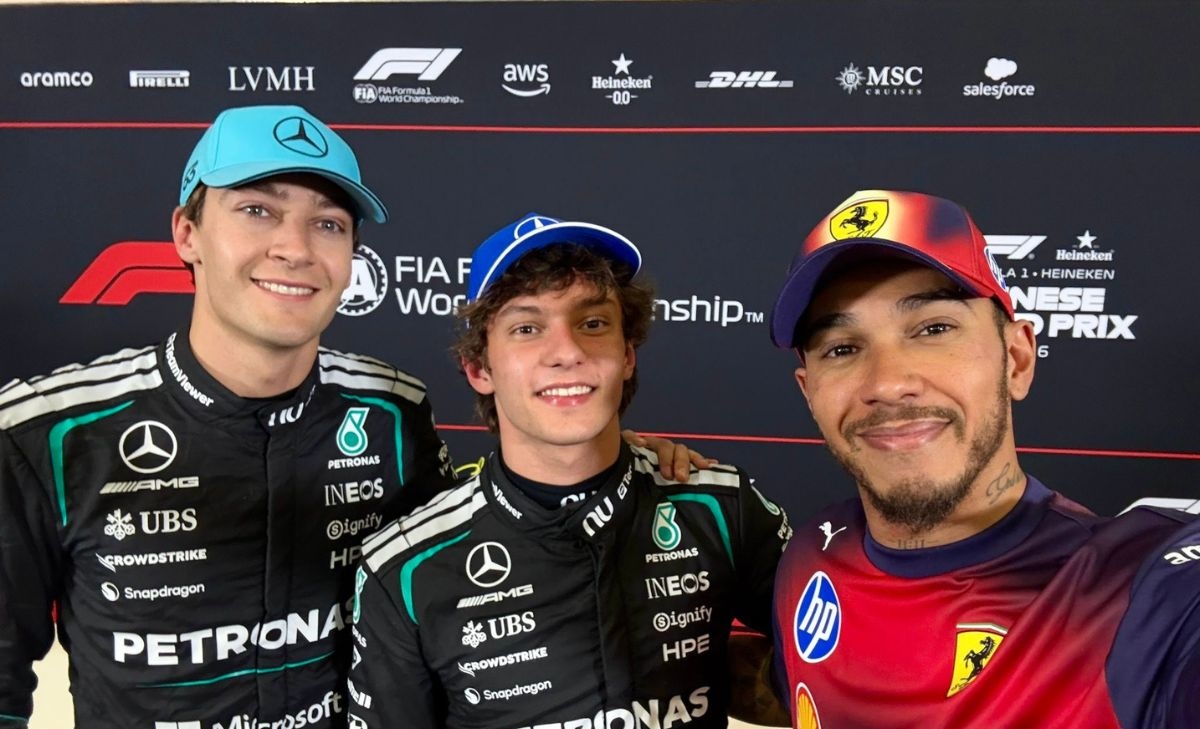
Top 3 Chinese GP qualifying: poleman Antonelli (Mercedes) alongside Russell (Mercedes) and Hamilton (Ferrari)
Hamilton isn't a driver who talks so much to talk, so where could Mercedes get more out of it? Maybe from the heat engine and the use it makes of it. The compression ratio is certainly a topic on the FIA table and from 1° June new checks will take place to try to better understand what is happening inside the Mercedes ICE (thermal part). But it's not the only thing. It could also be a discussion about mappings or a mode used only in qualifying (for a few laps) to avoid stressing the engine too much.
If what Lewis Hamilton says is true, alluding to ‘party mode’ implies that you can count on a mode or mapping that can be activated at will (with the necessary limitations). The data tells us, at least as far as qualifying is concerned, that it is not something that drivers activate, but that they always have in their possession, which they can always draw on during official testing. Which they unlock by advancing from session to session, but which they have as a dowry.
This actually fuels rumors about the compression ratio, but it could also be something else. What it is, we have not yet been given to know. The thing is, there's something. The gap to the opponents is too wide. Hamilton, on the other hand, was their driver and if he talks, it's not just to get air in his mouth.
Cover photo: X, Mercedes; internal photo: X, Mercedes
Read also in italian version: Mercedes: il party-mode è una provocazione, ma Hamilton sa quel che dice
All the news, photos, weather, session times and times from the Japanese GP 2026