 By:
By: During the second test session in Bahrain,we had the pleasure, together with our Formula 1,it director, Daniele Muscarella, of interviewing Pirelli motorsport director Mario Isola. We were able to touch on a great many themes indeed. The topics we bring to you today concern the difficulties drivers will encounter in completing a good qualifying lap, tyre management and the Italian coach's feelings about what the teams' on-field values might be at this start to the season marked by important regulatory changes.
Spins needed to prepare for qualification
M. Sassara: Many believe it will take two preparation laps to get the most out of these cars during the qualifying lap. What aspects will the pilots have to pay attention to during this delicate phase?
M. Isola: “The topic of preparing for the qualifying lap is not so much about recovery, but about energy saving. Qualifying is a living topic, which will be very present on low-stress tracks or where there will be a wide delta between the front and rear axles. Baku comes to mind, but there will be more during the World Cup. While the rear axle is constantly generating energy through traction, it is difficult to heat the front axle precisely because of its low-stress nature. What does this mean? On the exit lap until 2025, there was a tendency to push harder to bring the front tires to temperature without overheating the rear ones, they balanced the two axles and when they started the push lap they had the 4 tires at maximum grip. Today it is possible to bring the 4 tires to maximum grip, but this comes at a cost equal to part of the energy required during the push lap. Therefore, performing an exit turn and a preparation turn allows you to gradually bring the tires to temperature while managing the energy. For this reason we believe that on some tracks there will be a double lap before pushing for the qualifying time. You must have both the rubber in temperature and the battery charged."
M. Sassara: It's basically about working synchronously on the battery and the front of the tires for two laps, right?
M. Isola: “Yes exactly. Then they will try to figure out what the best system is. You can also push a little’ more into the external circuit, bring the rubber to temperature and then in the preparation round manage the temperature and at the same time recharge, which is a little’ what you were assuming. The ideal system is not yet clear to us and it is not up to us to look for it. What we can say is that it probably won't be the same on all tracks. If we take Silverstone, for example, in decent weather conditions, we are talking about a track with a lot of lateral load, where it is not difficult to bring the front axle to temperature. There's no need to create this situation, so on tracks like Qatar and Silverstone, it's very likely that with one round of outs you already have the most ready tire”.
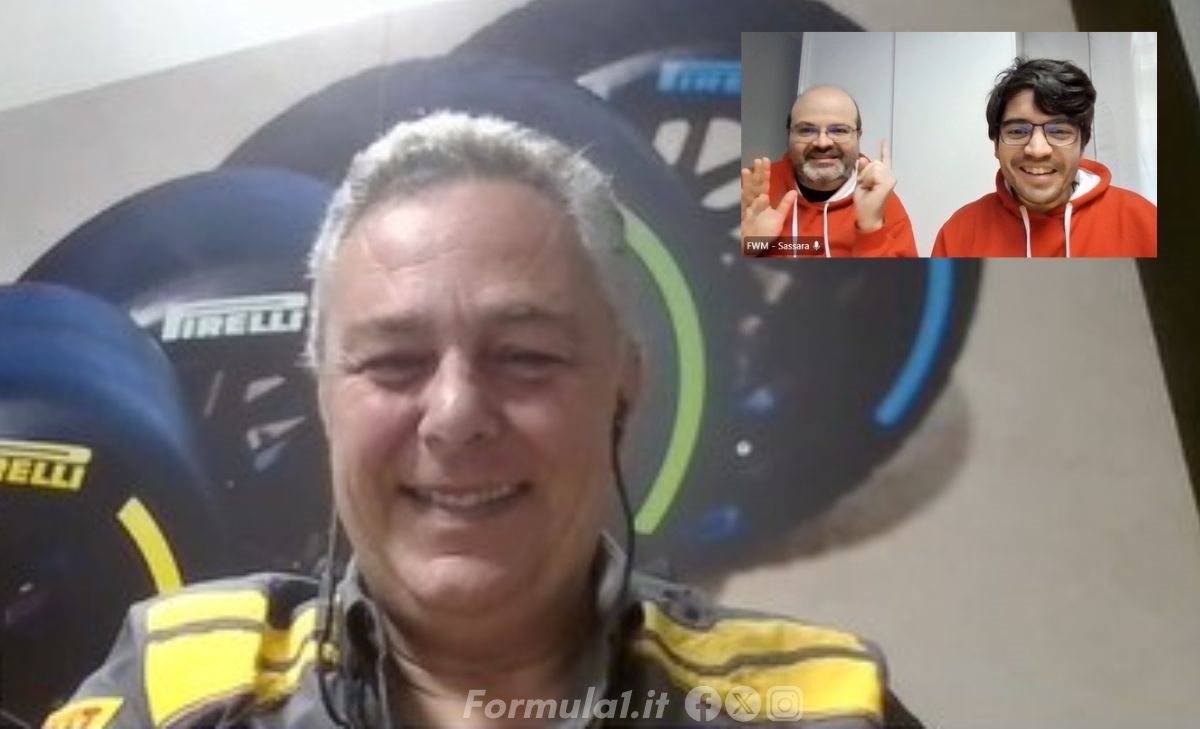
In the image we have Mario Isola, director of motorsport Pirelli, in the foreground, while in the small panel, starting from the left, the director of Formula1.it, Daniele Muscarella and the editor Marco Sassara.
Tire management: Isola responds to Alonso: "No one will use the 2025 cars"
D. Muscarella: Will tire sizes, because they will be smaller than last year, have more problems maintaining temperature?
M. Isola: “No. We have seen that the performance is not far from last year's. Especially the car works differently. On the straight you have a lower load on the straight, which allows for higher speeds, but then at the corner the load is there. So the energy in the corner is there and it affects the smaller tire (the front one, ed.). We have worked carefully to reduce overheating without penalizing degradation. We've already reduced granulation, so if we tried to reduce degradation too much the risk was of making single stops in most races and that's not what we want. The idea is to always ensure a mix at the strategy level”.
M. Sassara: Taking as a starting point the words released by Fernando Alonso (Aston Martin driver), after the first test session, with the drivers having to be careful when cornering to save, or rather not consume energy, could this benefit the tire management? Not having to stress her too much.
M. Isola: “Yes, it's just a different situation than last year. Braking, cornering, cornering… All of this we're talking about will then have to be evaluated. What I can tell you with the information we have today is that the data collected last year with mule cars we have been able to confirm quite well. I personally had doubts about that. So, as a mixing behavior, front-rear balance, particular effects like graining, which we haven't seen, blisters, which we haven't seen, we are satisfied. We redefined the entire rubber profile, the footprint on the ground so that there were no temperature spikes that could generate blisters. The delta time between the compounds is also another data that we were able to confirm. On degradation, a question mark remains. In testing, it's logical that the teams don't want to find out, but we've seen some’ degradation and we'll only see the impact this will have on strategies during the race. Going back to what Fernando (Alonso, ed.) said, it is clear that it is a different way of driving the car, no one will drive the 2025 cars instead of the 2026 cars. There will be a levelled situation on another approach to driving and cornering. There are so many things that change. When they close the SM, the unloaded wing immediately loads, so that phase also impacts the tire. Then the braking comes right after. There are many aspects that we like Pirelli are also studying and understanding. How will tire stress change between dry and low grip conditions? That is, in wet conditions and in low grip conditions. When the de facto system will not be used, except partially on the front wing. It will stay loaded a lot in the back, while in the front it will unload a little’. Will there be changes at the budgetary level? Probably yes, but it has to be understood. For example, mule cars did not provide the opportunity to simulate this effect”.
Forces on the pitch, Pirelli's feelings
D. Muscarella: Without naming names… Based on the data received from the teams, will there be substantial differences in rubber management between the various teams?
M. Isola: “There was a big difference in the simulation data received in June 2025, we have several gates. Based on the progress made by the teams with the model, we then receive simulations. These differences were then significantly reduced in the December 2025 simulations. This data helps us define, get a first idea of tire prescribing, and start thinking about the selection we need to make for primary care physicians. The data therefore tend to converge. We have already seen an approach. Will there be time zone differences on the ride? YES. My feeling is that there will be groups. We're seeing teams that represent the best teams, the midfield and someone who's fighting a little’ harder. But within the groups they are all quite close”.
We thank Pirelli and Mario Isola for their cordiality and helpfulness in the interview. Partial reproduction of this exclusive interview is possible after citing the author (Marco Sassara) and the formula1.it source with a link to the original content.
Photo: Formula1.it
Read also in italian language: Pirelli, Isola in esclusiva: «Team divisi in gruppi. All'interno tutti molto vicini»