 By:
The Autódromo José Carlos Pace, better known as Interlagos, is one of the most complete and demanding circuits from a driving perspective. At 4,309 metres long, it features 15 corners and runs anti-clockwise, with constant elevation changes and a mix of very fast sections and technical sequences. It is a layout that forces teams to find a compromise between aerodynamic efficiency, cornering downforce and electrical energy management, which is particularly important with the 2026 power units.
The lap begins with the famous Senna S, a downhill sequence that demands precision through the changes of direction and stability under braking, before the acceleration towards the Reta Oposta. The middle sector is instead defined by slower, more technical corners, where mechanical grip and the car's ability to change direction quickly become crucial. The final section, from Junção to the finish line, is dominated by a long uphill acceleration zone that tests traction and power unit delivery. It is a sector in which the availability of electrical energy could make a significant difference, especially in qualifying.
The elevation changes, the different types of corners and often unpredictable weather conditions make Interlagos a circuit where the car's balance can change significantly over the course of the weekend. The São Paulo Grand Prix will be contested over 71 laps, for a total distance of 305.879km.
Braking demands
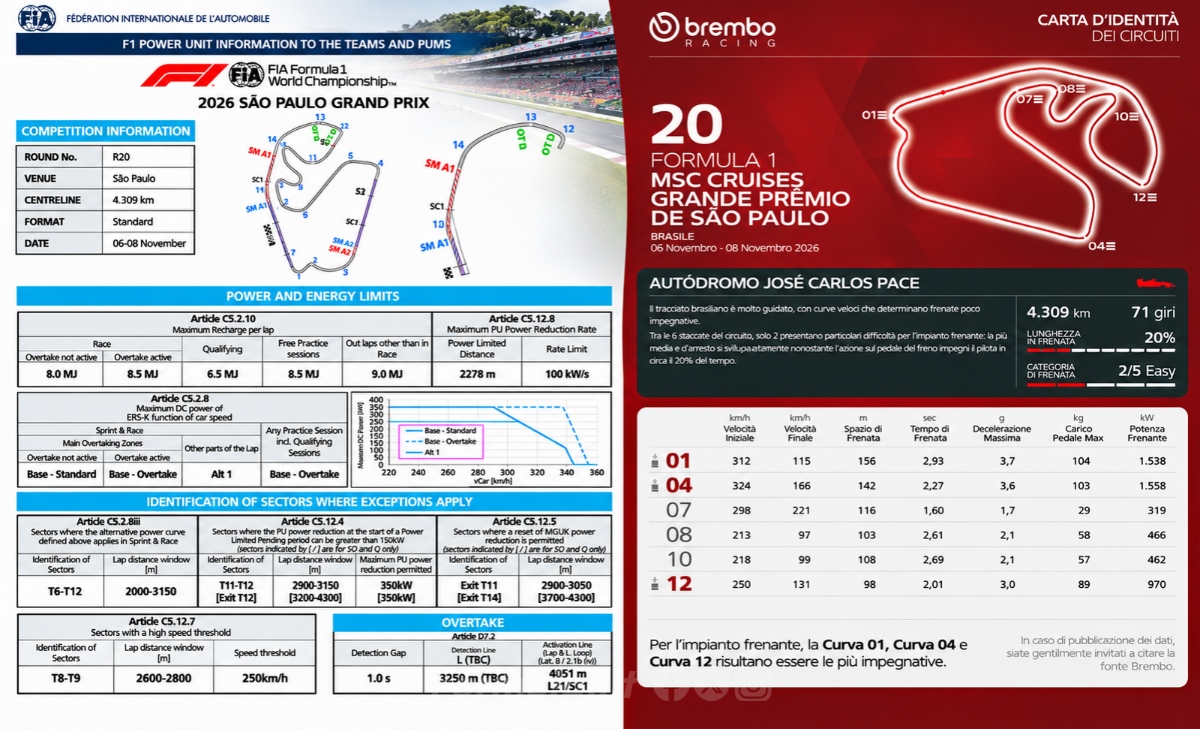
According to simulations by Brembo engineers, Interlagos falls into the category of circuits that place a low demand on the braking system, with a difficulty index of 2 out of 5, compared with the 4 assigned to Mexico. A notable difference, despite the two tracks being virtually the same length.

There are just six braking zones per lap, one fewer than in Mexico City, and they occupy the drivers for more than 14 seconds in total, equivalent to around 20% of the lap time. Two braking zones are classified as Hard, one Medium and three Light. The presence of long acceleration phases and corners negotiated without particularly heavy pedal input helps keep the strain on the system under control, despite some demanding decelerations.
The most severe braking zone is at Turn 1, at the end of the main straight. The cars slow from 312 to 115km/h in 2.93 seconds over a distance of 156 metres. Deceleration reaches 3.7g, with 104kg of force applied to the pedal and braking power of 1,538kW. By comparison, in Mexico the cars reached the first corner at 340km/h and required 193 metres to slow to 114km/h, with braking power of 1,668kW.
The comparison with 2025 confirms the profound differences introduced by the new-generation cars. At Turn 12 last year, drivers were subjected to a deceleration of 4.7g, applying 148kg of force to the brake pedal. This year, the projected figures fall to 3g and 89kg respectively: an effort reduced by 59kg, accompanied by a substantial 1.7g drop in deceleration.
However, the distance needed to slow down increases. Again at Turn 12, the braking distance rises from 84 to 98 metres, an increase of 14 metres, while the time rises from 1.73 to 2.01 seconds. The 2026 cars therefore demand considerably less effort from drivers, but take more time and distance to negotiate the same braking zone.
Power units: FIA limits for Brazil
The official Power Unit Information document published by the FIA for the São Paulo Grand Prix introduces some significant differences compared with Mexico, particularly in electrical energy management. In qualifying, the MGU-K will be able to recover a maximum of 6.5MJ per lap, compared with the 8.5MJ permitted in Mexico City. That is a reduction of 2MJ, or around 23.5%, particularly noteworthy given that the two circuits are virtually the same length: Interlagos measures 4,309 metres and the Hermanos Rodríguez 4,304 metres.
The differences continue in the race, where maximum recovery will be 8MJ without Overtake Mode and 8.5MJ with the overtaking system active, compared with 8.5MJ and 9MJ respectively permitted in Mexico. In free practice, the limit will be 8.5MJ, while on out-laps from the pit lane, excluding those in the race, it will rise to 9MJ. These are regulatory maximum values and do not necessarily represent the amount of energy the cars can actually recover.

The Power Limited Distance, meanwhile, increases to 2,278 metres, compared with 2,101 metres in Mexico. The difference of 177 metres means this parameter accounts for around 53% of the Brazilian circuit's length, compared with 49% at the previous Grand Prix. The maximum rate of power reduction for the power unit remains unchanged at 100kW per second.
The MGU-K will continue to be able to deliver a maximum of 350kW, but with a progressive reduction at higher speeds. With the Base Standard curve, the cut will begin at around 290km/h, while with Base Overtake, full power can be maintained until around 340km/h.
As for Overtake Mode, drivers must still be within one second of the car ahead. The gap will be measured at approximately 3,250 metres from the start of the lap, while activation will be permitted at 3,411 metres, in the final part of the circuit. This will allow drivers to exploit the greater availability of electrical power on the uphill run to the finish line and into the subsequent Turn 1 braking zone.
Qualifying simulation
The Interlagos qualifying lap simulation published by engineer Marek Lubieniecki indicates a benchmark time of 1m10.82s, around 1.3 seconds slower than the 2025 pole position of 1m09.51s. The prediction ranges from 1m10.5s to 1m11.2s, while top speed could reach 343km/h, seven more than in 2025.
Of particular interest are the energy-management figures, which now find important confirmation in the official Power Unit Information document published by the FIA. The simulation predicts total recovery of 6.5MJ per lap, exactly the regulatory limit set for qualifying at Interlagos. This is significantly lower than the 8.5MJ permitted in Mexico, despite the two circuits being virtually the same length.
Above all, the source of the recovered energy changes. While only 43% came from braking in Mexico, at Interlagos this proportion would rise to 64%, with 35% recovered during partial-throttle phases. The contribution from superclipping, or energy recovery during full-throttle sections, would remain below 1%.
This is an interesting figure in light of the Brembo simulations: despite being classified as a circuit that places little demand on the braking system, Interlagos would offer its main energy-recovery opportunity precisely in its six braking zones. According to Lubieniecki's model, around 4.2MJ would come from braking, while just under 2.3MJ would be recovered during the other phases of the lap. The relationship between the mechanical demands placed on the brakes and their importance in energy management is therefore very different from Mexico, where recovery relied more heavily on lift-off and partial-throttle phases.
There remains an uncertainty over outright performance. Lubieniecki's first simulation produced a time of 1m09.3s, even faster than the 2025 pole position. A result not particularly consistent with what has been observed so far from the 2026 cars, prompting the engineer to reduce grip by 5% in the updated model. FP2 will provide an initial comparison with real-world data, particularly to establish whether the distinctive characteristics of Interlagos's asphalt and gradients have been interpreted correctly.
All the news, photos, weather, session times and times from the Brazilian GP 2026