 By:
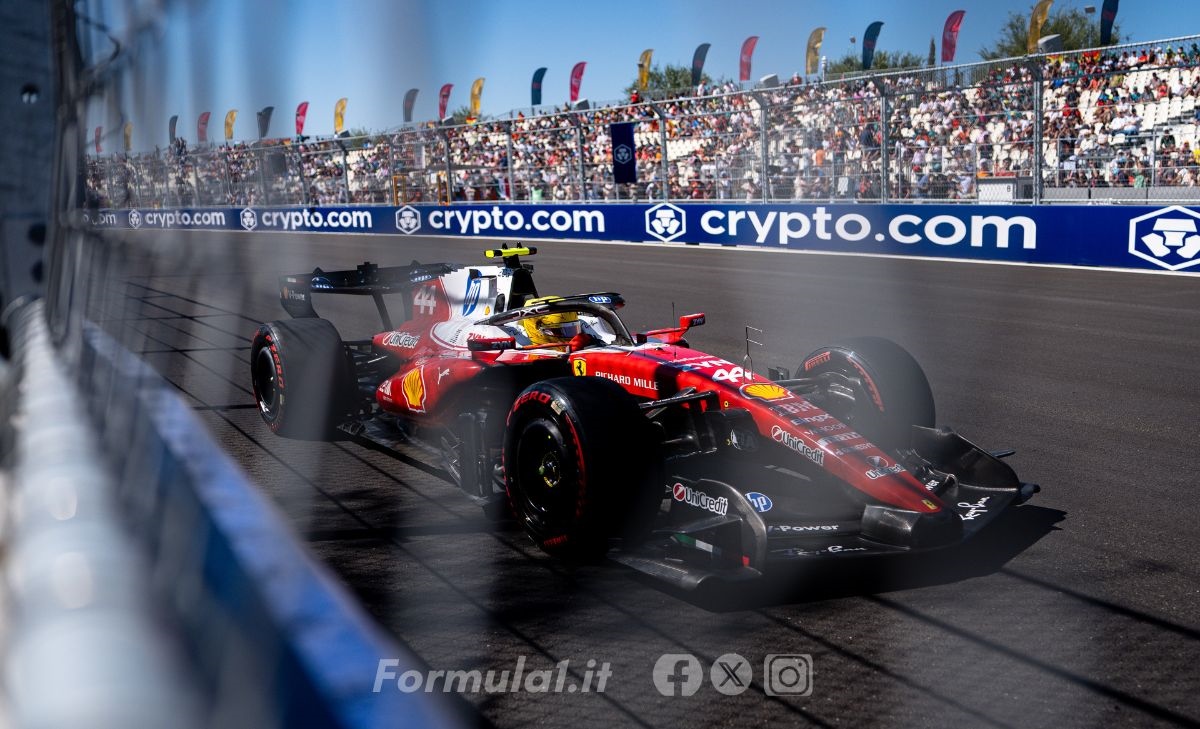
By: During the Spanish GP in Madrid, there was much discussion in the paddock about the true potential of Ferrari’s ADUO-2 compared with the ADUO-1. The debate arose because Leclerc, following his accident at the Parabolica in Monza, had to reinstall the older power-unit specification for the Madring street circuit. That prompted comparisons with team-mate Lewis Hamilton, who, unlike him, was able to use the new specification.
The qualifying battle was extremely close. So close, in fact, that Hamilton beat Charles by just six thousandths of a second: 1’32’’013 for Hamilton, 1’32’’019 for Leclerc. At first glance, one might say that the ADUO-2 did not make such a significant contribution. What are six thousandths over a lap that takes 92 seconds to complete? Nothing. Even looking at top speeds, the differences are minimal: around 3-4km/h on the purely straight sections. The question asked repeatedly was: does the ADUO-2 really make a difference compared with the ADUO-1?
Having carefully analysed the telemetry, we have reached conclusions which suggest that the Spanish layout did not allow the strengths of the new specification developed in Maranello to fully emerge. The ADUO-2 was designed to maximise straight-line performance while suffering less from the issues encountered in Austria. The change to the angle of the turbine blades was made precisely for this purpose.
How Hamilton and Leclerc adapted to their respective power units
The technical gap between the two power unit specifications did not emerge in Spanish GP qualifying for two reasons: 1) there were no long straights; 2) Leclerc and Hamilton were both very good at tailoring their qualifying driving styles to the power unit at their disposal.

Speed graph - Leclerc and Hamilton compared - Madring 2026 qualifying
If we look at the graph from GPTempo.com and zoom in on the two drivers’ speed traces between Turns 1 and 3, two particularly interesting details emerge. The first is that Leclerc tries to exploit the “advantage” of having a “small” turbine, putting the power unit under greater demand during the traction phase. Hamilton, by contrast, has a turbine of the same diameter, but with the blades angled differently to deliver greater benefits at higher revs, and makes greater use of the unit in acceleration.
Two driving styles, two different ways of recharging the battery
The obvious question at this point is: why does Hamilton’s top speed not shoot through the roof, instead remaining fairly close to, albeit higher than, that achieved by the Monegasque? This is where our theory comes in. To make greater use of traction while also recharging the battery, the driver of car number 16 brakes much earlier than car 44, which instead exploits the higher top speed achieved before losing out on corner exit.

Speed graph - Leclerc and Hamilton compared, zoomed in on the first three corners - Madring 2026 qualifying
But if Charles lifts and brakes earlier to recharge, how does Hamilton recharge? By using the engine. Hamilton’s top speeds do not shoot through the roof, but gradually approach a peak before dropping off, probably because Lewis is using the engine to recharge the batteries at that point.
In essence, the Madring layout did not allow Hamilton to fully show the performance level of the ADUO-2. It effectively drained it of its potential. Things should be very different in Baku. The Azerbaijan circuit features the longest straight on the calendar, and that is where the ADUO-2 will come into its own. The fact that it is better than the ADUO-1 is demonstrated by Ferrari’s apparent determination to use it on Charles Leclerc’s car at all costs as well.
Conclusions
Ultimately, the different power units at their disposal led Hamilton and Leclerc to adopt completely different driving styles in Spain. When one made up ground in a sector, the other had the upper hand in the next. The six-thousandths gap stems from the combination of all these factors: different engines, different driving styles and a different approach to battery recharging.
What will happen in Baku?
The Monegasque is still waiting to find out whether the Monza unit can be recovered. If the checks produce a positive result, Charles will not face any kind of issue. Should the team instead decide to fit car number 16 with a new unit, something the team appears already to have considered, Leclerc would inevitably have to start from the back of the grid.
However, it is better to start last but have some chance of putting together a strong race than to endure a race like Austria, where the engine suffered excessively and Ferrari had no say in the GP.
All the news, photos, weather, session times and times from the Spain GP 2026