 By:
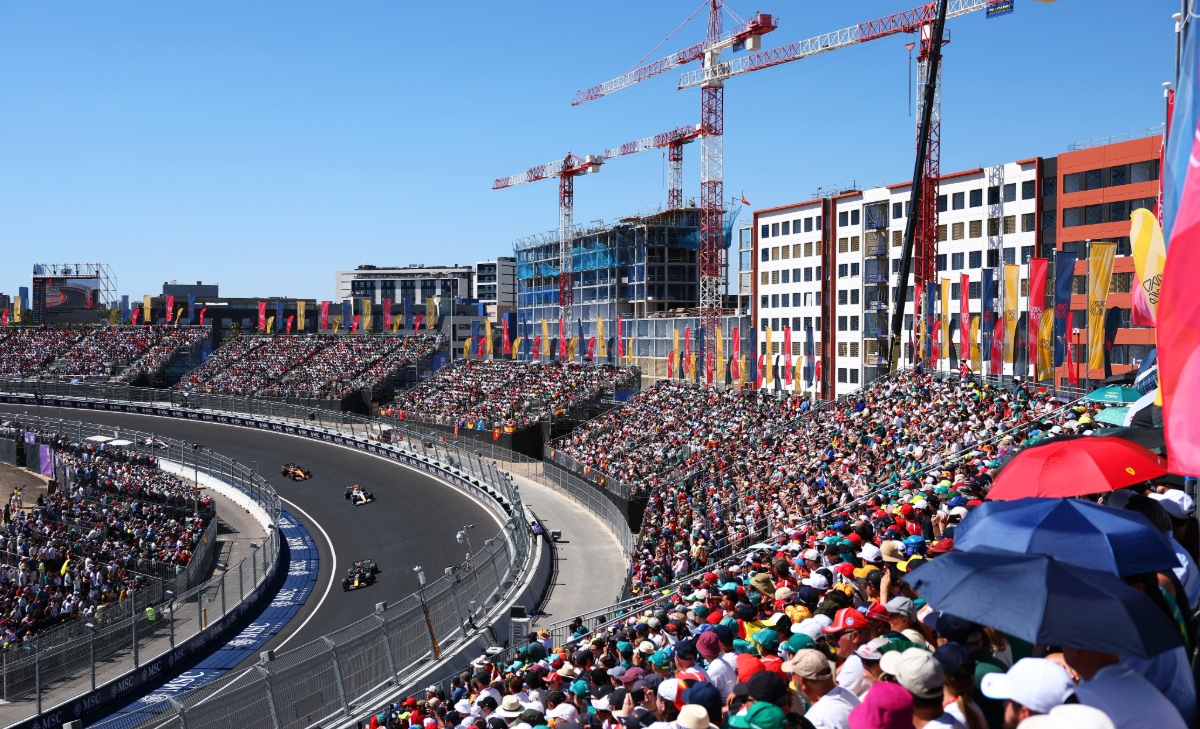
By: The Madring Grand Prix left behind a statistic that carries more weight than any technical analysis: just four overtakes over the entire race. That figure alone illustrates the gap between what Madrid was said to be capable of and what it actually delivered. A new circuit designed from scratch should have offered the opportunity to reinvent the concept of the modern street circuit; instead, it ended up replicating the limitations of the calendar’s most constrained venues. This is where Nico Rosberg’s view becomes central: in his opinion, overtaking zones should have been incorporated from the outset. The hope, therefore, is that a circuit which cannot remain as it is will be modified.
The central issue: four overtakes are not an accident, but the result of a design philosophy

The figure of four overtakes is not merely a statistic: it is the direct consequence of how the Madring was conceived. A modern street circuit created from a “blank sheet” must include at least several places where overtaking is possible, rather than making it a driver’s “kamikaze” choice. Madrid, however, opted for an approach that prioritises flow and average speed, creating a track that works brilliantly in qualifying but goes flat in the race, like Monaco.
The medium- and high-speed corners are superb, but they do not open up alternative lines; above all, the braking zones are not heavy enough to allow an overtaking attempt. The fast section is not long enough to make “overtake mode” genuinely effective. The result is a circuit that rewards precision but not racing. And when a new track chooses flow over competition, the race becomes a procession.
Rosberg said it with a clarity that leaves no room for interpretation:
“If you start from scratch, you have to include at least one place where drivers can attack. Madrid did not do that.”
The criticism comes from someone who has been part of this sport and knows what it means to spend 50 laps or more without the slightest chance of gaining a position. A new circuit cannot afford to be static, to be beautiful but uncompetitive, and above all to produce only four overtakes. That is why Rosberg hopes the layout will be revised as early as next year, with the introduction of a heavier braking zone, a longer straight and a genuine attacking point. In other words: what Madrid should have had from the outset.
Monaco as the acid test: when the old beats the new
The comparison with Monaco is natural, but it confirms everything said so far: Madrid produced four overtakes, Monaco 10. This is not simply a statistic, but a paradox that exposes the conceptual fragility of the Madring project. Monaco has always represented the ultimate limit of overtaking possibilities: narrow, old and constrained by an urban fabric that cannot be altered. Its streets are what they are, its width is what it is, its identity is what it is. It is a circuit that cannot evolve, cannot adapt to modern cars and cannot reinvent itself; indeed, that is precisely what makes it unique.
This figure does not mean Monaco has suddenly become a circuit suited to overtaking, but rather that Madrid failed to make use of its freedom to create a circuit capable of producing spectacular races. That is precisely why the comparison is so damning: when the most static circuit on the calendar produces more overtakes than a new track, the problem is not the race, not the strategy and not the VSC, but the design.
So, paradoxically, Monaco becomes the mirror that reveals Madring’s lack of ambition. There is a further factor that makes the comparison even harsher: Monaco produces overtakes not because it was designed to do so, but because the race, in its natural chaos, creates small differences that drivers can exploit, such as mistakes, tyre degradation, traffic and divergent strategies: all contribute to creating opportunities. Madrid, by contrast, showed a layout that allows none of this. The pace is too uniform, the speeds too similar and the lines too constrained. It is a circuit that offers no margins, opens no windows and creates no differences. And when the old beats the new, it is not because the old has improved: it is because the new has failed in its mission.
All the news, photos, weather, session times and times from the Spain GP 2026