 By:
By: With the introduction of the 2026 regulations, the FIA tried to solve one of the historic problems of modern Formula 1: the risk of performance crystallisation among power unit manufacturers, with corresponding long periods of dominance, as seen in the first turbo-hybrid era with Mercedes’ superiority between 2014 and 2018.
This is where the ADUO mechanism comes from, an acronym for Additional Development and Upgrade Opportunities, a tool designed to guarantee a form of technical rebalancing without overturning the concept of power unit homologation, which is necessary to reduce the costs of a costly and unrestricted development race.
It is not, in fact, a total liberalisation of development, but an extremely regulated system, with precise time windows, defined performance thresholds and clearly limited margins for intervention. In essence, ADUO represents a controlled opportunity for struggling manufacturers. Ferrari is certainly among them, having shown a significant performance gap in pure power compared to Mercedes in these opening rounds. Many are wondering whether ADUO will allow the SF-26 to recover ground and return to fighting for victories. In the final paragraph, we have tried to answer this question analytically, but first let us clarify the issue by going deeper into the details of the regulations.
When ADUO is granted
The heart of the system is the ICE Performance Index, a parameter developed by the FIA to measure the performance of the internal combustion engine compared to the best on the grid. The assessment takes place at three key points of the season:
• GPs 1–6
• GPs 7–12
• GPs 13–18
At the end of each period, the FIA compares the collected data and determines the performance gap. It is precisely from this deficit that the possible granting of ADUOs derives:
• Between −2% and −4%: 1 extra upgrade in the current season and one in the following season
• Over −4%: 2 extra upgrades in the current season and two in the following season
• Below −2%: no intervention granted
A fundamental aspect is that access to ADUOs is not continuous: if a manufacturer does not meet the criteria in the first two periods, it definitively loses the possibility of obtaining them in the third. Furthermore, the granted upgrades must be used within the season, otherwise they are lost.
How the development steps work
Once the right to ADUOs has been obtained, the power unit manufacturer must follow a strict procedure. The first step is the definition of the interventions, which must fall exclusively within the components authorised by the FIA in Appendix C4 (see the next paragraph).
It is then necessary to update the homologation dossier, which must be submitted at least 14 days before introduction on track. Only after this phase can the upgrade be used, starting from the first available Grand Prix.
Equally important is the obligation of fairness: each new specification must also be made available to customer teams, with at least one updated power unit already available at its debut.
What manufacturers can work on
Below is a summary of the main components on which it is possible to intervene through ADUO according to the 2026 F1 regulations, in particular Section C of the Technical Regulations, Appendix C (Issue 17, 28 April 2026).
- ICE and combustion: main structure of the internal combustion engine, combustion chamber components, pistons, connecting rods, valves, cams, pre-chamber and flywheel.
- Auxiliary systems: ICE-mounted pumps, actuators, air valve compressors, oil and fuel filters, fuel system components and High Pressure Fuel Pump.
- Intake: trumpets, throttles, plenum and air intake system components.
- Exhaust and turbo: exhaust system, fixings and gaskets, turbocharger, wastegate, pop-off valve and electrical components connected to the turbo, ICE and exhaust.
- Injection and ignition: injector spray calibration, spark plugs and ignition coils.
- Sensors and fluids: lambda sensors, other regulatory PU sensors, fuel, engine oil, hydraulic fluid, coolant and ERS fluid.
- Air valves: regulators and auxiliary components of the power unit air valve system.
- Lubrication: main PU oil tank, oil level sensor, catch tank and breather system connected to the power unit.
- Cooling and hydraulics: ERS cooling systems mounted and not mounted on the ICE, filters, servo valves, manifolds, pipes, actuators and hydraulic circuit filters.
- Other elements: ICE ballast.
In essence, although formally linked to internal combustion engine performance, the scope of ADUO is broad enough to affect combustion, turbo, fluids, cooling, reliability and the overall management of the power unit.
In other words, although formally tied to the internal combustion engine, the ADUO system allows interventions that can have cross-cutting impacts on the entire power unit.
The crucial role of dyno testing and timing
One of the most interesting elements concerns the additional testing hours. Manufacturers receiving ADUOs obtain an increase in power unit test bench (PUTB) usage hours, proportional to the performance gap:
- +70 hours for a deficit between 2% and 4%
- +110 hours between 4% and 6%
- +150 hours between 6% and 8%
- +190 hours between 8% and 10%
These hours are not unrestricted: they must be declared within two months of being granted and distributed between the current and following season. Their use is strictly monitored by the FIA, with precise definitions of Operation Hours and Occupancy Hours.
Once the technical and bureaucratic process has been completed, the upgrade can be introduced immediately, without waiting for fixed windows. However, every change must be consistent with the updated homologation and all power units from the same manufacturer must operate with identical parameters, except for minor regulated exceptions.
How much can Ferrari recover with ADUO?
The Ferrari SF-26 has proved to be a very effective car in mixed sections, where it was the performance benchmark in the first 4 rounds of the season (fastest in these sectors), thanks to good balance and excellent aerodynamic load. Things change when considering its performance on the straights and in certain acceleration phases, where Ferrari loses out especially compared to Mercedes-powered cars. Since ADUO is linked to a percentage gap on the ICE Performance Index, it allows struggling manufacturers to progressively reduce their disadvantage compared to the most powerful engine. Up to now we have analysed exact data and regulatory indications; for the following analysis, however, we must rely on some estimates, still solid and confirmed by statements from several key figures, above all Vasseur, Mekies and Wolff.
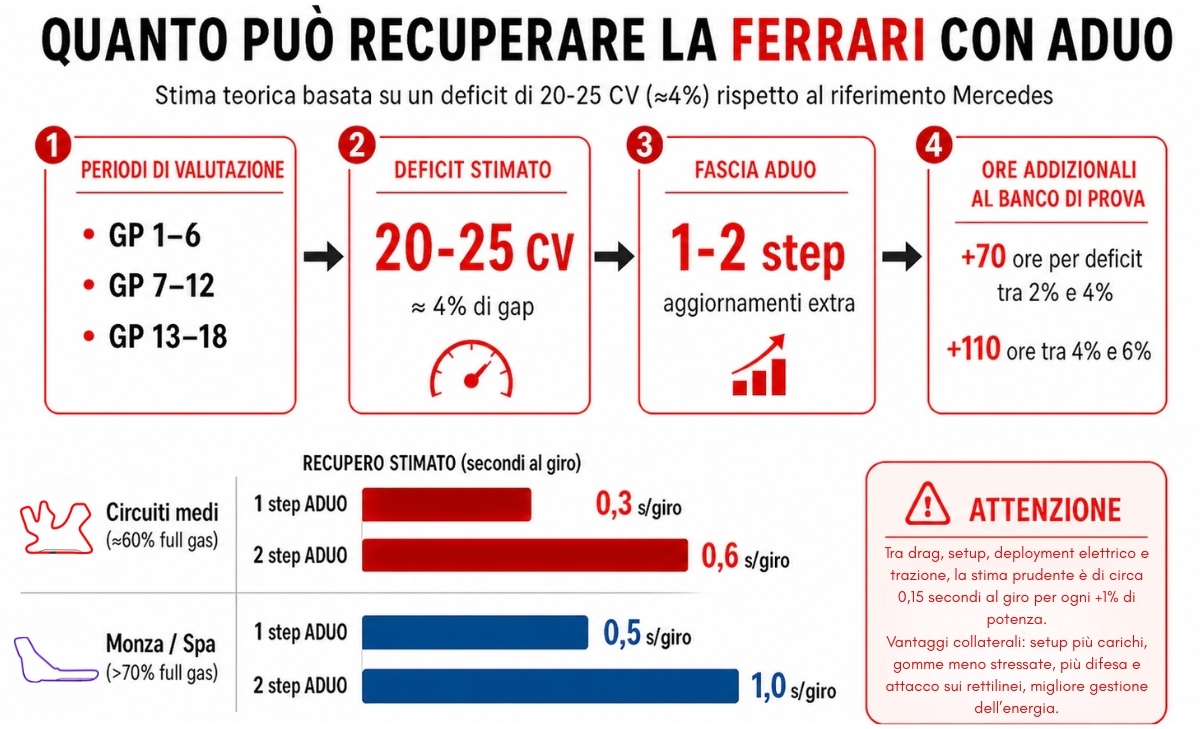
If we take as valid the widespread estimate of a shortfall of around 20-25 hp for the Ferrari engine compared to the Mercedes one, equal to a deficit of around 4% on a reference base of ~585 hp (Mercedes), the ADUO system fully comes into play and, in this scenario, the Scuderia would fall within the range allowing one or two upgrade steps.
More power does not automatically translate into proportionally gained lap time. Drag, gear ratios, electrical deployment, aerodynamic efficiency, fuel consumption, lift and coast, traction and setup compromises all come into play. Trying to translate this gap into on-track performance terms, and adopting a conservative estimate for circuits with average sensitivity to engine power (60% of the lap time at full throttle), both historically and relying on telemetry feedback — for example by comparing the performance jump cars make on the straights when power is increased between Q2 and Q3, with everything else remaining unchanged — we arrive at a value of around 0.15 seconds for every 1% increase in engine power.
With a single ADUO step, Ferrari could therefore recover around 3 tenths per lap. If it were granted two steps — the scenario Maranello is counting on — the gain could rise to 6 tenths per lap, a value capable of radically changing its competitive position. On power-sensitive tracks such as Monza or Spa (over 70% full throttle), these values rise to 5 tenths and 1 second per lap.
It should be noted that these values concern the possible recovery of lap time over a single qualifying lap (the SF-26’s weakest point), but having a more powerful Power Unit also brings collateral advantages in the race, for example allowing higher-downforce setups without compromising top speed and benefiting tyre consumption, with tyres less stressed through corners. It also allows the car to attack and defend more effectively on the straights and to manage electrical energy better during acceleration and regeneration phases.
When could the new Ferrari engine debut?
Considering the ICE Performance Index assessment procedures, the approval of the dossier, the timing of dyno testing and the production of a unit for at least all customer teams, it is very likely that Ferrari could bring an evolved Power Unit to the track around the Belgian GP.
But is ADUO the much-hated BoP?
ADUO is, in every respect, a compromise between technical freedom and cost control. On the one hand, it prevents a power unit manufacturer from remaining stuck for years with an uncompetitive project; on the other, it maintains strong central control to avoid uncontrolled technological escalation.
After explaining the mechanism and the margins for recovery, one question remains: will this system really be enough to guarantee balance without penalising those who worked better from the start? Or does it risk becoming a mechanism that, in an attempt to level performance (BoP), introduces unfairness, new complexities and regulatory grey areas? Many of these questions will not be answered before next season; in the meantime, let us hope to see an entertaining championship without further controversy.
Also read: Ferrari, Vasseur calls for ADUO and dreams of victory for the Red car of aurea mediocritas
Also read: Ferrari, Leclerc confident: “With ADUO we can think about closing the gap”