 By:
By: Perhaps not everyone knows, and we do not hesitate to repeat, that the 2026 regulation, regarding powertrains, was born as an alternative to the electric one. Many builders had stopped believing that this was the right way to enable all of us to have a sustainable and therefore non-fossil fuel future.
They stopped believing it for many reasons: the lack of infrastructure, the green car using energy that is not produced in an environmentally friendly way, and so on. Manufacturers saw a future more hybrid than electric, but the previous generation's engine designed in F1 brought with it an MGU-H that was too elaborate and expensive to be introduced into the production car market.
This is where the current regulation based on a ratio of 50% to 50% between the thermal and electrical parts comes from. With a combustion engine powered by fuels from a completely sustainable process. Initially, everyone had insisted on this report because, not yet knowing the efficiency of the new fuel, they wanted an electrical component capable of compensating for any power shortage resulting from combustion.
Fortunately, however, the new fuel has given excellent results, so much so that, from what emerges from the entries regarding ICE (we are waiting for the performance indicators that will determine the manufacturers who will be able to use the ADUO system), the power distribution already seems to be more skewed towards the thermal one.
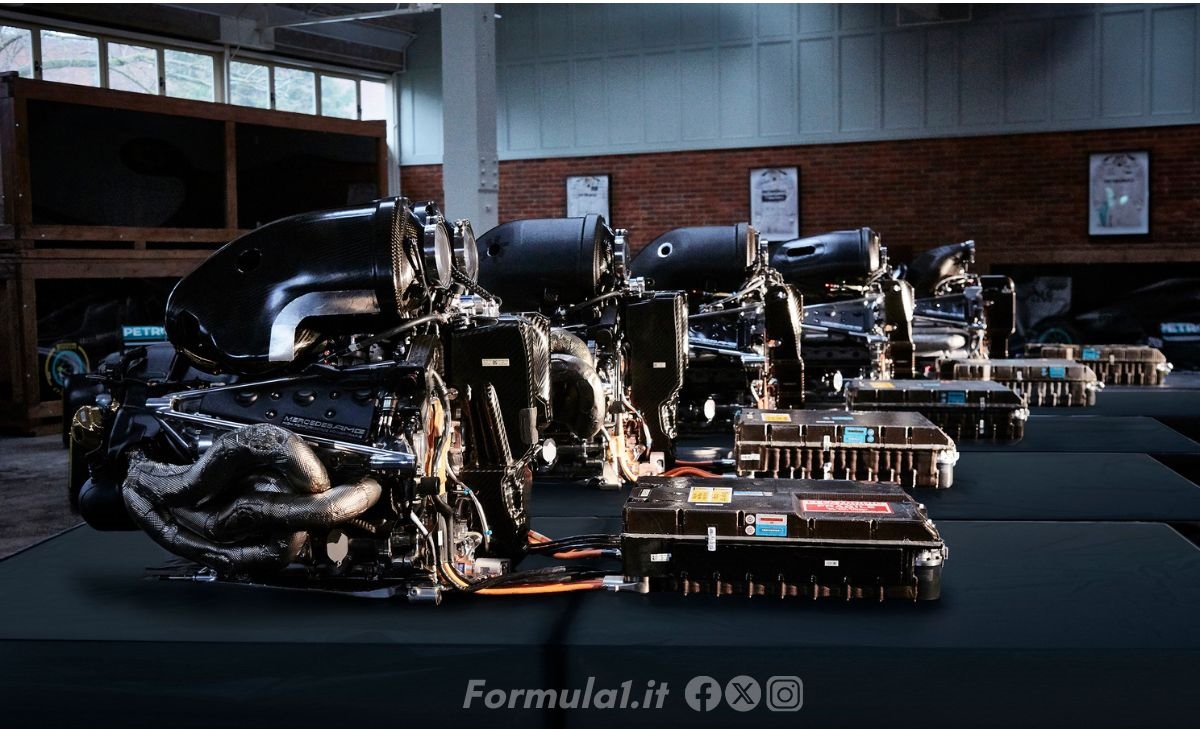
Photo: Mercedes powertrain from 2014 to 2018
Real progress could be triggered in 2030
So, riding the wave of complaints earlier this year, on the sidelines of the Miami GP, FIA President, Mohammed Ben Sulayem specifically revealed his intention (still unofficial) to see a Formula 1 driven by a hybrid V8 engine, to get even more power from the combustion side starting in 2030.
Returning to V8s, even if hybrids, is not a utopia and this makes not only F1 fans dream, but also drivers who drive their cars on the road in everyday life. Lately, automakers have been pushing for increasingly smaller internal combustion engines: 1000 three-cylinder CCs, for example. If Formula 1 decides to reverse the trend, receiving positive feedback even from us mere mortals, we might once again hope to see a decidedly more attractive engine than a three-cylinder 1000 CC under the hood of our car.
Based on the evolution of Formula 1 (with Ferrari, Mercedes, Audi, Cadillac, Ford, Honda as manufacturers and Toyota at the door) and the market in general, the cars of the future could differentiate into three main engines: sustainable gasoline, hybrid (which could replace the current diesel) and electric. Unless further alternatives such as hydrogen and all other possible options currently available are then developed.
Cover photo: Red Bull, internal photo: Mercedes
Read also in italian language: F1, il ritorno del V8 fa sognare anche gli automobilisti