 By:
By: The Italian Grand Prix will be remembered not only for Kimi Antonelli’s historic and incredible victory from the back row, but also for Pierre Gasly’s unexpected and outstanding pole position.
The sheer dominance of the Mercedes Power Unit was expected at the ultra-fast Brianza circuit, and it duly materialised in both qualifying and the race.
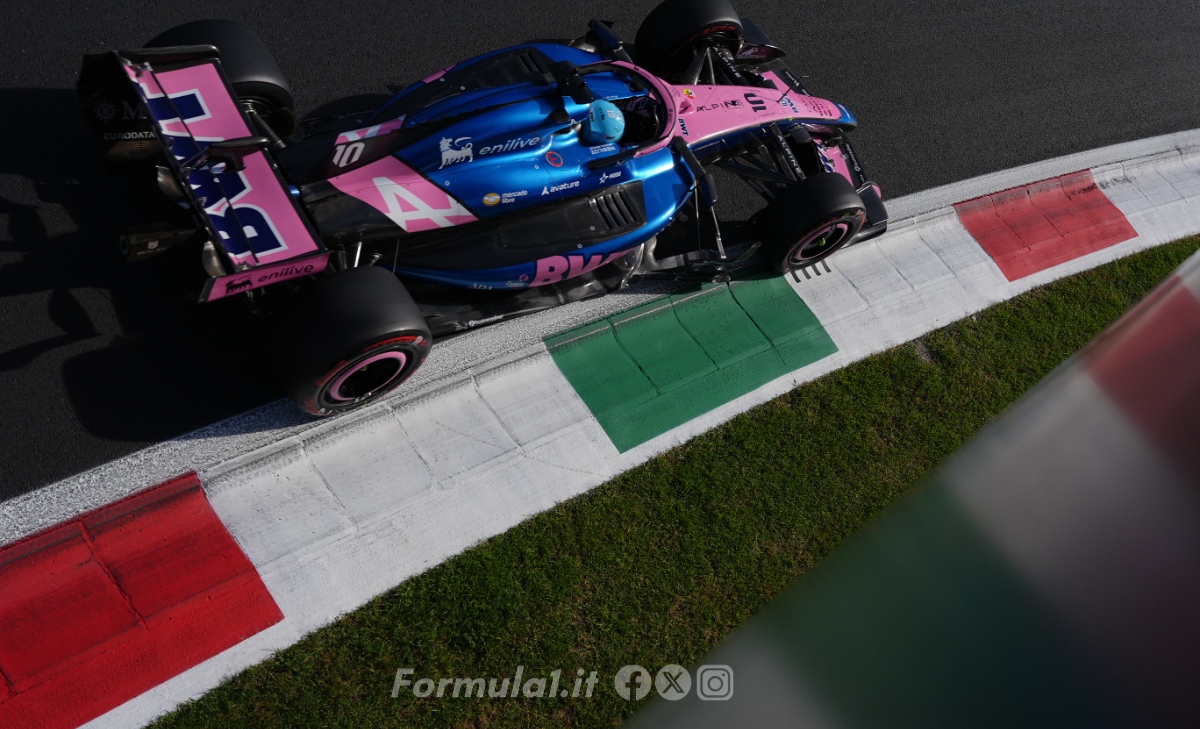
However, nobody could have imagined that the fastest Mercedes-powered team on Saturday would be an Alpine, capable of even finishing ahead of a factory car.
Alpine telemetry data is missing

Many have already analysed Gasly’s fastest lap in an attempt to understand how he put together the time that earned him pole, and it has already been highlighted that the telemetry data is mysteriously missing from the end of Curva Biassono until almost the exit of the Variante della Roggia.
Without taking anything away from the Rouen driver’s talent, something does not add up, not only in qualifying but throughout the Italian weekend.
Nothing can be said about FP1, when he was replaced by Paul Aron, while in FP2 Gasly’s telemetry trace is complete and consistent, placing him 14th.
From FP3, things change: telemetry data is missing, always in the same section described above, and the two Alpines rise up the order just behind the top teams.
Curiously, the data is also incomplete for Colapinto, in the same section, from FP3 onwards and throughout all subsequent sessions.
But that is not all: the telemetry traces for both Alpine drivers remained compromised in the race, before surprisingly becoming complete again during the closing laps. Gasly’s was the first to return to normal, around lap 47, while Colapinto’s did so on lap 50.
It is difficult to say what caused this anomalous data transmission, which it should be remembered affects only the surprisingly competitive Alpine and no other team.
A technical problem on one car can happen. A problem affecting two cars at the same time is far less likely. Even less likely is the possibility that the issue would be resolved on both cars almost simultaneously, right at the end of the race.
What lies behind the missing data?

Ultimately, it is impossible to analyse why Alpine performed so well at Monza or how much the incredible Mercedes Power Unit contributed to the Anglo-French team’s improved performance, because the telemetry data is virtually unusable. Many websites provide telemetry, and this can be verified.
What if Mercedes, as has already been suggested several times, is not using the full potential of its Power Unit?
What if Alpine’s qualifying performance came from the manufacturer authorising the release of the full potential of the Power Unit designed in Brixworth?
What if this data had been deliberately concealed?
Why Alpine, and for what purpose?
There is no answer to these questions.
What is certain is that the teams’ engineers, especially those at Mercedes, have long demonstrated their mastery of operating within the rules and managing their technical advantages, concealing them as much as possible.
All the news, photos, weather, session times and times from the Italian GP 2026