 By:
At Las Vegas, Formula 1 cars could comfortably exceed 360km/h, but with the new 2026 power units, top speed will be just one of several areas in which energy management comes into play. The exceptionally long straights and limited braking opportunities make managing electrical energy particularly demanding, to the extent that the FIA has introduced especially stringent rules governing power reduction.
The Las Vegas Strip Circuit is 6,201 metres long, features 17 corners and runs anti-clockwise. Its layout favours aerodynamic efficiency, with long high-speed sections interrupted by several slow corners, where braking stability and traction become crucial.
The most distinctive section is along the Strip, where the cars undergo a long acceleration phase before braking for Turn 14. It is a sequence in which correctly deploying electrical energy becomes essential, given the limited recovery opportunities. The teams’ work will also be complicated by low night-time temperatures, which may make it difficult to bring the tyres into their correct operating window.
The Grand Prix will be contested over 50 laps, for a total distance of 309.958km.
Brakes: few braking zones, but demanding ones
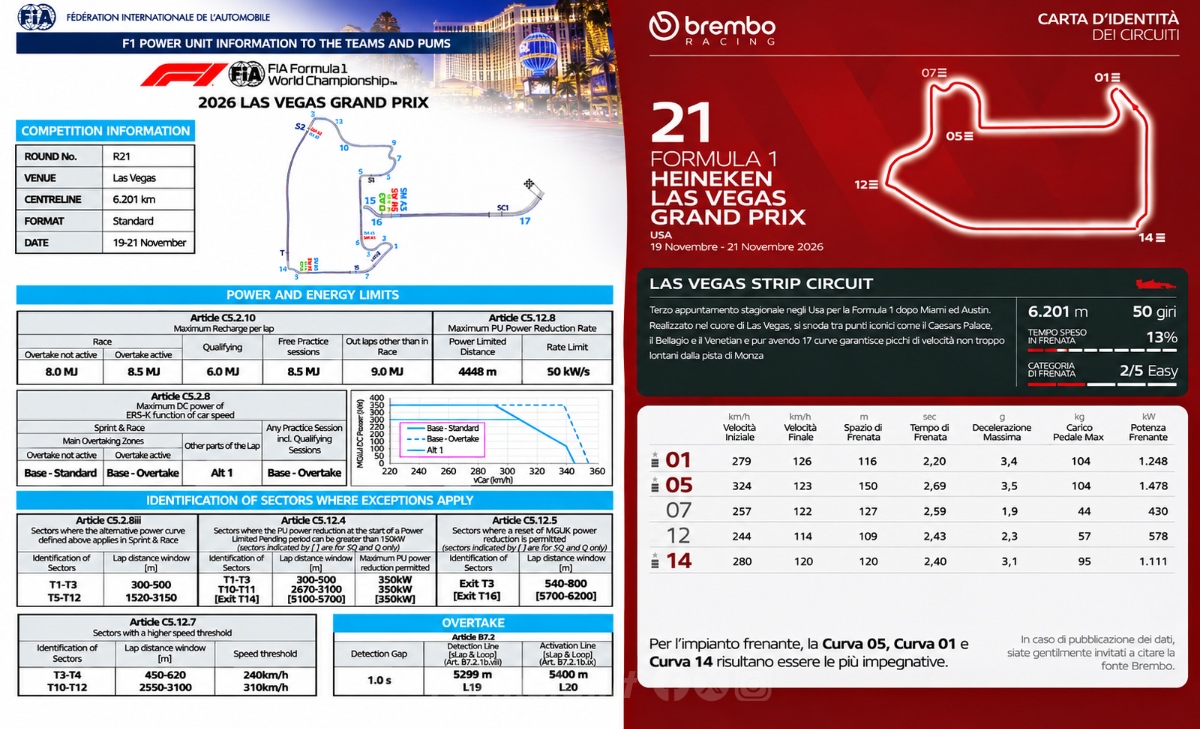
According to simulations by Brembo engineers, Las Vegas falls into the category of circuits that are not particularly demanding on the braking system, with a difficulty index of 2 out of 5, the same rating assigned to Interlagos.
Drivers use the brakes only five times per lap, for a combined total of 12.3 seconds. Three braking zones are classified as Hard and two as Light. The most demanding is at Turn 5, where the cars slow from 324 to 123km/h in 2.69 seconds over 150 metres. Deceleration reaches 3.5g, with 104kg of pedal load and braking power of 1,478kW.
A comparison with 2025 highlights the differences introduced by the new cars. At Turn 1, predicted deceleration falls from 4.3 to 3.4g, while pedal load drops from 131 to 104kg. The speed to be shed also decreases, from 210 to 153km/h, as does braking time, from 2.56 to 2.20 seconds.
Power unit: only 6MJ of energy recovery in qualifying
The official Power Unit Information document published by the FIA for Las Vegas sets a maximum electrical energy recovery of 6MJ per lap in qualifying, compared with the 6.5MJ permitted at Interlagos, despite the American circuit being almost two kilometres longer.
In the race, the limit rises to 8MJ without Overtake Mode and 8.5MJ with the system active. It is set at 8.5MJ in free practice, while on out-laps from the pits, excluding those in the race, it reaches 9MJ.
These are regulatory maximum limits, rather than the amount of energy the cars will necessarily be able to recover. The limited braking and prolonged acceleration phases make the contribution from other charging modes particularly important, including lift phases and recovery at full throttle, known as superclipping.
Power Limited Distance: what 71.7% means
The most interesting figure concerns the Power Limited Distance, set by the FIA at 4,448 metres, compared with 2,278 metres at Interlagos. This equates to 71.7% of the circuit length, but it does not mean that the MGU-K will actually be limited for more than 70% of the lap.
Power Limited Distance is a parameter calculated according to FIA criteria and used to determine which power-reduction rate limit applies to an event. It therefore does not indicate where, or for how long, the cars will actually undergo a power cut.
Under Article C5.12.6 of the 2026 technical regulations, when this parameter exceeds 3,500 metres, as it does at Las Vegas, the maximum permitted power-reduction rate is 50kW per second, compared with the 100kW/s stipulated for events below that threshold.
This does not mean the MGU-K can deliver only 50kW: maximum output remains 350kW. The limit instead concerns how quickly the power requested by the driver can be reduced. Under the conditions governed by the regulations, a 50kW reduction must therefore take at least one second, rather than the 0.5 seconds permitted under the 100kW/s limit.
The provision includes specific conditions and exceptions, but it takes on particular importance at a circuit dominated by long straights because it helps prevent overly abrupt reductions in electrical power. On its own, it does not allow a prediction of when, or by how much, power delivery will actually be reduced.
MGU-K and Overtake Mode: power at high speeds
The MGU-K can deliver up to 350kW, around 476bhp, but the available power progressively decreases at higher speeds. According to the curves published by the FIA, in the Base Standard configuration the reduction begins at around 290km/h, while with Base Overtake, 350kW can be maintained up to around 340km/h.
In the race, the Base Standard curve is used in the main overtaking zones when Overtake Mode is not active, and Base Overtake when the system is available. The alternative Alt 1 curve applies elsewhere. During free practice and qualifying, Base Overtake is used instead.
To activate Overtake Mode, the driver must, as always, be within one second of the car ahead. The gap will be measured 5,299 metres from the start of the lap, while activation will be permitted at 5,400 metres, in the final part of the circuit before the straight leading to the finish line.
The advantage does not lie in a maximum output above 350kW, but in the ability to keep it available to higher speeds. This is an important benefit on Las Vegas’s long straights, where the amount of energy remaining in the battery could directly influence the ability to attack or defend.
The article in 2 minutes
Las Vegas is one of Formula 1’s fastest circuits, with cars potentially capable of exceeding 360km/h. But in 2026, with the new power units, electrical energy management will be decisive. Long straights, few braking zones and low night-time temperatures will complicate the teams’ work as they seek the right balance between performance, energy recovery and battery consumption.
The circuit is 6,201 metres long, has 17 corners and will host a 50-lap race. According to Brembo, the demands on the brakes are relatively low, with a difficulty index of 2 out of 5 and only five braking zones per lap. The most demanding is Turn 5, where the cars slow from 324 to 123km/h over 150 metres.
The real issue will be the energy available. The FIA has set a maximum recovery limit of just 6MJ per lap in qualifying, compared with 6.5MJ at Interlagos, despite Las Vegas being much longer. In the race, the limit rises to 8MJ, or 8.5MJ with Overtake Mode active.
Of particular interest is the Power Limited Distance of 4,448 metres, equivalent to 71.7% of the track. This figure does not mean that electrical power is limited for more than 70% of the lap. Instead, it determines the application of an FIA rule that limits the power-reduction rate to 50kW per second, rather than the usual 100kW/s stipulated for events below the regulatory threshold.
The MGU-K will still be able to deliver up to 350kW, around 476bhp. With Overtake Mode, available to drivers running within one second of an opponent, this output can be maintained up to around 340km/h, compared with 290km/h in the standard configuration.
At Las Vegas, then, having energy at the right moment could matter as much as having the fastest car.
Cover photo by Brembo and FIA