 By:
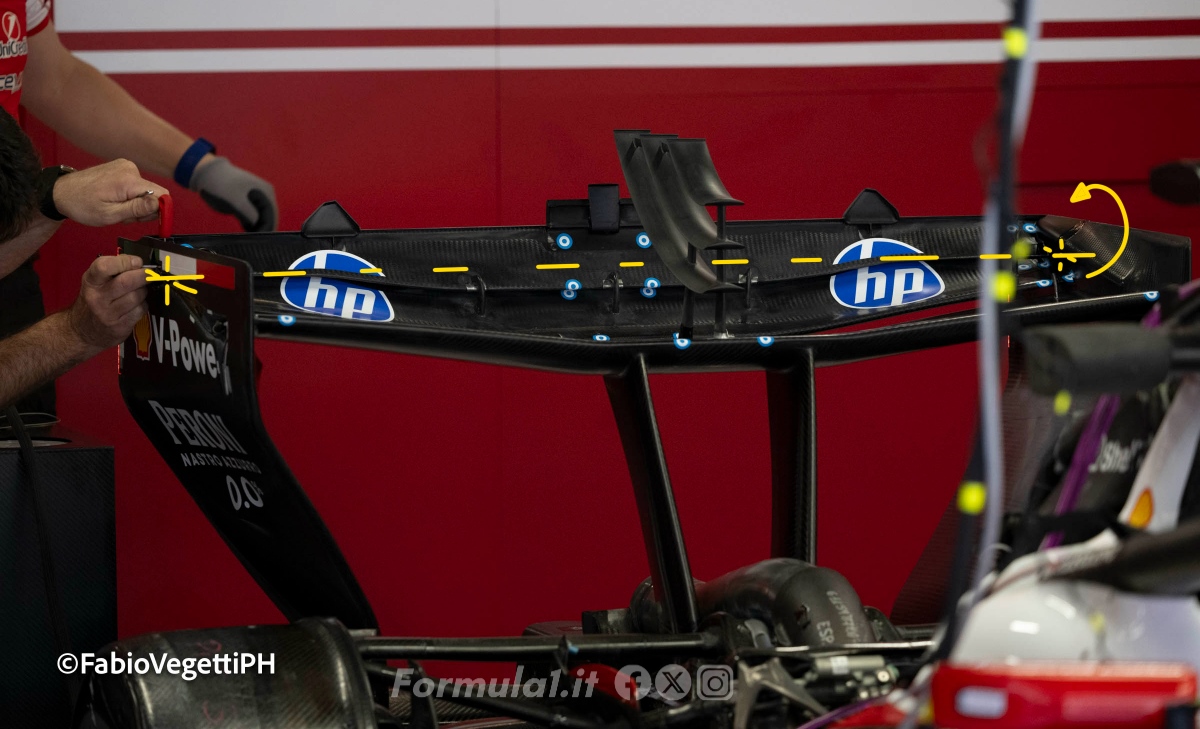
By: When Ferrari first unveiled its reversible wing during pre-season testing, fans and paddock insiders alike were left wide-eyed, unsure quite what they were seeing: the upper flap rotated, turning over completely.
The arrival of active aerodynamics represented a major new development which, in some way, was always expected to go far beyond the DRS concept. However, nobody was prepared to see such an extreme and imaginative interpretation of the regulations, defined not only by a reduction in the profile’s angle of incidence but by its complete reversal.
From the first images, its main purpose appeared clear: to reduce aerodynamic drag as much as possible, cancelling out the profile’s angle of incidence and amplifying the drag-reduction effect through the gap created between the two opposing profiles.
Given the strong interaction between aerodynamic elements, it is not entirely inappropriate to imagine that the solution may somehow go beyond the wing’s purely aerodynamic operation, working in synergy with the car’s highly distinctive rear end, equipped with the FTM system that makes aerodynamic use of the exhaust gases.
A brilliant solution
To understand the ingenuity of the solution developed by Ferrari’s Maranello technicians for the SF-26, we must first look at what the technical regulations require.
The FIA text leaves considerable freedom, setting the transition time between “corner” mode and “straight” mode at 400ms (C3.11.6), while requiring the control volumes to be respected once the flap has closed again.
No restrictions have been imposed on the opening angle or other geometric constraints, other than that it must comply with the regulatory control volumes once it returns to the “closed” position.
The regulations do clearly state, however, that the rear movable wing must be operated by a single actuator (C3.11.6).
In addition, up to three Rear Wing Rotation Brackets (C3.11.7) are permitted, these being mechanical elements that support the rotation, while the flap position must be checked by a sensor mechanically linked to the movable flap and calibrated to the actuator’s movement.
With a hydraulic actuator needed to operate the movable flap, the most intuitive and mechanically simple solution is to place it centrally, directly in front of the rear wing, enclosing the system beneath an aerodynamically favourable cover.
This is the solution we have come to know through DRS, but it has the downside of interfering with the rear wing and creating a degree of aerodynamic drag that, under the current regulations, is more undesirable than ever.
The brilliant idea devised by Ferrari’s Maranello technicians was to eliminate this encumbrance entirely by placing the actuator in one of the rear wing’s two endplates. This is the true masterpiece that distinguishes Ferrari’s “macarena” from the systems subsequently adopted by the other teams.
How it works in detail
Thanks to photographs circulating online, it has been possible to attempt to understand how Ferrari’s system works, first by locating the hydraulic actuator in the left-hand endplate, concealed beneath a fairly large carbon cover (Photo Mateusz Mróz).
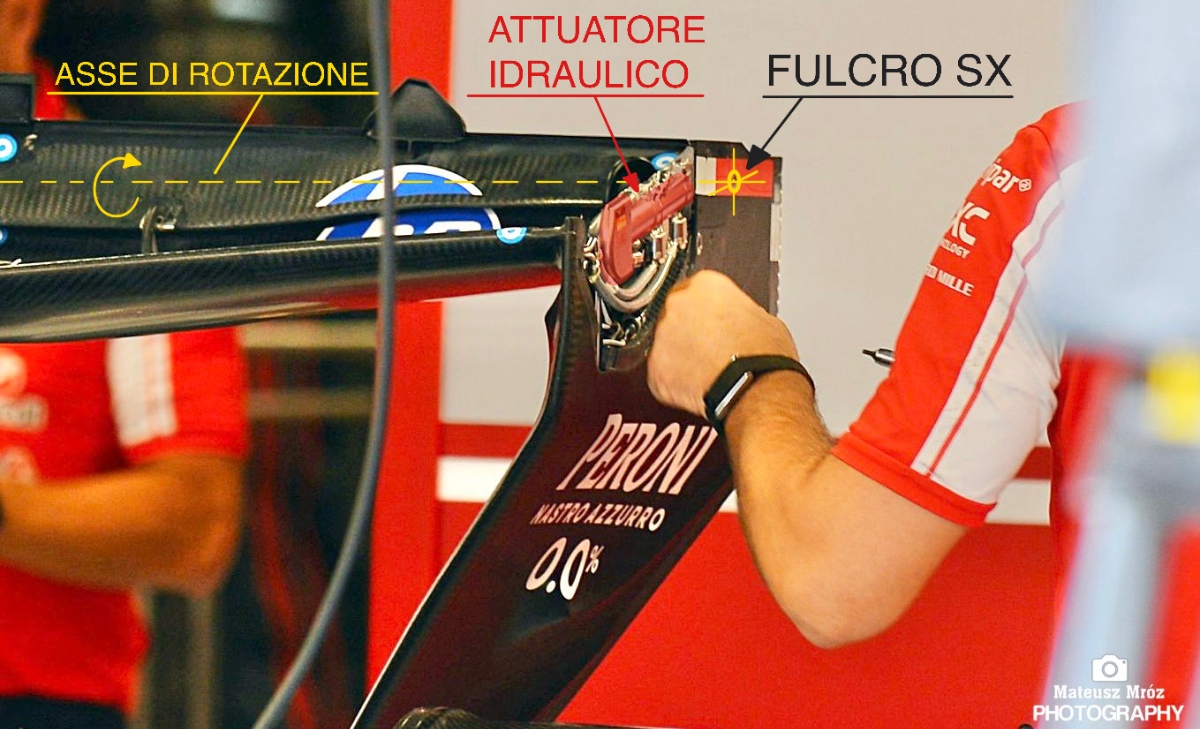
The hydraulic actuator is housed with its rear end facing the front of the car, while its rod must necessarily point towards the rear and upwards.
Near the end of the rod is the centre of rotation around which the movable flap turns and, clearly, there will be a corresponding element in the right-hand endplate.
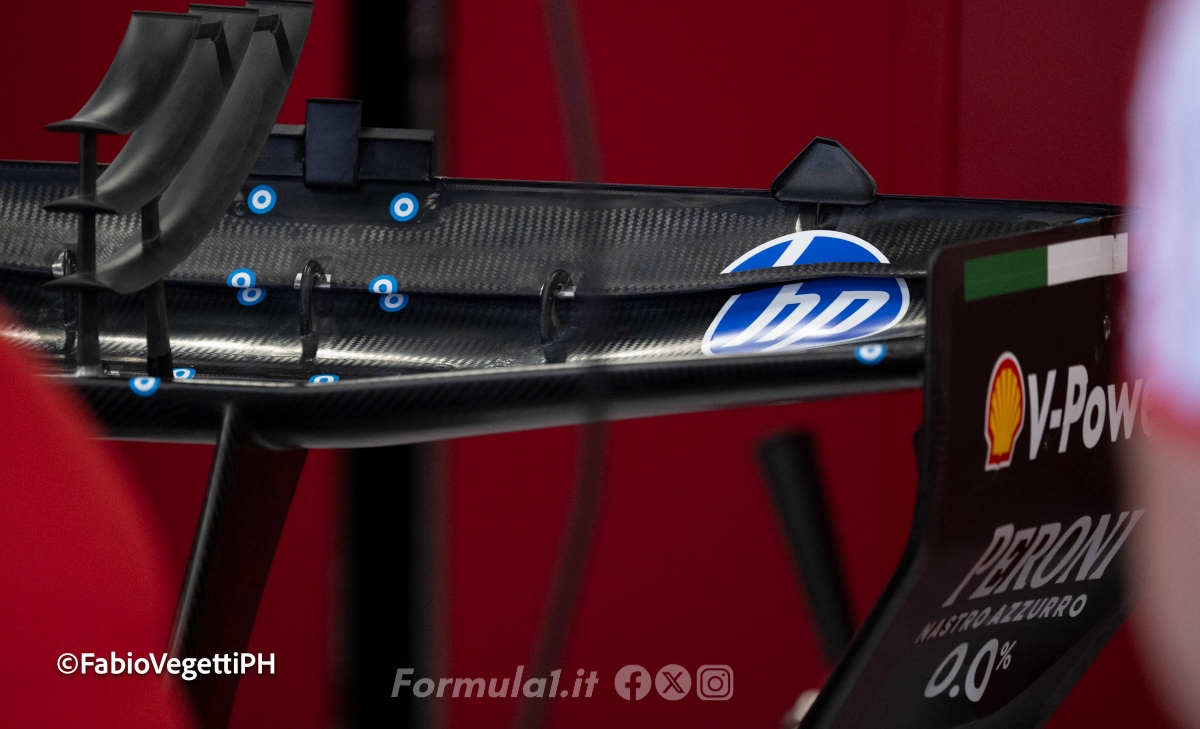
The latter features a smaller, slender removable panel (Photo Vegetti), covering an elongated compartment which does not, of course, contain the actuator, but where wiring can be seen.
This space must be dedicated to the position sensor that monitors the flap’s rotation.
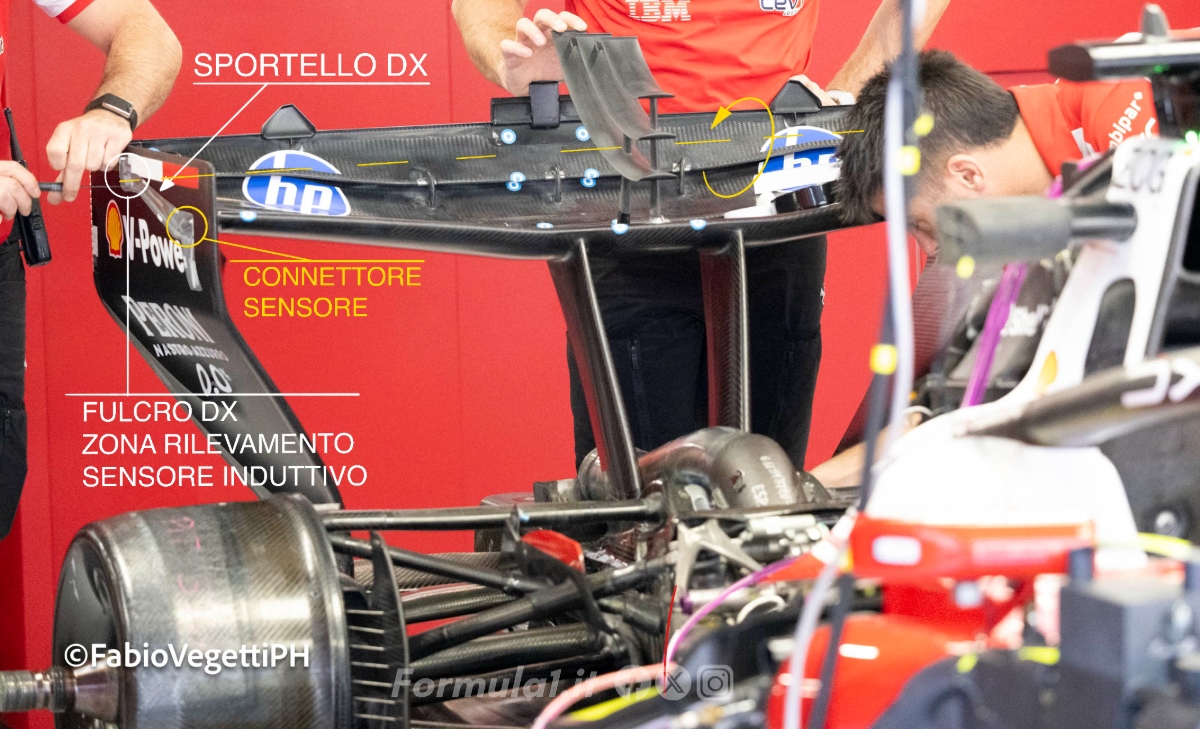
Once this is understood, the question becomes: what is the mechanism that rotates the flap?
Given the space taken up by the linkages used by Red Bull and McLaren, what is the actuator connected to in such a confined space?
The most plausible hypothesis, as well as the most intriguing, is also the mechanically simplest, most direct and most compact.
The left-hand pivot of the “macarena” wing and the actuator rod form a rack-and-pinion system.
The reversible wing is fixed to a type of toothed gear which meshes with the linear teeth machined into the actuator rod.
If that is the case, the actuator’s resting position, corresponding to the wing being closed in “Corner Mode”, would have the rod extended towards the rear of the car. Once authorised, the rod would retract sufficiently to transmit rotational movement to the movable wing. The mechanical stop could be provided by the hydraulic piston itself reaching the end of its stroke, or incorporated elsewhere.
Using the same system, at the centre of rotation located in the right-hand endplate, Ferrari’s Maranello technicians may have fixed a suitably shaped disc to the profile, allowing it to be read by an inductive proximity sensor capable of detecting the presence of metal at close range.
A system constructed in this way would have the advantage of being extremely simple, direct, reliable, compact and lightweight.
Its drawback could lie in the greater force required from the actuator, an issue that could probably be addressed by increasing its operating pressure.
It should be remembered that, in relatively simple hydraulic circuits, a pressure of 150 bar is fairly common and, for a cylinder with a bore of just 15mm, can produce a force of more than 2500N (270kgf).
Among the various versions of rotating wing, the “macarena” earns its status as the standout innovation not merely because it was the first to hit the track, but also because of its complete integration into the wing structure and the sophistication of its construction. For once, the term “masterpiece” is not being used lightly.