 By:
By: The recent Azerbaijan Grand Prix saw the debut of a substantial upgrade package for the AUDI R26, so extensively revised that it effectively represents a B-spec version of the Hinwil-based team’s car.
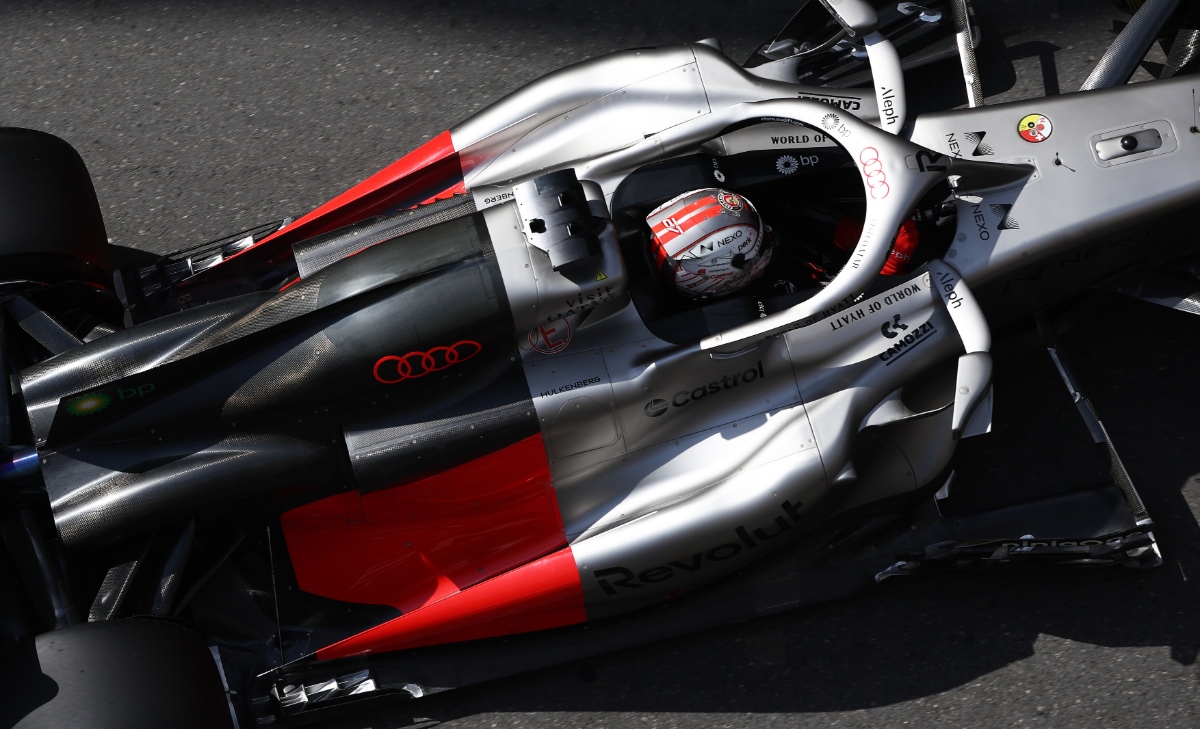
Among the many areas affected was a radical evolution of the sidepods, whose volumes and surfaces have a major influence on the operation of the entire aerodynamic platform.
Audi’s engineers retained the distinctive choices made at the front of the sidepods, accentuating certain surfaces to exert greater control over the airflow.
At the rear, however, the team adopted the solution introduced by Red Bull from the Austrian Grand Prix onwards, featuring sidepods that taper progressively downwards and incorporate a prominent upper chute.
The ultimate aim is to channel the airflow passing over the top of the sidepods towards the upper surface of the diffuser, enhancing its effectiveness.
The workaround used by Red Bull and AUDI

The 2026 regulations sought to prevent the use of this technical solution by imposing relatively large minimum radii in the transition areas between bodywork elements, but Red Bull and AUDI managed to recreate the desired effect by exploiting a regulatory loophole.
The sharp profile visible on both cars, which keeps the airflow within the channel, is not officially classed as bodywork, but is formally declared as part of the floor-stiffening tie-rod. The carbon skin rests directly on this component and, in the areas where the tie-rod meets the sidepod, the minimum-radius rules do not apply, allowing designers to create this sharply defined separation.
These interesting and clever interpretations of the rules regarding what constitutes bodywork and what is considered part of the floor have been deemed legal for the current season, but the Federation has introduced the appropriate changes in the draft 2027 regulations published at the beginning of last August.
Changes to the 2027 regulations

As well as banning systems similar to Ferrari’s FTM for next season, Article C3 clarifies in Article C3.2.9 that:
"All bodywork components and components beneath the bodywork described in points C3.5 to C3.11 and C3.14 to C3.15 must maintain tangency continuity".
The change was made specifically to C3.5.14, which governs the so-called "Floor Auxiliary Components", including the aforementioned tie-rods.
At present, the position of the mounting points is relatively unrestricted, which has allowed the very shallow longitudinal orientation seen on the RB22 and R26, helping to facilitate this technical solution. There are also currently no restrictions on the way in which this tie-rod intersects the bodywork, allowing the adoption of the shapes described above.
Next season, the amendment to the preceding clause will require, among other things, the tie-rod to be positioned within tighter limits and:
"the tie-rod must not intersect any bodywork surface, except within 25 mm of the inner and outer mounting points and within 7 mm of a maximum of two points located on the engine cover".
This final provision should not only eliminate the distinctive shapes that characterise the current cars from Milton Keynes and Hinwil, but also limit other imaginative interpretations, although, as the sport’s top category has taught us, one of the great sources of technical interest is precisely the constant and endless challenge between engineers and regulatory restrictions, which could lead to new and unprecedented forms.