 By:
By: The FIA has published its summary document covering all the upgrades brought by the teams to the 2026 Azerbaijan Grand Prix. Six teams have declared technical updates for Baku: McLaren, Red Bull, Williams, Visa Cash App Racing Bulls, Audi and Cadillac.
The picture is particularly interesting because, despite the extreme characteristics of the Azerbaijani circuit and its very long full-throttle section, much of the development is not simply aimed at reducing drag. The work is focused chiefly on flow quality, local load generation and the integration of the floor, bodywork and rear end.
The most extensive package comes from Audi, which has made changes to virtually the entire car: a new front end, a completely redesigned floor, revised bodywork and significant modifications at the rear. McLaren has also undertaken extensive work, revising flow management from the sidepods to the diffuser and introducing a specific rear-wing solution to achieve a greater drag reduction in Straight Line Mode.
Red Bull, meanwhile, has concentrated its development primarily on the interaction between the floor, diffuser and sidepod, supporting the new flow field with changes to the mirrors and Halo. Williams has also introduced a significant package, making changes to the FW48’s floor and tail, with corresponding revisions to the aerodynamic geometries at the front and rear.
Racing Bulls has focused all its new parts on the front end, with a new front wing accompanied by changes to the brake area and suspension fairings. Cadillac has undertaken more limited work, increasing front brake cooling capacity and revising the diffuser to increase local load.
Mercedes, Ferrari, Aston Martin, Haas and Alpine have not declared any upgrades for the Baku weekend.
Here are all the official changes brought by the teams to the 2026 Azerbaijan GP.
McLaren
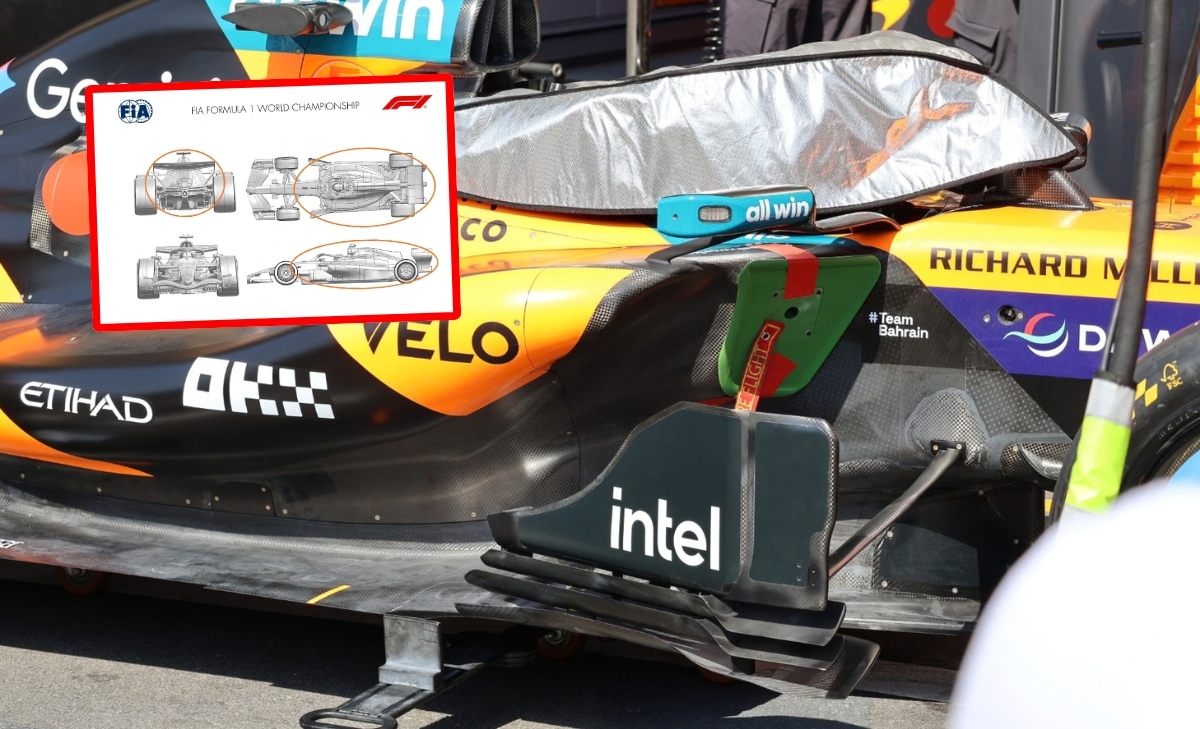
McLaren brings a highly extensive package to Baku, involving virtually all flow management from the sidepod area to the rear end. New sidepods, bodywork, floor and diffuser work as a single system, while the rear suspension fairings have also been adapted. The rear wing is also specific to Baku, having been modified to achieve a greater drag reduction when Straight Line Mode is activated.
| Component | Reason | Differences | Description |
|---|---|---|---|
| Sidepod Inlet | Performance - Flow conditioning | Revised sidepod inlet shape | The sidepod inlet shape has been revised to improve flow conditioning towards the rear of the car, increasing aerodynamic performance. |
| Coke/Engine Cover | Performance - Flow conditioning | Revised engine cover and Coke line | The engine cover and Coke line have been revised together with the new sidepod inlet, improving downstream flow conditioning. |
| Coke/Engine Cover | Performance - Flow conditioning | Alternative sidepod shape | An alternative sidepod shape is available as an option for the bodywork described above, resulting in different aerodynamic characteristics. |
| Cooling Louvres | Circuit-specific - Cooling range | New louvre arrangement | As part of the new bodywork package, the arrangement and position of the cooling louvres have been changed to achieve maximum aerodynamic performance across different cooling levels. |
| Floor Edge | Performance - Local load | Revised floor-edge shape | The changes in flow conditioning generated by the bodywork are exploited through a new floor-edge design, resulting in improved aerodynamic performance. |
| Diffuser | Performance - Local load | Revised diffuser configuration | In conjunction with the floor edge, the diffuser has been revised to achieve greater aerodynamic performance from the new flow configuration. |
| Rear Suspension | Performance - Flow conditioning | Revised rear suspension fairings | Changes to the upstream aerodynamic flow conditions have required a revision of the rear suspension fairings to maximise aerodynamic performance. |
| Rear Wing | Performance - Drag reduction | Alternative flap position in Straight Line Mode | The medium-downforce isochronous rear wing has been modified to allow the flap to adopt an alternative position in Straight Line Mode, achieving a greater reduction in aerodynamic drag. |
Mercedes
No upgrades.
Red Bull
Red Bull brings a coordinated package centred chiefly on the floor and diffuser, with the aim of increasing local load without compromising flow stability. The changes also involve the sidepod, cooling louvres, mirrors and Halo, all adapted to work in synergy with the new aerodynamic configuration.
| Component | Reason | Differences | Description |
|---|---|---|---|
| Floor Body & Diffuser | Performance - Local load | Revised floor and diffuser geometries | Successive development iterations have led to a new floor geometry, with changes within the permitted limits to generate greater local load while maintaining flow stability. |
| Sidepod | Performance - Local load | Revised junction with the floor | In conjunction with the new floor, the sidepod has been revised with a new junction to the floor to support its changes and achieve greater local load. |
| Cooling louvres | Reliability | Revised to suit the sidepod | To integrate the new sidepod with the surrounding existing geometries, the cooling louvres have been revised while retaining the previously available range of cooling levels. |
| Mirrors | Flow conditioning | Revised mirror geometry | In conjunction with the floor and sidepod modifications, the mirror assembly geometry has also been revised to improve downstream flow conditioning and contribute to increased local load. |
| Halo | Flow conditioning | Revised Halo fairing geometry | A small change affects a flow deflector on the fairing, revised to feed downstream components more effectively, improve flow stability and, consequently, load generation. |
Ferrari
No upgrades.
Williams
Williams brings one of the weekend’s most significant packages. The work primarily concerns the floor, modified in its front and outer regions to increase local performance and improve the operation of the main underfloor surfaces. The new configuration is accompanied by a revised tail and changes to the wheel areas, rear suspension fairings and brake aerodynamic elements.
| Component | Reason | Differences | Description |
|---|---|---|---|
| Floor Body / Floor Leading Edge / Floor Corner | Performance - Local load | Revised floor geometry in the front and outer areas | The front and outer regions of the floor have been modified to extract greater performance both locally and through the main underfloor surfaces. |
| Tail | Performance - Flow conditioning | Revised tail geometry | The tail geometry has been updated to work with the new floor and exploit more effectively the flow field generated by the aerodynamic package. |
| Front Corner | Performance - Flow conditioning | Revised aerodynamic geometries in the front corner | The aerodynamic elements in the front corner have been updated to improve flow management and the quality of air directed towards downstream components. |
| Rear Suspension | Performance - Flow conditioning | Revised rear suspension fairings | The rear suspension fairings have been updated to integrate with the new flow field generated by the other changes and improve rear-end aerodynamic performance. |
| Rear Corner | Performance - Flow conditioning | Revised aerodynamic elements of the rear brake ducts | The aerodynamic elements associated with the rear brake ducts have been modified to work with the new package and improve flow management in the rear wheel area. |
Visa Cash App Racing Bulls
Racing Bulls has concentrated its upgrades on the front end: a new front wing, changes to the brake area and revised suspension profiles work together to improve the quality of flow directed towards the rest of the car and, in particular, allow the floor to operate more effectively.
| Component | Reason | Differences | Description |
|---|---|---|---|
| Front Wing | Performance - Flow conditioning | New front-wing assembly | The new front-wing geometry helps create a cleaner flow field, improving the performance of downstream aerodynamic components. |
| Front Corner | Performance - Flow conditioning | New brake inlet and new front profile | In combination with the new front wing, the front-corner and suspension upgrades help manage flow downstream and around the car, allowing the floor to work more effectively. |
| Front Suspension | Performance - Flow conditioning | Changes to suspension-element profiles | In combination with the new front wing, the front-corner and suspension upgrades help manage flow downstream and around the car, allowing the floor to work more effectively. |
Aston Martin
No upgrades.
Haas
No upgrades.
Audi
Audi brings the most extensive package declared to the FIA for Baku, affecting virtually the entire car. The new front end includes a revised wing, endplate and nose, accompanied by new suspension fairings. The floor has been completely redesigned, while the bodywork, Halo, rear suspension and brake area have been adapted to the new flow field. The work is completed by a new rear-wing assembly, beam wing and endplate.
| Component | Reason | Differences | Description |
|---|---|---|---|
| Front Wing | Performance - Flow conditioning | New complete front wing and new nose fairing | A completely new front wing is introduced together with an updated nose fairing, with the aim of improving flow directed towards the rest of the car and ensuring the balance levels required by the new package. |
| Front Wing Endplate | Performance - Flow conditioning | New complete front wing and new nose fairing | A completely new front wing is introduced together with an updated nose fairing, with the aim of improving flow directed towards the rest of the car and ensuring the balance levels required by the new package. |
| Nose | Performance - Flow conditioning | New complete front wing and new nose fairing | A completely new front wing is introduced together with an updated nose fairing, with the aim of improving flow directed towards the rest of the car and ensuring the balance levels required by the new package. |
| Front Suspension | Performance - Flow conditioning | New front suspension fairings | The front suspension fairings have been revised to integrate with the new wing and nose and support the aerodynamic objectives of the new package. |
| Floor Body | Performance - Local load | New floor | A completely new floor is introduced for this event. All surfaces have been redesigned with the aim of achieving a more substantial increase in aerodynamic load. |
| Floor leading edge devices | Performance - Local load | New floor | A completely new floor is introduced for this event. All surfaces have been redesigned with the aim of achieving a more substantial increase in aerodynamic load. |
| Diffuser | Performance - Local load | New floor | A completely new floor is introduced for this event. All surfaces have been redesigned with the aim of achieving a more substantial increase in aerodynamic load. |
| Halo | Performance - Flow conditioning | New bodywork and new Halo fairing | The revised bodywork and associated cooling options have been introduced to work with the upgraded package and improve the management of downstream flow structures. |
| Coke/Engine Cover | Performance - Flow conditioning | New bodywork and new Halo fairing | The revised bodywork and associated cooling options have been introduced to work with the upgraded package and improve the management of downstream flow structures. |
| Rear Suspension | Performance - Local load | New rear suspension fairings and new rear brake inlet elements | The rear suspension fairings and brake inlet elements have been revised to complete the new rear-end flow field and improve aerodynamic performance. |
| Rear Corner | Performance - Local load | New rear suspension fairings and new rear brake inlet elements | The rear suspension fairings and brake inlet elements have been revised to complete the new rear-end flow field and improve aerodynamic performance. |
| Beam Wing | Performance - Local load | New rear-wing assembly | A revised rear-wing assembly is introduced, with updated elements designed to work as an integral part of the new overall aerodynamic package. |
| Rear Wing | Performance - Local load | New rear-wing assembly | A revised rear-wing assembly is introduced, with updated elements designed to work as an integral part of the new overall aerodynamic package. |
| Rear Wing Endplate | Performance - Local load | New rear-wing assembly | A revised rear-wing assembly is introduced, with updated elements designed to work as an integral part of the new overall aerodynamic package. |
Alpine
No upgrades.
Cadillac
Cadillac has focused chiefly on thermal and aerodynamic management at the front end, increasing brake cooling capacity and adapting the suspension fairings accordingly. At the rear, the diffuser has been refined to increase local load across different operating conditions.
| Component | Reason | Differences | Description |
|---|---|---|---|
| Front Corner | Performance - Brake cooling | Updated inlet and outlet duct profiles for brake cooling | The front-corner geometry has been revised to increase available brake cooling capacity while maintaining good flow quality towards the rear of the car. |
| Front Suspension | Performance - Flow conditioning | Revised suspension-fairing surfaces | The front suspension fairing surfaces have been updated to maintain compatibility with the new front-corner and brake-duct geometry. |
| Diffuser | Performance - Local load | Revised lower-edge geometry of the winglet | The lower-edge profile of the rear diffuser winglet has been updated to increase local aerodynamic load across the car’s full operating range. |
2026 Azerbaijan GP: complete guide
This is the fifth of the six in-depth features that we regularly publish on formula1.it in the build-up to every race weekend: alongside all the official upgrades and the table of power unit components in use, they include technical analysis and the first images from the pit lane, Pirelli’s tyre and strategy analysis and information, analysis of braking and energy regeneration, and the TV and streaming schedule for the 2026 Azerbaijan GP.
All the news, photos, weather, session times and times from the Azerbaijan GP 2026