 By:
By: Last winter, on the eve of the most radical regulatory revolution in Formula 1, the case surrounding the Mercedes power unit and its alleged illegality erupted.
There is now no trace of the fierce controversy that fuelled the start of the new turbo-hybrid era.
“Power Unit Gate” has disappeared, mysteriously, like the most classic of summer mysteries.
For months, discussion focused on a possible breach of Article C5.4.3 of the regulations, essentially accusing the Stuttgart manufacturer of being able, under certain conditions, to increase its compression ratio to 18:1 rather than the 16:1 required by the rules.
This increase would essentially translate into a significant advantage in thermal power, through the interpretation of a regulatory grey area.
The rule change
Whether this accusation was actually well founded remains a mystery.
Many said the trick lay in an unspecified, yet controlled and strategic, thermal expansion of certain components.
There were many theories, some of which could easily be disproved with a few simple arguments.
What is certain is that, on 23/02/2026, shortly before the start of the World Championship, the FIA published an amendment to the technical regulations which, regarding the above article, clarified the following:
“No cylinder, as specified in C5.4.3, of the Engine may have a geometric compression ratio higher than 16.0, measured under the following conditions:
Until 31 May 2026: when the Engine is at ambient temperature
From 1 June 2026 to 31 December 2026: when the Engine is at ambient temperature and when the Engine is at 130°C.
Any component, assembly, mechanism or integrated arrangement of components designed or operating to increase the compression ratio above 16.0 in operating conditions is prohibited.”
From the Monaco Grand Prix onwards, checks have therefore been carried out on the cylinders of the internal-combustion units of all power unit manufacturers, to ensure that every power unit complies with the prescribed compression ratio.
It is very difficult to establish how the Federation intends to carry out these measurements, because defining the procedure used to assess compliance with the regulations is left to each power unit manufacturer, provided that the instructions contained in FIA-F1-DOC-042 are followed, a document which is unfortunately not publicly available.
That procedure must be approved by the FIA Technical Department and included in the manufacturer’s homologation dossier.
What is the impact of the FIA’s countermeasure?
What is the impact of a measurement at 130°C, namely with a temperature delta of around 100°C compared with ambient conditions?
Given the materials involved, which are tightly regulated, it must be borne in mind that a temperature increase of the scale imposed causes volumetric expansion of the elements that would alter the combustion chamber by less than 1% in volume.
It is not easy to say whether this change is positive or negative, because it depends heavily on the specific interaction between several simultaneous expansions, which only the individual manufacturers know.
What is certain is that it is not of a magnitude that proves the compression ratio could reach as much as 18:1, and it is negligible compared with what would be sought.
A compression ratio significantly higher than 16:1 must necessarily stem from a different device than thermal expansion alone, and the regulations, in last February’s revision, also banned mechanical systems of every kind.
We do know, however, that the strength of the Stuttgart power unit lies not only in the combustion side but also, and above all, in highly effective energy recovery, the perfect integration of all systems and software.
We also know that the three-pointed-star manufacturer’s internal-combustion unit is not even the best of the field, according to FIA measurements.
Whether these restrictions on the combustion side have harmed Mercedes remains to be proven; indeed, the track appears to say precisely the opposite.
What happened? Why is nobody talking about Mercedes’ compression-ratio trick any more? Why is it not even said that Mercedes had to abandon it after the checks were introduced?
In a first scenario, the manufacturer that exploited the compression-ratio grey area brought itself back into compliance with the regulations. Case closed, along with all the controversy. Too simple for a summer mystery, especially because, if that were the case, something should have leaked out.
There is, however, a more plausible and more intriguing second scenario.
Mercedes claimed the use of the grey area, while pointing out that any ban on its power unit would have meant putting no fewer than four teams out of contention: practically half the grid.
The Federation, at that point, under pressure from the other manufacturers’ demands and caught between two fires, may have opted for a political solution: adding the aforementioned checks, about which very little is known and whose effectiveness remains to be proven.
In this way, all parties may have been satisfied without harming anyone.
With one simple move, the case that shook the start of the current season thus disappeared without leaving any trace, and was forgotten to everyone’s satisfaction.
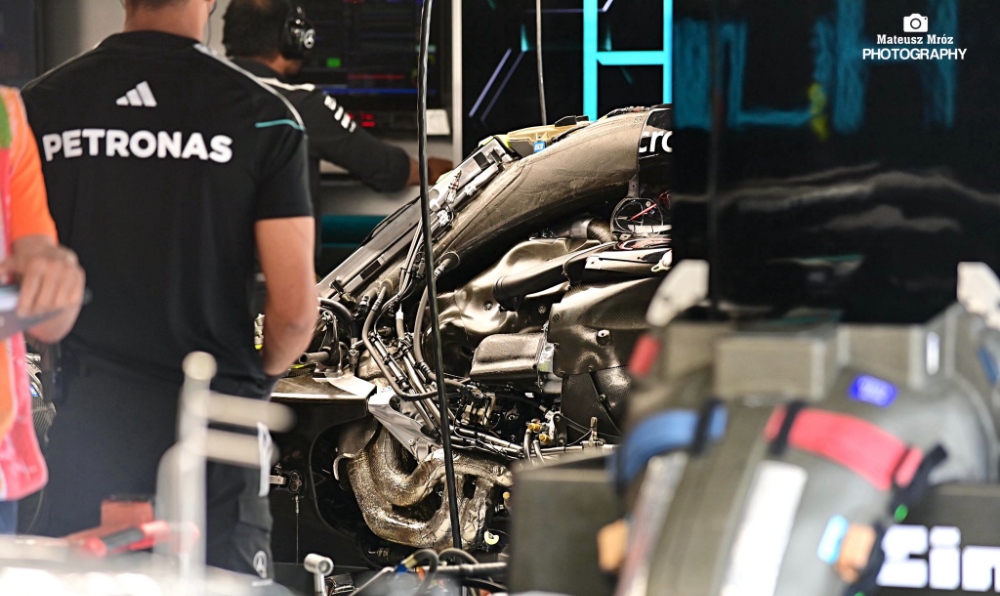
Internal photo X: Mateusz Mróz
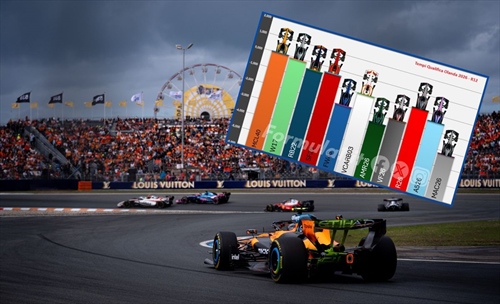
All the news, photos, weather, session times and times from the Dutch GP 2026