 By:
The 21st round of the F1 world championship in Las Vegas was packed with overtakes and twists. Many of these, of course, were chiefly down to differing energy management from driver to driver; nevertheless, the outcome of the race remained uncertain right to the end.
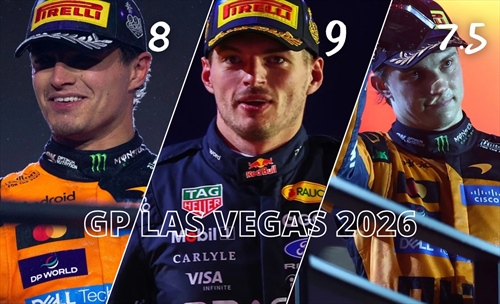
The two McLarens were impressive. Piastri managed to finish P3 after starting 17th, while Norris, who took several laps to bring the Softs up to temperature at the start of the race, came home second after spending much of the opening stint on the fringes of the top 10.
Strategy recap
There is little to analyse regarding strategies today. Race tactics were largely decided by the deployment of the Safety Car, which was brought out following the incident between Rafael Camara and Sergio Perez. The race unfolded as Pirelli had predicted: a single Soft-Medium stop was enough to allow drivers to complete the race competitively. The tyre manufacturer had suggested tackling the first stint on Mediums and the final one on Softs, but only three drivers chose to follow that advice: Antonelli, Bearman and Lawson, with Liam also taking the fastest lap of the race on the final lap: 1'35''591.
Hadjar, Camara and Bottas, meanwhile, made two stops due to contacts or other issues. Their strategy was Soft-Medium-Soft. Isack had been enjoying a fine race, alongside his Red Bull team-mate, but front-wing damage with 24 laps remaining forced him to pit for a replacement, leaving him to battle at the back. The Frenchman would finish 14th.

All drivers not mentioned completed the race on a Soft-Medium strategy. There were also four retirements: Alexander Albon (Williams) was unable even to start the race due to a technical issue; Sergio Perez (Cadillac) was eliminated after contact with Camara (Haas) on lap 17; Arvid Lindblad (VCARB) lost control of his car under the Safety Car; while Fernando Alonso (Aston Martin) was forced to retire with one lap remaining.
The psychology behind the Leclerc-Hamilton clash
We saw plenty of battles on track today, including one between the two Ferrari team-mates. In the early stages, the pair found themselves fighting each other and the McLaren drivers in the lower reaches of the top 10. Norris had lost considerable ground after failing to get the Soft compound up to temperature, while Piastri had quickly made up places from his starting position of P17.
On lap 12, Hamilton, while trying to defend from Norris and Leclerc, was “forced” to cut a corner. The FIA judged that he had done so deliberately to protect his position and therefore handed him a 10-second penalty.
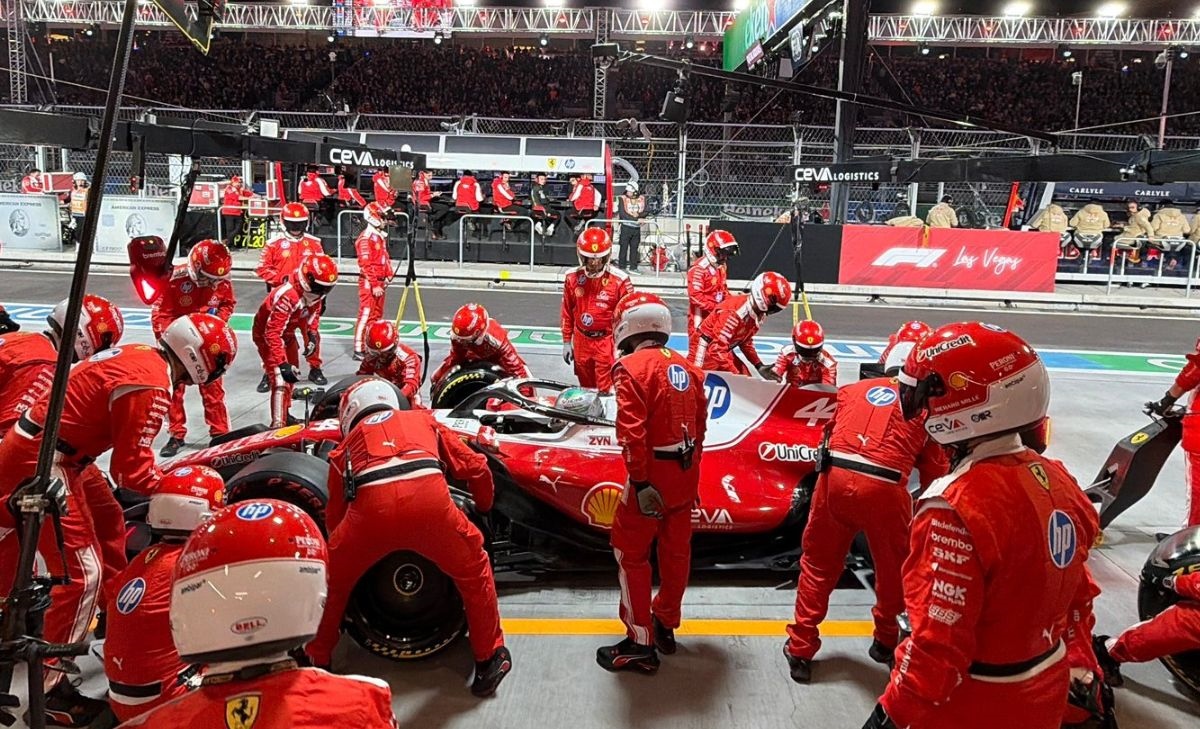
Later, on lap 19, the Safety Car was deployed following the contact between Perez and Camara. At that point, Hamilton was seventh, followed by Norris, Piastri and Leclerc, all covered by three seconds. Had Ferrari called both drivers into the pits, it would have forced Charles to serve the 10-second penalty alongside Lewis, and the team could not afford to compromise both of their races.
Ferrari rightly decided to pit Leclerc first and call Hamilton in only on the following lap. It was a difficult decision that allowed Charles to rejoin in P7, while Lewis dropped as far as P14.

It was the right and courageous choice, but this is where something began to play on the minds of the Ferrari drivers. Even though Hamilton knew Ferrari had made the wisest decision, he was the driver ahead when the Safety Car came out and was determined to reclaim the position he felt was his.
Making his way back through the field and closing in on Leclerc was almost as easy as drinking a glass of water. By lap 33, the two drivers were together again, one in front of the other: Charles seventh, Lewis eighth. The pass came on lap 34. Hamilton overtook him and set off in pursuit of Gasly, with Leclerc staying close behind. They both passed Pierre on the following lap, and it was at this stage that Ferrari, perhaps reconsidering the choice it had made under the Safety Car, ordered the two to hold position.
There were still 15 laps remaining in the GP, yet Ferrari had decided to protect Hamilton’s position. In an event full of overtakes, almost like a waltz, a dance that could also help them catch the rivals ahead and gain further places, the Prancing Horse decided to call a halt. Sixth and seventh were probably more than enough for the team. Leclerc evidently did not see it that way, and what happened, happened. He made a mistake, but worse still, he disobeyed team orders.
Every action has a reaction. It is physics. Leclerc will be the first to pay the consequences of his actions, but the team will too. As it already is.

Marrafuschi: “C4 and C5 in line with expectations”
As usual, we conclude with comments from Pirelli’s motorsport director, issued at the end of the event: “There were numerous overtakes and a high level of competition. The performance of the C4 Medium and C5 Soft compounds was in line with what we had observed in recent days. The C5 benefited from a higher level of grip and there was less graining than yesterday. The tyres remained clean and allowed the drivers to push consistently.”
“The low temperatures,” continued Dario Marrafuschi, “made tyre management more delicate, particularly during neutralisations and restarts. The drivers controlled this aspect by limiting mistakes. The neutralisation brought the pit-stop window slightly forward and the teams took advantage of it. This helped confirm a one-stop race thanks to low tyre degradation.”
Cover photo x.com
Internal graphics press.pirelli.com
Internal photo by Cameron Moon / WHYOUT images
All the news, photos, weather, session times and times from the Las Vegas GP 2026