 By:
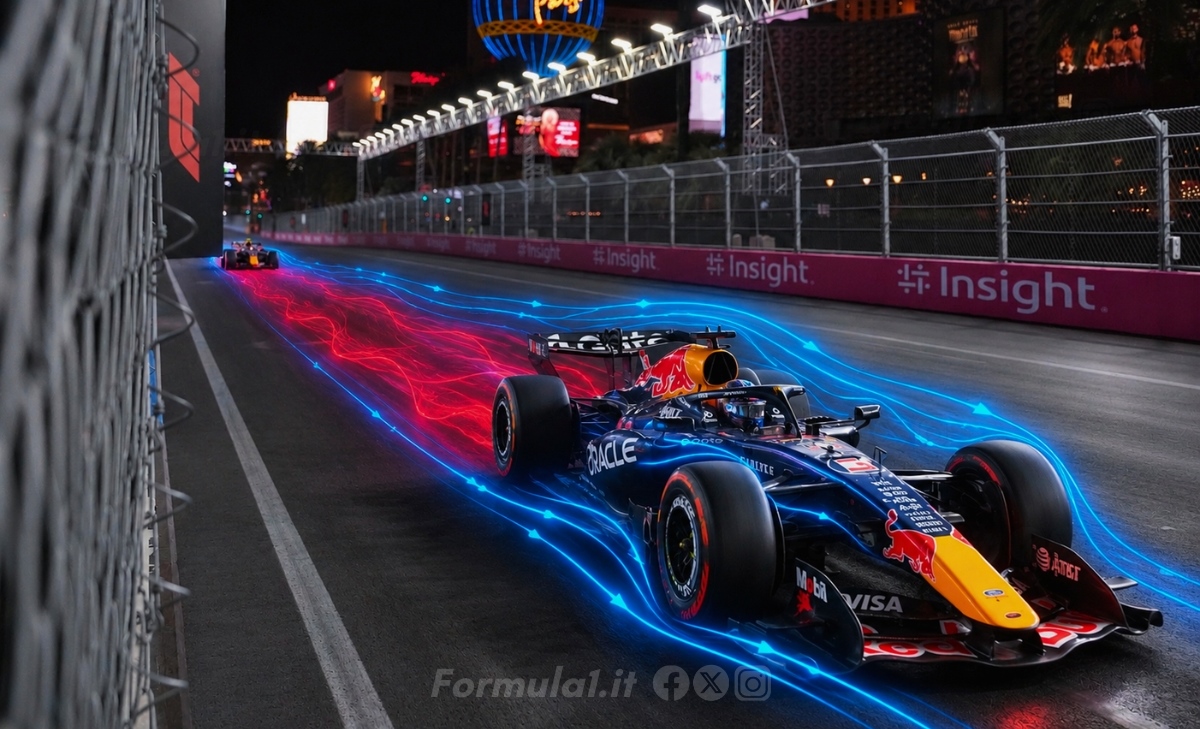
It is one of the first, and most fascinating, things you learn when watching a motor race, trying a driving simulator or simply watching a racing film: the closer you get to the car ahead, the higher the speed you can reach on the straight, using that valuable advantage to attempt an overtake. It is the famous slipstream effect.
At the Las Vegas Grand Prix, with speed differentials of 20-30km/h between chasing and leading cars, drivers struggling to pull away from the pack and others seemingly gaining dozens of extra horsepower, we saw hundreds of overtakes and counter-overtakes. Running in clean air was clearly a disadvantage.
But it is not quite that simple. Depending on the aerodynamic concepts of the cars, the effect is more or less pronounced. So why was it so decisive in Las Vegas, even compared with what we saw at the temple of speed at Monza, when the cars were otherwise evenly matched? And how can the slipstream effect have become even more important in the year in which the cars drastically reduced their aerodynamic drag through the introduction of movable front and rear wings? To understand this, it is necessary to analyse not only the fluid dynamics of the new cars, but also the close relationship between aerodynamic drag, power and energy.
The physics of the slipstream
When an F1 car moves through the air, part of the power delivered by the power unit is used to overcome aerodynamic drag. It is a little like pushing an object through water: there is a force opposing the car’s movement, which can be expressed by the following relationship:
F = ½ · ρ · Cd · A · v²
Where ρ represents air density, Cd the drag coefficient, A the reference frontal area and v the car’s velocity relative to the air. Aerodynamic drag therefore rises with the square of speed, while the power required to overcome it, in the absence of wind, rises with the cube:
P = ½ · ρ · Cd · A · v³

This means that, with the same aerodynamic configuration, going from 300 to 330km/h – increasing speed by 10% – requires around 33% more power to overcome air resistance alone. An apparently modest increase in speed therefore carries a considerable energy cost.
But what happens to the air through which the car passes? The car transfers momentum to the air, which behaves as a fluid, generating behind it a region characterised by a longitudinal velocity deficit compared with the undisturbed flow, pressure variations, vortices and turbulence. This is what we call the aerodynamic wake, or slipstream.
In the track reference frame, part of the air in the wake is dragged in the same direction as the car. The following car therefore encounters a flow with a lower average relative velocity. This reduces the dynamic pressure exerted on some aerodynamic surfaces of the chasing car and generally lowers its drag.
It is not, as is sometimes said, a region in which the air is necessarily less dense, nor is it an aspiration effect in the strict sense. The main benefit comes from the altered velocity and pressure field of the fluid.
How much horsepower is a slipstream worth?
Let us assume, using a simplified model, that an F1 car needs 500kW of power to overcome aerodynamic drag at a given speed. A 10% reduction in drag would save 50kW, equivalent to around 68 horsepower. With a 20% reduction, the benefit would rise to 100kW, or around 136 horsepower.
Naturally, the slipstream does not increase engine power: it reduces the power needed to overcome the air, making a larger share available for acceleration.
Considering an F1 car that reaches an equilibrium speed of 320km/h in clean air, while keeping power constant and disregarding other forms of resistance, the following values would theoretically be achieved:
| Drag reduction | Theoretical speed | Increase |
|---|---|---|
| 0% | 320 km/h | — |
| 5% | 325.5 km/h | +5.5 km/h |
| 10% | 331.5 km/h | +11.5 km/h |
| 15% | 337.8 km/h | +17.8 km/h |
| 20% | 344.7 km/h | +24.7 km/h |
| 25% | 352.2 km/h | +32.2 km/h |
These are purely theoretical figures, which do not account for straight length, gear ratios, changes in available power or other forms of resistance. They are nevertheless useful for understanding the scale of the phenomenon.
The other side of the coin is the loss of downforce needed to tackle corners. The reduction in dynamic pressure and the disturbed flow compromise the operation of the wings and floor, also altering the car’s balance. In Las Vegas, however, the presence of long straights and numerous relatively slow corners makes this trade-off particularly favourable: what is lost in the corners can be more than regained on the straights.
Why the slipstream of multiple cars is even more effective
The aerodynamic wake does not disappear immediately behind an F1 car. Further downstream, the disturbed flow progressively mixes with the surrounding air, recovering speed and reducing its momentum deficit. The distance over which this phenomenon continues to produce significant effects depends on the car’s geometry, its aerodynamic configuration and the characteristics of the flow.
At 330km/h, a one-second gap corresponds to around 92 metres. Yet, as we saw in Las Vegas, appreciable benefits can occur even at greater distances. When several cars run in line, their respective wakes also interact. Each car passes through an already disturbed flow and contributes to changing it further, generating a complex aerodynamic structure that can maintain a significant velocity deficit even behind the final car in the group.
The benefit is not necessarily proportional to the number of cars and also depends on their lateral alignment. Moving out of an opponent’s slipstream to attempt an overtake means being exposed once again to undisturbed air, increasing drag at precisely the final stage of the move.

An extraordinary example came in qualifying, when Kimi Antonelli set the outright fastest time by using the slipstream of a group of cars. The Italian driver started his lap around one and a half seconds behind Arvid Lindblad, who was himself preceded by other cars.
In those conditions, Antonelli enjoyed significant speed differences over Max Verstappen, with an advantage reaching around 20km/h along the Strip. The gap even surprised McLaren team principal Andrea Stella, who believes the slipstream effect appears greater in 2026 and is amplified when several cars are involved.
Of particular interest is the comparison between Antonelli’s two Q3 attempts. The Italian driver recorded the following speed increases:
- Before Turn 5: from 319 to 329km/h.
- Along the Strip: from 335 to 351km/h.
- On the start-finish straight: from 311 to 327km/h.
Increases of between 10 and 16km/h, achieved by the same car during the same qualifying session. It is a comparison that reduces some of the variables involved when analysing cars from different teams, even if it cannot fully isolate the aerodynamic contribution from the energy-related one.
Why is the slipstream also worth energy in 2026?
To understand the scale of the change, attention must shift to the power units. In 2025, the contribution from the MGU-K electric motor was limited to 120kW, equivalent to around 163 horsepower. In 2026, it can reach 350kW, or around 476 horsepower, while the internal-combustion engine produces around 400kW.
This is compounded by the disappearance of the MGU-H, which allowed energy to be recovered through exhaust gases and could also supply the MGU-K directly. The electric component has therefore become vastly more important than in the past, but energy availability has become one of the main factors limiting performance.
A 2025 car reducing or cutting its electric contribution gave up a relatively limited share of its power. A 2026 car, on the other hand, can lose almost half of the total power theoretically available.
And this is where the slipstream takes on a new role: it becomes a means of saving energy. Let us return to the previous example. If using the slipstream reduces the power required to maintain a given speed by 50kW, then over 10 seconds the theoretical energy saving would amount to 0.5MJ. If all of that were saved by the electric component, net of losses, it would allow the MGU-K to run at its maximum output of 350kW for around one and a half additional seconds.
The chasing car can therefore choose whether to turn the lower drag immediately into greater acceleration, preserve some electrical energy for later use, or adopt an intermediate strategy. The leading car, by contrast, must bear the full energy cost of cutting through the air.
In short, the slipstream does not offer only an immediate advantage: it can generate a benefit that extends over the rest of the straight and even into subsequent phases of the lap.
Las Vegas 2025 versus Las Vegas 2026
The Las Vegas circuit is a particularly interesting laboratory for comparing the two generations of cars. The layout has remained largely unchanged, but the ways in which the cars reduce aerodynamic drag and use the available energy have changed profoundly.
In 2025 there were two DRS zones: the first began 20 metres after Turn 4, while the second started only 870 metres before the braking point for Turn 14, along the Strip. In 2026, by contrast, the FIA identified three Straight Mode activation zones in normal grip conditions:
- 40 metres after Turn 4;
- 110 metres after Turn 12;
- 45 metres after Turn 16.
Along the Strip, therefore, the low-drag configuration is now adopted much earlier than in the past. Above all, it is available to everyone, regardless of the gap to the car ahead.
An interesting analysis of race telemetry makes it possible to compare the median speeds recorded in the past two editions of the Grand Prix.
| Configuration | Top speed | End of straight |
|---|---|---|
| 2025 – Clean air | 337 km/h | 332 km/h |
| 2026 – Clean air | 324 km/h | 311 km/h |
| 2026 – Slipstream without Overtake | 337 km/h | 329 km/h |
| 2026 – Slipstream with Overtake | 346 km/h | 332 km/h |
The first finding is seemingly paradoxical: despite the availability of active aerodynamics, the 2026 cars in clean air are noticeably slower than the 2025 cars, especially in the closing phase of the straight.
A further analysis of 2026 telemetry produced the following median top-speed figures along the Strip:
- In clean air or in the lead: 326km/h.
- Between one and 2.5 seconds behind the car ahead: 335km/h.
- Less than one second behind: 345km/h.
That is almost 20km/h of difference between those leading and those closely following, although the availability of Overtake Mode may also contribute in the latter group. The fact that significantly higher speeds are already seen at gaps of more than one second nonetheless confirms just how important it is to run within a pack.
But should active aerodynamics not reduce the slipstream effect?
From a strictly fluid-dynamic perspective, a car that generates less drag transfers less longitudinal momentum to the air overall. One might therefore expect its wake to offer a smaller benefit to the car behind. The issue, however, is more complex.
The aerodynamic drag of a Formula 1 car consists of several components: pressure drag, viscous drag, drag associated with generating downforce, and interference effects between the car’s various elements. Opening the front and rear wings reduces some of these components, but it does not eliminate the drag generated by the exposed tyres, suspension, bodywork and floor.
Furthermore, wake characteristics do not depend solely on the car’s overall drag, but also on how the momentum deficit is distributed in space. The 2022-2025 generation of cars was designed with particular attention to directing disturbed flow upwards, seeking to limit interference with the following car.
For 2026, the floor, diffuser, wings, tyre dimensions and numerous elements designed to manage vortex structures have changed. It is therefore possible that the new aerodynamic configuration produces a distribution of disturbed flow more favourable to reducing the drag of the chasing car, even with lower overall drag.
Moreover, as we have seen, the slipstream allows energy to be saved and therefore used for longer periods. George Russell himself, during the FIA press conference after qualifying, admitted that he did not know how much of the phenomenon depended on the particular Straight Mode configuration and how much on the possibility of extending electrical energy deployment.
The additional advantage of Overtake Mode
As shown by the FIA document concerning power-unit management in Las Vegas, in 2026 the maximum electrical power available in the main overtaking zones in standard mode begins to decrease above 290km/h. With Overtake Mode, however, it is possible to maintain the 350kW limit up to around 337.5km/h, naturally provided the necessary energy is available. This is in addition to the possibility of recovering an extra 0.5MJ per lap, rising from the 8MJ allowed under standard conditions to the 8.5MJ permitted with Overtake Mode active.
These numbers help explain just how delicate the energy balance has become at a circuit such as this. The chasing car can therefore benefit simultaneously from three favourable conditions: lower aerodynamic drag, the opportunity to preserve electrical energy and, when entitled to it, a more favourable electrical power-deployment curve at high speeds.
The strange case of the 2026 Formula 1 cars
We cannot yet say with certainty that the wake generated by the 2026 cars is aerodynamically more effective than that of the 2025 cars. We can, however, say that its performance and strategic value has increased significantly.
In 2025, the slipstream was primarily an opportunity to go faster. In 2026, it is also an opportunity to consume less energy, recover it when strategy permits and have more power available in subsequent acceleration phases.
Formula 1 has thus introduced a new strategic variable: choosing when to overtake and, above all, when it is better not to. Because getting ahead too early may mean arriving at the next straight with less energy, no slipstream and a decidedly faster rival behind. That is why the Las Vegas Grand Prix felt like a Formula E race or Mario Kart. Do we like all this? The answer is far more complicated than the formulas set out above, so much so that F1 has been literally divided on the issue.
Cover photo by Cameron Moon / WHYOUT images
All the news, photos, weather, session times and times from the Las Vegas GP 2026