 By:
The FIA has published its summary document of the official upgrades declared by teams for the 2026 Las Vegas Grand Prix, the 21st round of the World Championship. After a Brazilian weekend in which only McLaren brought technical updates, seven teams have returned with changes for the Nevada street circuit: Mercedes, McLaren, Ferrari, Red Bull, Racing Bulls, Haas and Audi, for a total of 13 declared modifications.
The figure is particularly interesting given the stage of the season. Just three Grands Prix remain before the championship concludes and much of the technical resource is now focused on 2027. Yet Las Vegas, with its especially unusual characteristics, requires specific aerodynamic solutions that have prompted several teams to make changes to their cars.
The very long straights, high speeds and generally low temperatures demand a delicate compromise between drag, downforce and cooling. As a result, many of the declared upgrades do not necessarily represent developments intended to improve performance at every circuit, but rather adaptations to the demands of the American track.
Mercedes has brought the highest number of changes, four, focused on reducing drag and optimising cooling. Racing Bulls has also introduced a substantial package comprising three changes to the floor, front wing and rear area, all aimed at reducing downforce and improving lap efficiency.
Ferrari and Audi have also introduced Las Vegas-specific solutions, while Haas is trialling a different configuration for its rear-wing Straight Mode mechanism.
The situation is different for McLaren and Red Bull. The Woking team is continuing its work on the floor with two upgrades intended to improve airflow management and downforce, following the substantial package already introduced at Interlagos. Red Bull, meanwhile, has made changes to the front-wing dive-plane, altering its position and geometry to improve airflow stability.
Here are all the official changes declared by the teams for the 2026 Las Vegas GP.
McLaren

McLaren is continuing its aerodynamic development programme with another two changes to the floor, just two weeks after the substantial package introduced in Brazil. Unlike the Las Vegas-specific adaptations presented by other teams, the British outfit's declared modifications are directly aimed at improving performance through more effective airflow management.
The first change concerns the introduction of a new vertical floor element, developed alongside modifications to the floor edge and diffuser. The aim is to improve aerodynamic airflow conditioning and increase the downforce generated by the underside of the car.
The second upgrade concerns the aerodynamic elements in the rear section of the floor. It is a more limited change, designed to influence the airflow directed towards the car's rear corners and diffuser, improving overall efficiency.
| Component | Reason | Differences | Description |
|---|---|---|---|
| Floor Furniture | Performance - Aerodynamic airflow management | New vertical floor element and modified floor edge. | A new vertical floor element has been designed alongside the floor edge and diffuser, with the aim of improving aerodynamic airflow management and increasing the downforce generated. |
| Floor Furniture | Performance - Aerodynamic airflow management | Changes to the aerodynamic elements in the rear section of the floor. | A minor change to the rear floor elements allows intervention on airflow directed towards the car's rear corners and diffuser, with the aim of increasing overall aerodynamic efficiency. |
Mercedes

Mercedes has brought the numerically largest package of the weekend, comprising four changes. Unlike McLaren's, the modifications are predominantly linked to the characteristics of the Las Vegas circuit, where reducing drag can be particularly advantageous on the long straights.
The main change concerns the rear wing, from which several aerodynamic appendages have been removed. The solution reduces the overall camber of the wing assembly and, consequently, both the downforce generated and drag. The objective is to achieve a more favourable downforce-to-drag ratio for the American circuit.
A similar intervention concerns the rear mirror support, which has been reduced in size to cut local downforce and associated drag. The position and extent of the aerodynamic appendages in the rear-wheel area have also been modified, optimising their contribution for Las Vegas's requirements.
The fourth new feature concerns the engine cover, which has a narrower rear exit opening. This configuration has been made possible by the lower cooling requirements expected at the circuit, where low ambient temperatures allow less open solutions than at hotter events.
| Component | Reason | Differences | Description |
|---|---|---|---|
| Rear Wing | Circuit-specific - Drag reduction | Removal of several aerodynamic appendages from the rear wing. | The removal of the appendages reduces the overall camber of the wing assembly, lowering downforce and drag in a ratio suited to the characteristics of the Las Vegas circuit. |
| Front Bodywork | Circuit-specific - Drag reduction | Rear mirror support reduced in size. | The modification to the mirror support reduces local camber and downforce, lowering drag with a downforce-to-drag ratio appropriate for Las Vegas. |
| Rear Corner | Performance - Local aerodynamic load | Optimisation of the position and extent of aerodynamic appendages in the rear area. | The position and extent of the rear aerodynamic appendages have been optimised for local load requirements, reducing downforce and drag in a ratio suited to Las Vegas's characteristics. |
| Engine Cover | Cooling management | Narrower rear exit opening in the bodywork. | The narrower rear opening allows a different cooling configuration, suited to the lower heat-rejection requirements expected at the Las Vegas circuit. |
Red Bull

Red Bull has introduced a localised front-wing upgrade, specifically targeting the dive-plane, the small aerodynamic appendage on the endplate.
The component has been lowered and shortened in chord, changing both its position and geometry. According to the team's declaration to the FIA, the intervention is intended to better preserve airflow stability in the junction between the endplate and the wing's horizontal surface, as well as over downstream surfaces. It is therefore not a comprehensive front-wing revision, but a local optimisation designed to improve airflow quality and the car's aerodynamic behaviour.
| Component | Reason | Differences | Description |
|---|---|---|---|
| Front Wing Endplate | Performance - Local aerodynamic load | Repositioning of the dive-plane on the front-wing endplate. | To better preserve airflow stability in the junction between the endplate and the front wing's horizontal surface, as well as over downstream surfaces, the dive-plane has been lowered and its chord length reduced. |
Ferrari

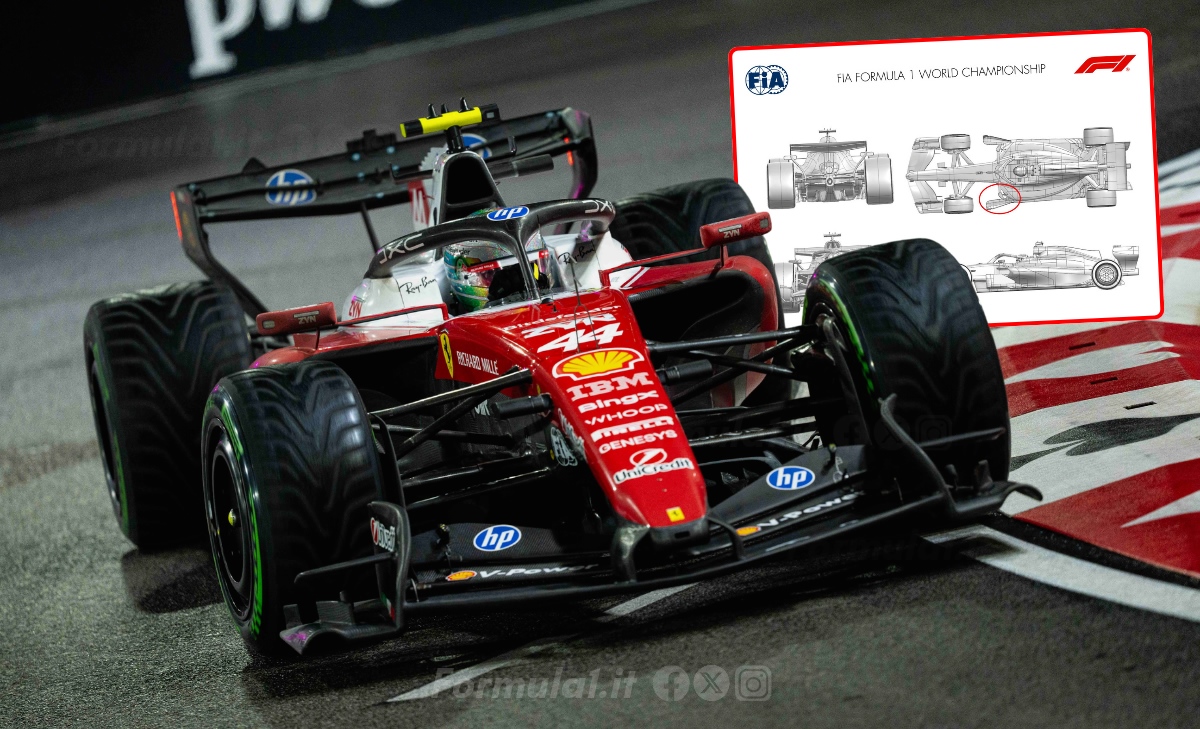
Ferrari has introduced a Las Vegas-specific modification affecting the front section of the floor. The intervention consists of optimising the aerodynamic elements of the floor board, with the adoption of a single vertical element.
The stated objective is to reduce the car's drag, favouring a more efficient configuration on the circuit's long straights. The change also entails a reduction in downforce, but this is considered a favourable compromise for the characteristics of the track.
It is therefore a targeted adaptation rather than an upgrade necessarily intended to improve performance at every circuit. Ferrari has worked on a particularly sensitive area of the car in search of a different balance between downforce and drag, favouring the latter in response to Las Vegas's requirements.
| Component | Reason | Differences | Description |
|---|---|---|---|
| Floor Board | Circuit-specific - Drag reduction | Optimisation of the front floor elements, with a single vertical element. | The changes were designed to adapt the car to the characteristics of the Las Vegas circuit and its aerodynamic-efficiency requirements. The main aim is to reduce drag, accepting a consequent reduction in downforce, with a compromise favourable to the track's characteristics. |
Williams
No upgrades.
Visa Cash App Racing Bulls

Racing Bulls has introduced a package of three aerodynamic changes developed specifically for the Las Vegas circuit, affecting the floor, rear-wheel area and front wing. The common objective is to reduce downforce to improve the car's overall efficiency, seeking a compromise more favourable to the characteristics of the American track.
The first upgrade concerns the Floor Board, whose elements have been modified by reducing their chord length. The resulting reduction in downforce generated by the floor should, according to the team's declaration, improve aerodynamic efficiency and lap time in Las Vegas.
The second change affects the rear-wheel area, where a different configuration of the aerodynamic appendages associated with the brake drums has been introduced. Here, too, the aim is to achieve an efficient reduction in downforce, with a net performance benefit expected at this specific circuit.
The third intervention concerns the front wing, with a flap featuring a reduced chord and altered incidence. The new configuration makes it possible to reduce the downforce generated by the front end and, above all, broaden the scope for adjusting the car's aerodynamic balance.
| Component | Reason | Differences | Description |
|---|---|---|---|
| Floor Board | Circuit-specific - Drag reduction | Reduced chord length of the Floor Board elements. | Reducing the downforce generated by the Floor Board improves the car's overall efficiency and lap time at this specific circuit. |
| Rear Corner | Circuit-specific - Drag reduction | Changes to the aerodynamic appendages on the rear brake drums. | An alternative configuration of the aerodynamic appendages on the rear brake drums makes it possible to reduce downforce effectively, delivering an expected net performance benefit at this track. |
| Front Wing | Circuit-specific - Expanded aerodynamic balance range | Flap with reduced chord and altered incidence. | A low-downforce front-wing flap is available for this circuit, featuring changes to chord and incidence to reduce the load generated by the front wing and broaden the scope for aerodynamic-balance adjustment. |
Aston Martin
No upgrades.
Haas

Haas has introduced a rear-wing modification to assess a different configuration of the Straight Mode mechanism, the system that reduces drag on the straights.
The team has revised the arrangement of the rear-wing elements, also introducing minor adaptations required to accommodate the new configuration. The stated purpose is to trial an alternative means of activating Straight Mode and evaluate its operation.
| Component | Reason | Differences | Description |
|---|---|---|---|
| Rear Wing | Performance - Drag reduction | Revised rear-wing configuration in relation to the Straight Mode mechanism. | The new configuration was designed to evaluate an alternative method of activating the rear wing's Straight Mode, with minor additional changes required to adapt the system to the different configuration. |
Audi

Audi has introduced a Las Vegas-specific change in the rear-wheel area, modifying the geometry of the baffle associated with the brake duct.
According to the FIA documentation, the new configuration was developed to adapt local aerodynamic behaviour to the particular efficiency demands of the American track.
| Component | Reason | Differences | Description |
|---|---|---|---|
| Rear Corner | Circuit-specific - Drag reduction | Updated geometry of the rear brake-duct baffle. | The geometry of the rear brake-duct baffle has been modified to meet the specific aerodynamic-efficiency requirements of the Las Vegas circuit. |
Alpine
No upgrades.
Cadillac
No upgrades.
Cover photo by Levi Erb / WHYOUT images | FIA images inside
The article in two minutes
Formula 1 arrives in Las Vegas with a surprise: despite just three Grands Prix remaining in the World Championship, seven teams have declared technical upgrades, for a total of 13 official changes. After Brazil, where only McLaren introduced updates, development has once again taken centre stage, albeit with different objectives.
The Las Vegas circuit, characterised by very long straights, high speeds and low temperatures, primarily requires reduced drag, even at the expense of some downforce.
Mercedes has brought the largest package, with four interventions: a rear wing stripped of aerodynamic appendages, reduced-size mirror supports, modifications in the rear-wheel area and an engine cover with a narrower cooling opening.
Racing Bulls follows with three specific changes: shortened floor elements, new appendages on the rear brake drums and a low-downforce front-wing flap, also intended to broaden the balance range.
McLaren, by contrast, continues its broader aerodynamic performance development. Following the substantial Interlagos package, it has introduced two further floor changes to improve airflow towards the diffuser and increase downforce.
Ferrari has modified the front floor elements, adopting a configuration with a single vertical element to reduce drag. Red Bull has lowered and shortened its front-wing dive-plane to stabilise airflow.
Haas is trialling a different configuration for its rear-wing Straight Mode mechanism, while Audi has modified the rear brake-duct baffle to improve aerodynamic efficiency.
The picture is clear: Mercedes, Racing Bulls, Ferrari and Audi are prioritising Las Vegas-specific adaptations, while McLaren and Red Bull continue to optimise airflow management. Even with three races remaining, technical development has not completely stopped.