 By:
Front wings are among the most important components on a Formula 1 car. They are the first surfaces to meet the air through which the car travels, heavily influencing the downstream flow and generating a significant share of front-axle downforce.
Across the various regulatory eras, their shapes have often changed radically, driven by the relentless search by engineers to exploit every surface at the front of the car.
The current regulations are no exception, although the prevailing trends differ greatly from some predictions made following the unveiling of the present car concept, which suggested a return to the inwash endplates – curved inboard – typical of the early 2000s. That has not happened.
With the season's latest front-wing configurations now in place, it is possible to begin understanding the philosophy pursued by the engineers at the various teams and attempt to describe it.
The wing returns to being primarily a downforce-generating device

The abandonment of enhanced ground effect has returned the front wing to the role of a downforce-generating surface that it held before 2022.
Until last year, its downforce effect was very limited and confined to the area around the car's nose, while the outer sections of the wing were primarily devoted to conditioning the airflow around the outside of the front wheels.
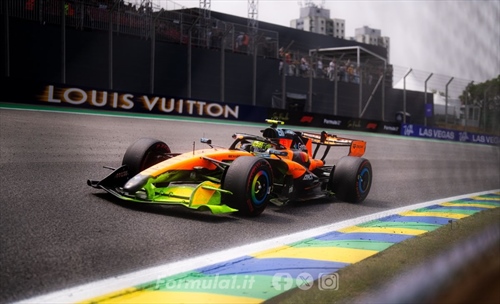
In the example of the MCL40 wing, the large light-blue section is primarily devoted to generating downforce, while the area highlighted in yellow is progressively more focused on directing air into the crucial area on the inside of the tyre.
This outwash effect is now also pursued through the elaborate shaping of the endplates, while the flaps feature much greater chord, angle and camber to generate substantial downforce without fear of paying an excessive straight-line drag penalty. That is because the low-drag ‘straight-line’ mode has been introduced, changing the incidence of the profiles to reduce drag along with downforce.
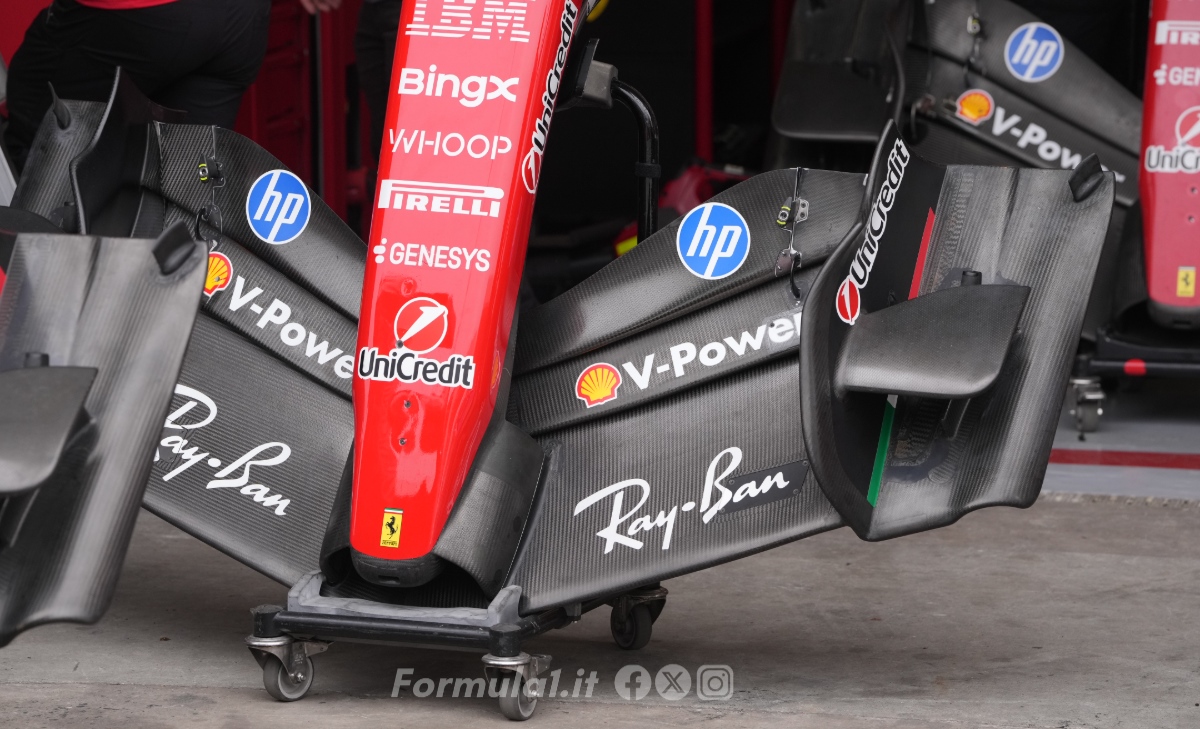
Endplates dedicated to outwash

The task of managing the harmful effects caused by the tyre's interaction with the airstream therefore falls to the endplates. Contrary to the predictions mentioned earlier, the layout of these elements has taken on a function clearly dedicated to conditioning the airflow so that it passes around the outside of the tyre, clearing away as much as possible of the high-pressure zones around it. This benefits aerodynamic efficiency and provides the surfaces downstream of the tyre with a more orderly, manageable flow field.
A tunnel dedicated to tyre turbulence

The element extending outboard of the endplate was immediately shaped with a curled form at its outermost section. Along its length, this small tunnel becomes progressively less concave until the concavity almost disappears level with the tyre.
The aim is to create a small Venturi-like channel, not so much to generate low pressure as to accelerate the air in that area and blow directly into the zone where the tyre rolls close to the track surface.
This is an extremely critical and highly disorderly area. That disorder is commonly known as ‘tyre squirt’, and it is extremely harmful, with aerodynamicists fighting it by every possible means at both the front and rear axles.
The ‘blowing’ effect from this channel helps push this turbulence downstream.
Micro-aerodynamics to exploit every opportunity

Every additional element contributes to enhancing the basic effects described above.
The wing plane extending horizontally from the endplate has a profile that curves slightly downwards.
The aim is to combine downward flow conditioning with the very powerful outward effect generated by the endplate and described earlier. The intention is therefore to direct high-energy air towards the most critical areas of the rapidly rotating tyre, namely its lower sections.
The wing proximity vortex generated by this plane is also exploited, again passing around the outside of the tyre.
Making use of every available volume, a small vertical profile facing outwards appeared on almost every car during the season, with the aim of working in synergy with the overall shape of the endplate.
Although front wings may appear – and indeed are – already extremely sophisticated aerodynamic devices, it is worth remembering that this is only the first year of regulations that have completely changed the approach to the car's entire aerodynamic package.
We will see even more extreme solutions from next season onwards and, probably, some ideas at the limit of the regulations that could completely disrupt the convergence of solutions seen at this stage of the season.
Cover photo by Luca Martini / WHYOUT Image
Interior photo by Luca Martini / WHYOUT Image
All the news, photos, weather, session times and times from the Brazilian GP 2026