 By:
The Brazilian Grand Prix presents a very different technical challenge to the one faced in Mexico. At Interlagos, it is not altitude that shapes the behaviour of the cars, but the need to find the right compromise between downforce and efficiency. The 2026 cars make that balance even more delicate, because they introduce the issue of energy management, particularly along sections where the availability of electric power can become decisive.
The 4.309km José Carlos Pace circuit features 15 corners, constant elevation changes and two long flat-out sections. The middle sector demands downforce and good traction, while the climb from Junção to the finish rewards efficiency and the ability to exploit the power unit.
Interlagos: aerodynamics must also contend with energy
As we explored in our technical analysis of the circuit, the regulatory limit on MGU-K energy recovery in qualifying falls to 6.5MJ per lap, compared with 8.5MJ in Mexico. That is a 23.5% reduction designed to avoid superclipping, forcing teams to carefully study their energy recovery and deployment strategies.
Wing selection therefore becomes particularly important. Greater downforce aids cornering, but can compromise straight-line speed by increasing energy demand. A lower-downforce configuration presents the opposite problem, especially in the twisty middle sector.
Track-surface conditions must also be considered. As reported in our feature on the circuit's characteristics, the sections between Turns 3 and 5 and between Turns 8 and 9 have been resurfaced. Together with Pirelli's decision to bring the C3, C4 and C5 compounds, one step softer than in 2025, these changes add further variables to the search for the ideal balance.
With the cars already in the Interlagos garages, the first images from the pitlane offer a close look at the teams' technical choices. Between declared updates, experimental solutions and aerodynamic details, they provide interesting indications of the engineers' work, also with 2027 in mind. Let us look at the most significant developments, some of which could be evaluated on track as early as free practice.
McLaren in Brazil: a new front wing with an eye on 2027
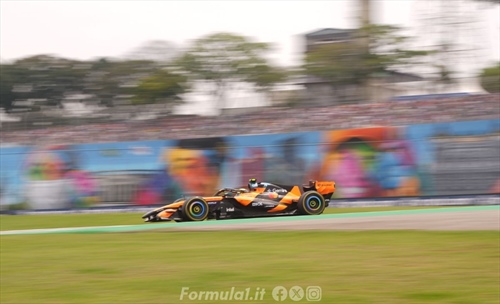
McLaren is the only team to have declared aerodynamic updates for Interlagos. The package includes four changes: a new front wing, a new rear-wing assembly, a revised beam wing and modifications to the floor's aerodynamic elements.
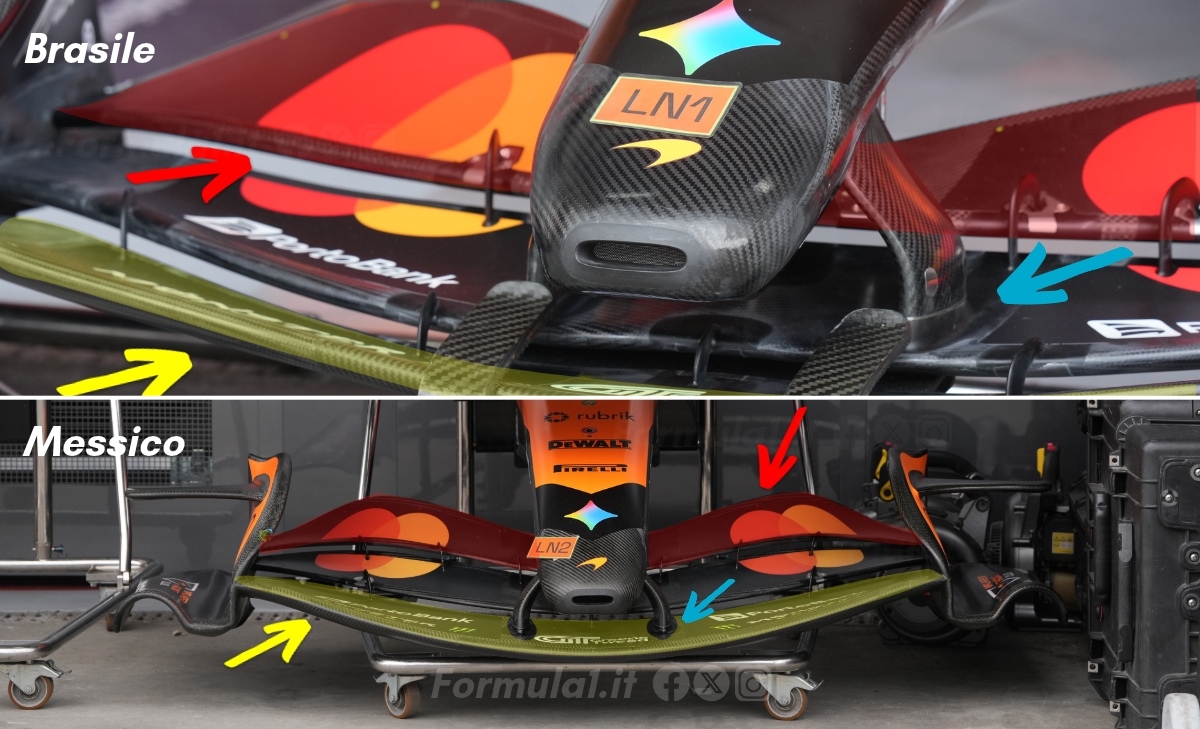
The most interesting development concerns the front wing, which features a significant redistribution of surface area. Compared with the previous configuration, the mainplane is noticeably shorter (highlighted in yellow), while the upper element has been enlarged (highlighted in red). The nose mounting has also changed, now attaching to the second element rather than the mainplane (blue arrows).
 McLaren front-wing updates, Mexico-Brazil comparison - Original photos by Finlay Williams / WHYOUT images
The flap geometry, its adjustment system and the junction between the wing elements and the endplates have also been revised. The aim is to improve the conditioning of airflow directed towards the floor and bodywork, increasing overall aerodynamic efficiency. This is the third specific evolution of McLaren's front wing in 2026, following those introduced in Canada and Barcelona. It is a less frenetic development path than some rivals, but one that has now delivered a particularly significant conceptual change.
Peter Prodromou, McLaren's head of aerodynamics, confirmed that the project is already looking towards next season: «The updates are designed to improve the car now and help us in the fight for third place in the World Championship. The information we gather will contribute to the development of next year's car, and we expect to retain the concept of the new front wing in the initial configuration of the 2027 car».
At the rear, there is a new wing assembly designed to generate downforce more efficiently, accompanied by a beam wing developed to improve the aerodynamic interaction between the two elements.
 McLaren rear-wing updates, Mexico-Brazil comparison - Original photos by Finlay Williams / WHYOUT images
Small changes to the floor, aimed at refining airflow management, complete the package.
Red Bull in Brazil: the hybrid sidepod tested in Mexico returns
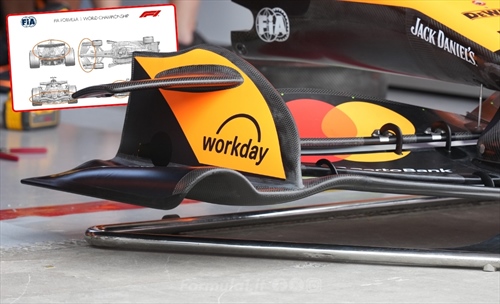
The images from the Interlagos pitlane once again show the distinctive sidepod configuration that Red Bull tested during FP1 for the Mexican Grand Prix. It is a hybrid solution, combining the upper section of the sidepods introduced in Baku, recognisable by their two distinctive bulges, with the lower profile of the previous configuration. The change reduces the area of floor exposed at the side and alters the geometry of the channel through which air flows towards the rear of the car.
 Red Bull sidepod, Mexico FP1-Brazil comparison - Original photos by Finlay Williams / WHYOUT images
Mercedes and McLaren: two aerodynamic philosophies converging
An interesting comparison concerns the evolution of McLaren and Mercedes' front wings. With its Interlagos update, the Woking team has moved the nose mounting from the first to the second wing element, while Mercedes took the opposite route in Singapore, adopting a solution that allows both flaps to move in Straight Mode. It is a curious reversal of direction, mirrored in the sidepod geometry. With its Baku update, McLaren had moved closer to the concept originally adopted by Mercedes, while the Brackley team subsequently developed bodywork more similar to McLaren's earlier interpretation. Two different development paths that end up crossing twice in the same season.
It is worth noting that Mercedes has closed the lower gills compared with Mexico, but is forced to retain several openings on the upper section of the engine cover, evidently concerned about the reliability of its power unit.
 Open gills on the Mercedes engine cover in Brazil too - Original photos by Finlay Williams / WHYOUT images
Ferrari in Brazil: no declared aerodynamic updates
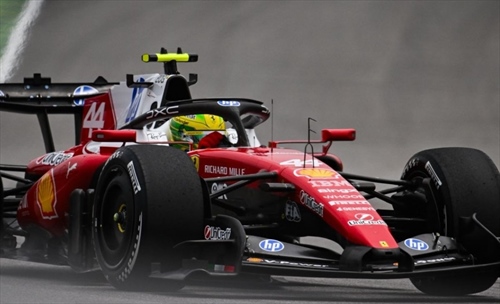
Ferrari arrives at Interlagos with no new components declared to the FIA. After the aerodynamic changes introduced in Austin and the particularly open cooling configurations used in Mexico, work on the SF-26 is focused on optimising the existing package. The compromise between downforce and drag will be particularly delicate. Energy management along the straights could amplify the differences between the power units, making it even more important to find a configuration capable of delivering speed without excessively sacrificing cornering performance. The front wing is the medium-downforce version, the latest evolution seen in Austin.


 Ferrari front wing in Brazil - Original photos by Finlay Williams / WHYOUT images
It is worth noting that all the additional gills seen in Mexico have been closed on the engine cover, while other teams, including Mercedes, are still forced to retain numerous openings.
 Single opening on the Ferrari engine cover in Brazil - Original photos by Finlay Williams / WHYOUT images
Article being updated...
Article updated on 06.11.2026 at 20:05
All the news, photos, weather, session times and times from the Brazilian GP 2026