 By:
The Autódromo Hermanos Rodríguez in Mexico City is one of the most unusual circuits on the calendar. At 4.304 km long, it features 17 corners and sits 2,238 metres above sea level, an altitude that profoundly affects the behaviour of the cars. The thin air reduces drag, allowing extremely high speeds on the main straight of more than 1.2 km, but it also reduces downforce and makes cooling the power unit and brakes more difficult. As a result, teams use maximum-downforce aerodynamic configurations, similar to those seen in Monaco, while still reaching speeds that could exceed 350 km/h this year, also thanks to the active aerodynamics introduced this season.
The circuit features three very different sectors. The first rewards top speed, power unit efficiency and stability under the heaviest braking. The second, defined by a sequence of slow corners and rapid direction changes, tests aerodynamic balance and front-end precision. The final sector, which passes through the famous stadium section, primarily demands traction and mechanical grip, placing the rear tyres under strain. The relatively smooth asphalt limits tyre wear but offers little grip, especially in the opening sessions, increasing the risk of sliding and graining. The race will be run over 71 laps, covering a total distance of 305.354 km.
Braking demands
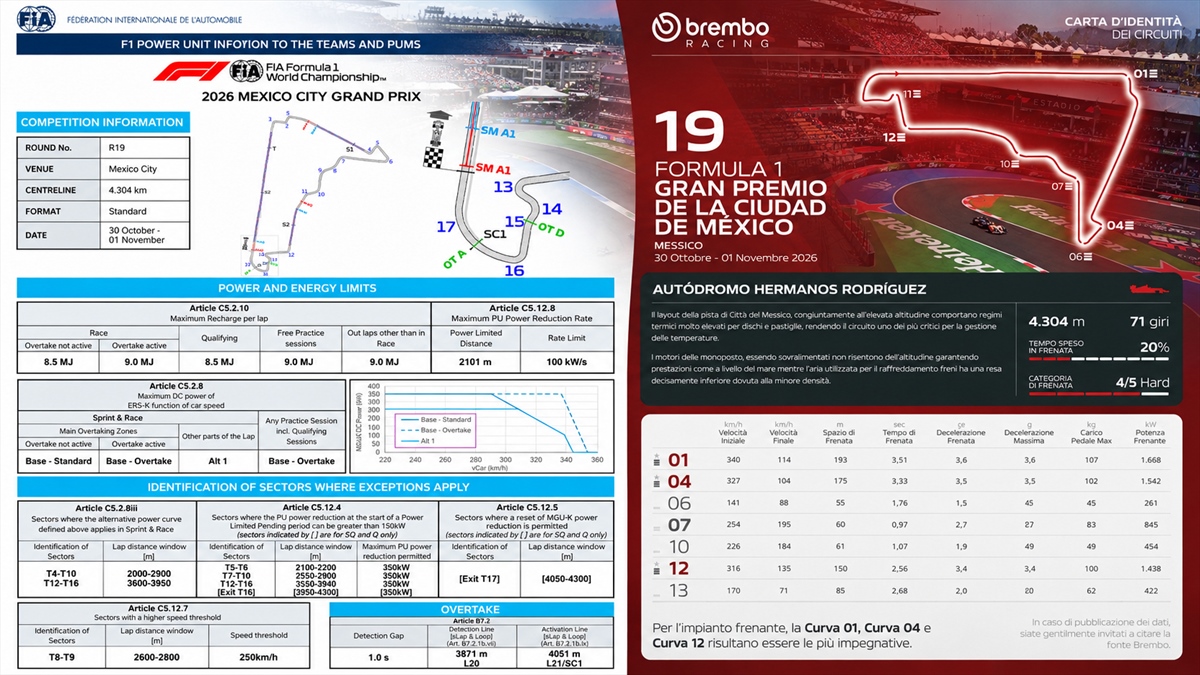
According to simulations by Brembo engineers, the Mexican circuit has a difficulty rating of 4 out of 5, despite featuring only seven braking zones per lap and just under 16 seconds of total brake use. Three braking zones are classified as Hard, one as Medium and three as Light. Deceleration remains below 3.7g in every case, but the thin air makes heat dissipation particularly difficult, with the carbon discs capable of reaching temperatures close to 1,000 °C.
The most demanding braking zone is at Turn 1, at the end of the very long main straight. The cars slow from 340 to 114 km/h in 3.51 seconds over a distance of 193 metres. Deceleration reaches 3.6g, with 107 kg of force applied to the pedal and braking power of 1,668 kW.
The comparison with 2025 once again highlights the differences introduced by the new-generation cars. At Turn 4, drivers were subjected to 4.1g of deceleration last year, applying 131 kg of force to the pedal. This year, the expected figures fall to 3.5g and 102 kg respectively. The most significant change is in the distances: the braking distance increases by 46 metres, rising from 129 to 175 metres, while the time needed to slow down increases from 2.76 to 3.33 seconds. In practical terms, the new cars demand less effort from the drivers, but require more than half a second longer to negotiate the same braking zone.
Power unit: FIA limits for Mexico
The official Power Unit Information document confirms the same energy limits for the Mexican Grand Prix as those already used in Austin. The MGU-K will be able to recover a maximum of 8.5 MJ per lap in qualifying and in the race without Overtake Mode, while the figure will rise to 9 MJ with the overtaking system active. In free practice and on out-laps, excluding race out-laps, the limit will be 9 MJ. This is an interesting choice given that the Mexican circuit measures just 4.304 km, compared with Austin's 5.513 km: the maximum recoverable energy therefore remains unchanged despite a markedly shorter lap. Naturally, having a high limit does not necessarily mean it can be exploited, especially when the available recovery opportunities under braking must be taken into account.
The Power Limited Distance is different, set at 2,101 metres, compared with 2,847 metres in Austin. That is a reduction of 746 metres, although when related to the length of the two circuits it still results in fairly similar percentages: around 49% of the lap in Mexico compared with 52% in the United States. The maximum rate at which power unit output can be reduced also remains unchanged, set at 100 kW per second.
The MGU-K will be able to deliver up to 350 kW, although the available power will progressively decrease at higher speeds. With the Base Standard curve, the reduction will begin at around 290 km/h, while with Base Overtake, full power can be maintained until around 340 km/h. As always, the FIA will impose certain specific exemptions in different sections of the circuit, applying specific electric power reduction rules according to speed.
As for Overtake Mode, it will again be necessary to be within one second of the car ahead. The gap will be measured 3,871 metres from the start of the lap, while activation will be permitted at 4,051 metres, shortly before the very long main straight towards Turn 1, where drivers will have one of their best opportunities to attempt an overtake, with high speeds also aided by the reduced air density at 2,238 metres above sea level.
All the news, photos, weather, session times and times from the Mexican GP 2026