 By:
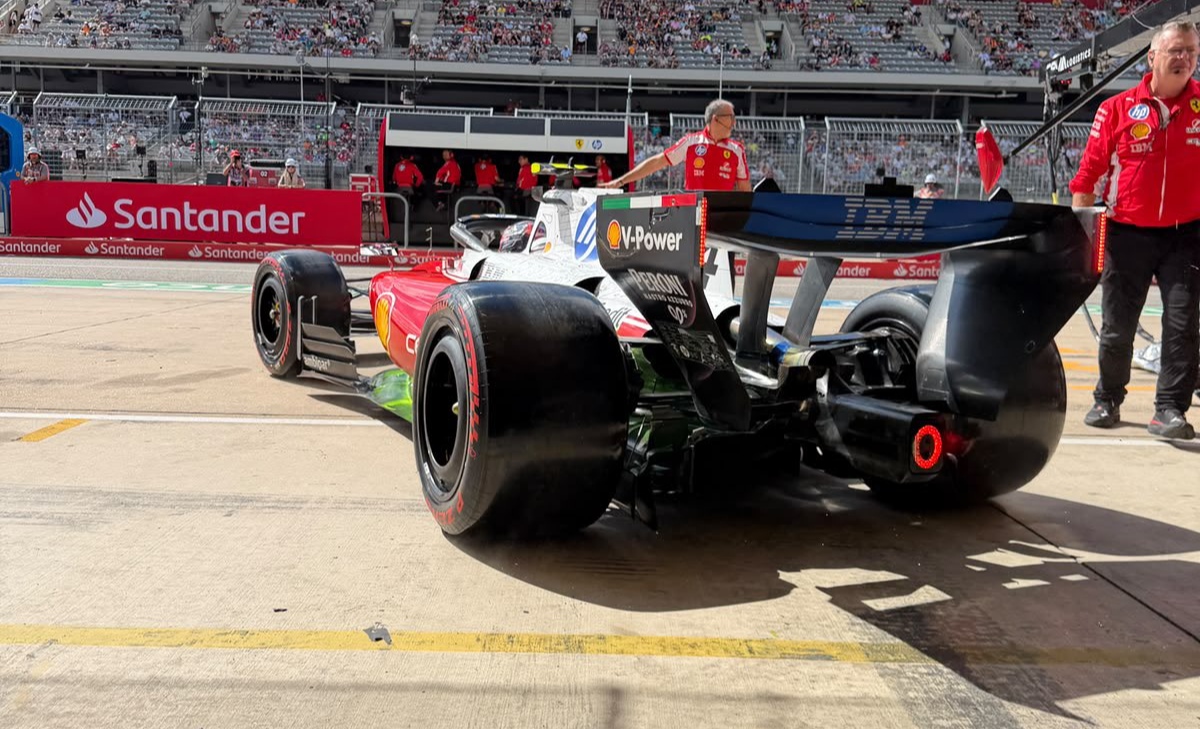
Scuderia Ferrari will arrive at the Autódromo Hermanos Rodríguez in Mexico City with plenty of doubts over its Power Unit, but also some confidence based on the positive results delivered by the upgrade package that made the SF-26 extremely solid at the recent United States Grand Prix.
The outright lap-time contribution of the changes introduced by the Maranello team was played down by everyone who discussed them before the Austin race, and that may well be true. However, it is worth remembering that Formula 1 cars are extremely complex systems, in which the balance and harmony between the various elements — the so-called “package” — often matter more than the absolute performance of an individual component.
The importance of “stability”, including in a car’s aerodynamics

Serra’s team revised the airflow management of the entire lower section of the car: the floor inlet profiles were reworked, along with the diffuser volume and the shapes of its associated internal fences.
The sidepod has been reshaped with additional volume and, as stated in the documents published by the Federation, the objective is clear: “to simultaneously increase the quality, energy and stability of the flows directed towards the rear of the car”.
When a single-seater first takes to the track, particularly one born under entirely new regulations such as the SF-26, the usual approach is to explore a general concept without excessively pushing or conditioning the airflow.
Every surface affects the airflow around it and, using a simple wing as an example, attempting to impose too much conditioning can lead to instability, preventing the intended target from being achieved.
With developments introduced after the car’s first on-track version, in addition to addressing any issues encountered in real-world running, aerodynamicists always seek to increase the influence of the surfaces on the airflow in order to extract more from the car’s overall concept. Very often, that means trying to generate more overall downforce.
Clearly, as the limits are pushed, instabilities can emerge, just as a wing can be driven into stall by excessively increasing its angle of attack without introducing further countermeasures.
Is it more advantageous to remain within a known aerodynamic map?

Ferrari has modified the SF-26 but, compared with McLaren and Mercedes, has remained faithful to the car’s original concept. It is as though it has chosen to move in a known direction, fully aware of where and how to push for a different conditioning of the airflow around the bodywork while keeping it stable and predictable.
It is no coincidence that the Prancing Horse’s updates correlated with expectations and were successful, unlike those of Mercedes and McLaren, with the latter no longer able to find its way back to competitiveness.
Mercedes pushed the airflow strongly downwards and towards the centre of the car with the latest version of the W17, but has struggled considerably to understand whether the step taken was genuinely forward and what the car’s new operating map might be.
McLaren has reshaped the entire sidepod, with the surfaces around the sidepod inlet now markedly different and more influential on the air flowing around them. It could be an extremely promising concept, but it undoubtedly places the MCL40 in unfamiliar aerodynamic territory that has yet to be understood.
Such a radical change is made during the season above all when it is considered likely to pay off not so much immediately, but in the future, once there has been time to study and mitigate its negative effects.
Ferrari, then, has achieved a system that is not necessarily capable of generating more downforce in absolute terms, but can generate it with greater stability.
Having done that, there is always scope to move further in a more extreme direction. Once, for example, the diffuser has adopted an efficient geometry and all the airflow feeding it is controlled and sufficiently energised to prevent it from stalling, its effect can be enhanced by pushing its geometry further in a continuous search for the limit.
However, negative effects cannot be ruled out. Leclerc himself spoke of an operating window that appears to have narrowed, especially in qualifying. Indeed, a temperature change of just a few degrees between Q2 and Q3 in Austin proved costly — perhaps costing Ferrari victory in the Grand Prix.
Setting aside all speculation, the encouraging signal delivered by the latest SF-26 upgrade must be acknowledged, as must the fact that every update introduced on the car has delivered during the season now approaching its conclusion. Ferrari will probably secure second place in the constructors’ standings, despite the substantial Power Unit deficit.
All the news, photos, weather, session times and times from the Mexican GP 2026