 By:
The AMR26 has shown signs of recovery only intermittently. At times it appears capable of fighting for strong positions in Q2, leading to a battle for the top 10 in the race; at others, however, it remains rooted to the back of the field, delivering performances similar to those seen at the start of the year.
The disastrous start put all the engineers under pressure: both those within Aston Martin and those working on Honda’s power unit project. The department led by Adrian Newey worked hard in the opening months to bring a substantial upgrade package to Hungary. Effectively, a B-spec car. The Japanese manufacturer lent further support at the following Grand Prix by introducing a new specification of its engine.
New car, new engine, new life... but only every other Grand Prix
From that point, Aston Martin’s season effectively began. Despite the upgrades, Lance Stroll has remained on zero points, while two-time world champion Fernando Alonso, after scoring just one point in the first part of the season by capitalising on others’ mistakes in Monaco, immediately scored two in the Netherlands before adding four more with an excellent seventh place in Kuala Lumpur (the Bahrain Grand Prix in Malaysia).

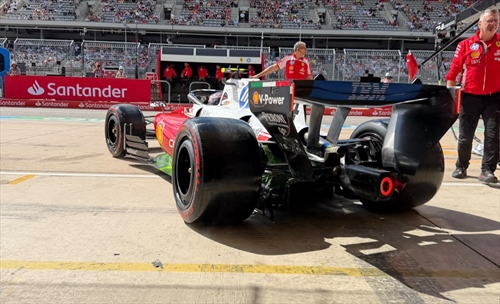
Stroll in the AMR-26 during the Miami Grand Prix (pre-upgrade car)
Those points were fully deserved: the first came at a slow circuit (Zandvoort), the others at a proper track in Malaysia, featuring high-speed corners, technical turns and long straights.
The theory
Why, then, has it been unable to deliver consistent performance and fight for points every weekend? The answer may lie in engine rotation. At several recent Grands Prix, both Alonso and Stroll have dropped back towards the rear of the field. The Spaniard finished as low as 16th in Singapore, immediately after that superb performance at Sepang. Could it all come down to engine rotation?

Aston Martin chairman Lawrence Stroll celebrates Honda’s 500 Grands Prix in F1 with Honda president and CEO Koji Watanabe (who will leave the role on 1 January 2027). The milestone was reached in Austin.
It is likely. The theory is that, in an effort to avoid changing too many units, Aston Martin may still sometimes have to use the first power unit specification produced by Honda, or be forced to run more conservative engine mappings in order to extend the life of its engines.
These are theories. Nothing is certain or confirmed, but they would partly explain the rollercoaster behaviour we are seeing. Unfortunately, it would also have a negative impact on the work of Aston Martin’s engineers, whose data collection at the Grands Prix in question would be distorted by the use of an old, problematic or otherwise underperforming PU.
If that is the case, it would only slow the entire development process, causing great disappointment and frustration throughout the team.
Photos: Aston Martin
All the news, photos, weather, session times and times from the Mexican GP 2026