 By:
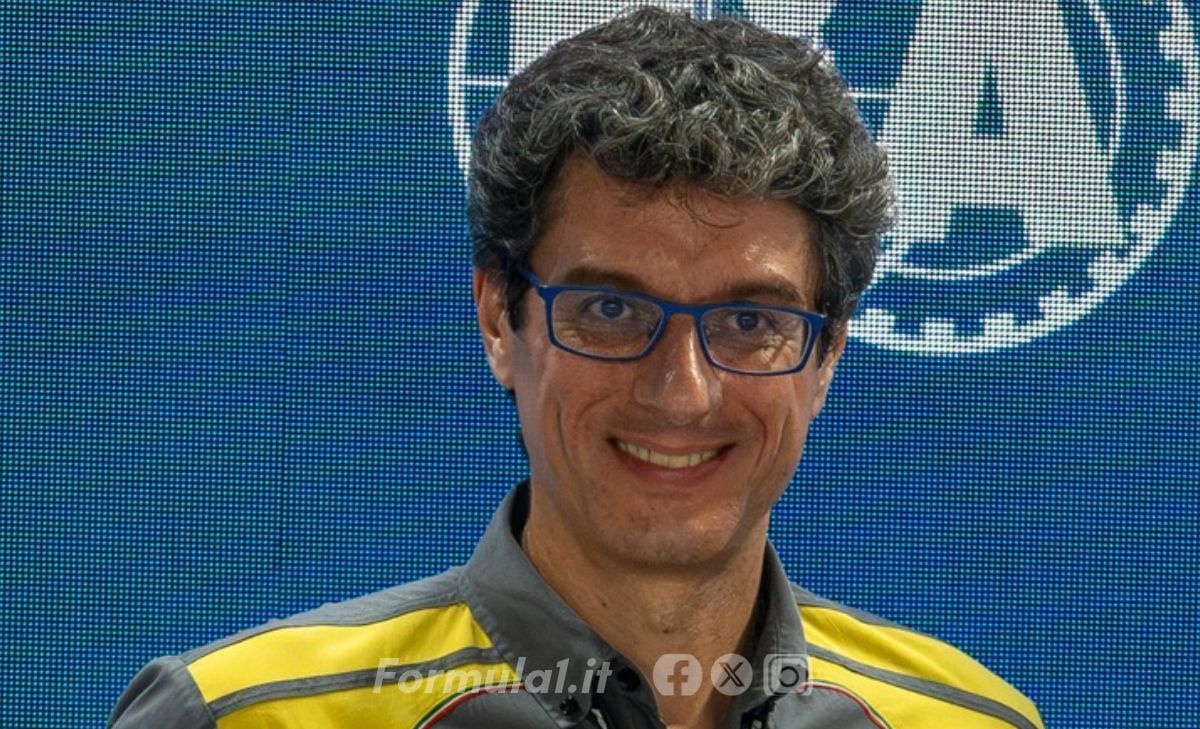
By: The Azerbaijan GP was a hugely important event for us at Formula1.it in many respects. Among them was the opportunity to spend time with Pirelli motorsport director Dario Marrafuschi, whom we asked to clarify the behaviour tyres have displayed over the course of this season.
During the 2026 Grands Prix, we noticed that not all teams are able to manage and use the compounds in the same way. Some teams are more comfortable on harder compounds, others on softer ones, and we essentially wanted to understand why. Dario Marrafuschi and Pirelli were not only willing to accommodate our request, but also answered our questions in great detail.
There are differences, indeed
Marco Sassara (Formula1.it journalist): “You often tell us that teams adopt different strategies depending on the characteristics of their cars. Do you have evidence that certain types of compound suit some teams better than others? If so, which ones? And above all, can these differences be explained?”
Dario Marrafuschi (Pirelli motorsport director): “We have found evidence of that, yes. There are compounds that work better for certain teams at some races. Objectively, it is potentially a very complicated subject, but we will try to simplify it. Let us start with the simplest aspect: the driver’s driving style. There are drivers who prefer a more oversteery car, so when they are driving at a rear-limited circuit, they are better able to manage the rear compounds and find themselves with a competitive advantage over their rivals. That is certainly a subjective factor. What happens from an engineering point of view? Every car has its own characteristics and the set-up that suits it best. One characteristic we can use as an example is the aerodynamic load it can generate. The higher the aerodynamic load, the better the lap time, the greater the forces involved and the higher the operating temperatures of the compounds. Each car, in terms of its aerodynamic set-up, may be able to get certain types of compound into their operating window more easily than others. To simplify, even if some teams may not agree with this statement, you might observe that the second half of the grid is more comfortable on the soft compounds, while the teams at the front are able to perform better on the harder specifications. This is an example, even if it is not entirely absolute. What we have said can become more complicated at certain types of track, but it depends on how much the layout itself limits power or grip; it may be that greater aerodynamic load allows a team to manage the soft compound better. If the car remains firmly planted to the ground and does not tend to slide, then the soft becomes a good compound to use. We are no longer talking about the working range, but have moved more towards wear and abrasion. So, let us say there are two main effects a team has to manage: on one hand the thermal effect, to be triggered through aerodynamics, and on the other abrasion and wear, also to be looked after through aerodynamic load. In some cases, having this sort of helping hand from the sky, represented by aerodynamics pressing the car into the ground, can help with using the softer compounds. Our tyre range offers different working ranges. And it is not true that the softer you go, the lower the working ranges become. That was the case some years ago, but now, precisely in order to promote different strategies and have tyres that can be used by all teams, we have a situation that is not entirely linear. The C5 has a slightly higher working range. To be competitive and manage the tyres well, you need to be able to generate the right temperature by relying on the car’s aerodynamics.”

Why teams are constantly pursuing aerodynamic load
Daniele Muscarella (Formula1.it director): “This is an interesting topic, because it introduces a counterintuitive concept, doesn’t it?”
Dario Marrafuschi (Pirelli motorsport director): “Exactly. In the past, interaction with the teams led us to design tyres of this type in order to better withstand high temperatures. Moving the working range too low would send the tyre out of range: it would suffer too much abrasion and leave its working window too quickly. It would become unusable; it would essentially be a qualifying tyre. This is what allows us to see extensive use of the softer compounds during race phases. Graining is a phenomenon closely linked to the force the tread has to exert on the asphalt to keep the car on track. In particular, the lateral bands of the tyre are especially stressed during cornering. There are also cases of longitudinal graining, but that is rarer. Here too, the higher the fuel load, the greater the mass, and the greater the risk of graining. But if you have, returning to the metaphor, this hand from above that tends to press you into the ground, graining is reduced. Generally, you slide when there is little grip: the compound cannot penetrate the asphalt. This can happen when the asphalt is dirty, when there is dust…”
Marco Sassara (Formula1.it journalist): “The temperatures are low…”
Dario Marrafuschi (Pirelli motorsport director): “Yes, they are all consequences of the same effect. Take the case of dust: when we have an unstable layer between the asphalt and the tyre, the tyre slides over it. By sliding over it, the graining phenomenon is triggered. Cold has a similar effect: a cold track lowers tyre temperatures, the rubber becomes harder, like chewing gum, it does not penetrate the asphalt properly, it slides and grains. How do you combat it? By increasing aerodynamic load and reducing the weight of the car.”

Marco Sassara (Formula1.it journalist): “So, in light of what you have just told us, with the increase that will come with development towards 2027 and with cars that have greater aerodynamic load, should there be smaller differences between teams in terms of tyre use and management?”
Dario Marrafuschi (Pirelli motorsport director): “If everyone had the same aerodynamic load, that would be the case, but we know that in reality, even setting aside drivers’ driving styles, that is not so… Even though the regulations define maximum limits, development then leads teams down different paths and aerodynamic load can also vary considerably from one team to another. That is precisely what leads teams to favour one tyre over another.”
We would like to thank Dario Marrafuschi (Pirelli motorsport director) for his courtesy and availability during the interview, as well as the Pirelli staff for their support in making it possible. Partial reproduction of this exclusive interview is permitted provided the author (Marco Sassara) and Formula1.it are credited, with a link to the original content.
Cover photo by Peter Kiss / WHYOUT Images
Internal photos: Pirelli