 By:
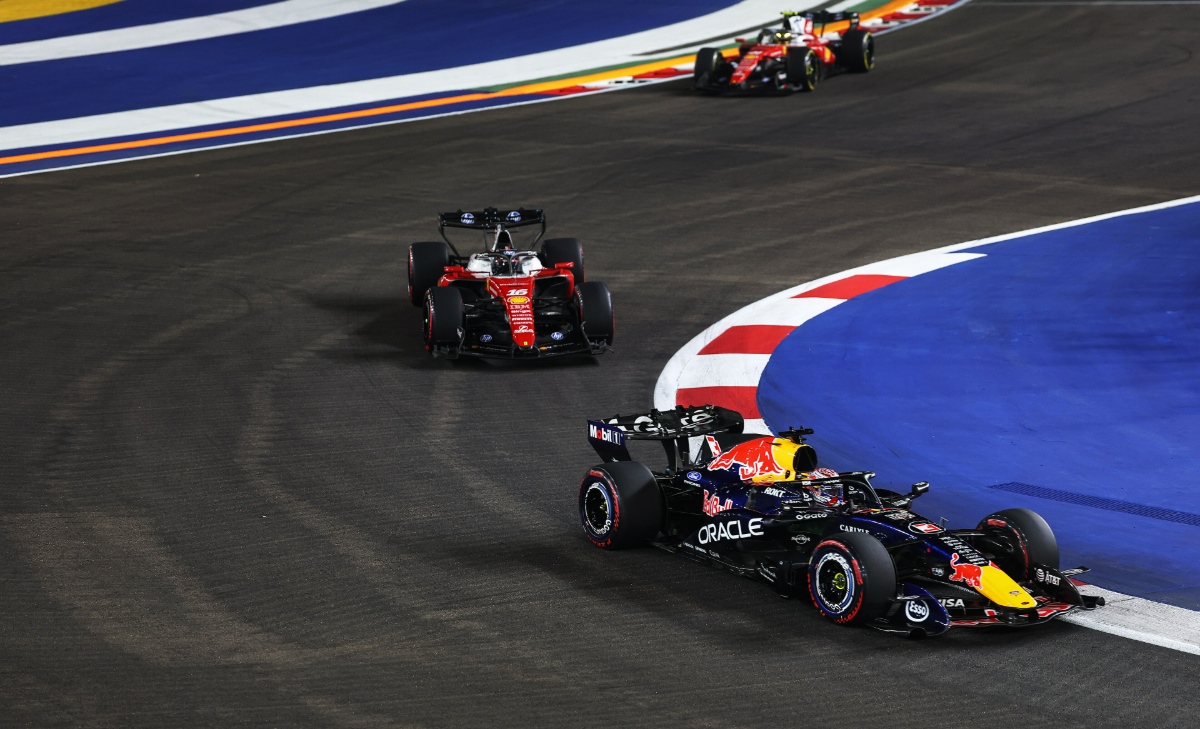
By: The last three Grands Prix of the Formula 1 World Championship have been marked by the emphatic return of Red Bull and its leading light Max Verstappen, who took an excellent second place in Baku before claiming two magnificent pole positions and two victories in Malaysia and Singapore, the latter dominated in both the Sprint and the main race.
Across those events, what made the RB22 not only competitive again but even the leading force was above all a major step forward in the use of the electrical side of the Red Bull power unit. In the first part of the season, it had been regarded as the strongest in terms of the internal-combustion engine, but appeared much further behind Mercedes and Ferrari in overall management.
Is downforce no longer needed to win?

Clearly, we cannot believe the power unit alone transformed the Milton Keynes car; the profound metamorphosis of the machine, particularly in the aerodynamics of the sidepods, has made it far more predictable and, for once, usable by both drivers.
The power unit, however, is the focal point of this season. Ferrari’s SF-26 proves it: from a chassis and aerodynamic perspective, it has nothing to envy the other front-running cars, yet it was unable to win in Singapore because the advantage built up in the corners was wiped out by the RB22 under acceleration and in top speed.
Verstappen’s driving style itself has changed: the Dutchman comes off the throttle metres earlier, does not use any partial throttle, lets the car roll through the corner without seeking the limit, and is happy to lose even valuable tenths in order to charge the battery to the maximum so he can accelerate explosively and recover what he has lost with interest.
For a driver of the calibre of the four-time world champion, it may seem almost sacrilegious, but it is effective, and Verstappen, like all great champions, has adapted to it in order to return to winning ways.
Looking at the telemetry from the last two races, one observation could be that 2026 cars do not need downforce in the corners.
The relatively slow speeds at which corners are taken in order to recharge the battery suggest that, counterintuitive though it may be compared with what we have known until now, there is no need to push the search for downforce to extremes, as it would serve no purpose.
Conversely, a car capable of generating plenty of downforce also brings with it a degree of drag that becomes an unwelcome burden on the straights.
Compared with the past, the focus has shifted to traction, which must be capable of putting all the immense torque delivered by the electric motor onto the track without, at the same time, overwhelming the rear tyres.
Returning to the Ferrari example, it is a very successful car, but only when compared with the past of this sport.
Until 2030, unless something changes, the chassis qualities of the Maranello car may count for nothing.
Confirmation came at the start of the season, when an informed source told us not to expect the 2026 car to be competitive because of its lack of overall downforce.
In reality, from the very first races, that same car was among the revelations of the grid and was therefore probably judged according to parameters that hold a different value under this regulatory framework than they did in the past.
Will the current philosophy also be rewarded in 2027?
As we know, at the time of writing, all teams are working on finalising their 2027 cars and, if this reasoning is correct, they may consider focusing on this development path, but that is far from certain.
The 2027 season will feature a different split between electric and combustion power, in favour of the latter, in an effort to avoid the paradoxical situations seen in the opening races, when drivers slowed noticeably in qualifying to charge the battery.
To achieve this, the Federation has, as is known, allowed an increase in fuel energy flow of around 5%, which naturally has the side effect of increasing consumption.
We also know that races will become shorter to allow some teams, including front-runners, to avoid rebuilding their chassis to accommodate larger fuel tanks.
All these changes could, however, reduce the importance of the electrical element enough to place the chassis qualities needed to increase cornering speed back at the centre of development.
In this writer’s view, the 5% increase in fuel energy flow will not be decisive, especially in combination with the new floor regulations that will limit the overall ability to generate downforce.
The real change could instead come with the 13% increase over the current situation planned for 2028.
The teams’ dilemma remains, in any case: continue development along the lines that are paying off today, or once again place at the centre of development the car characteristics that have historically made it fast?
Cover photo www.redbullcontentpool.com
Internal photo X: Oracle Red Bull Racing
All the news, photos, weather, session times and times from the United States GP 2026