 By:
By: The Singapore Grand Prix, the 17th round of the 2026 season, marks the start of the final phase of the championship, with power-unit management becoming increasingly delicate. Many drivers have now exhausted their seasonal allocation of components, and the replacements made during the Marina Bay weekend have brought a particularly significant development for Mercedes.
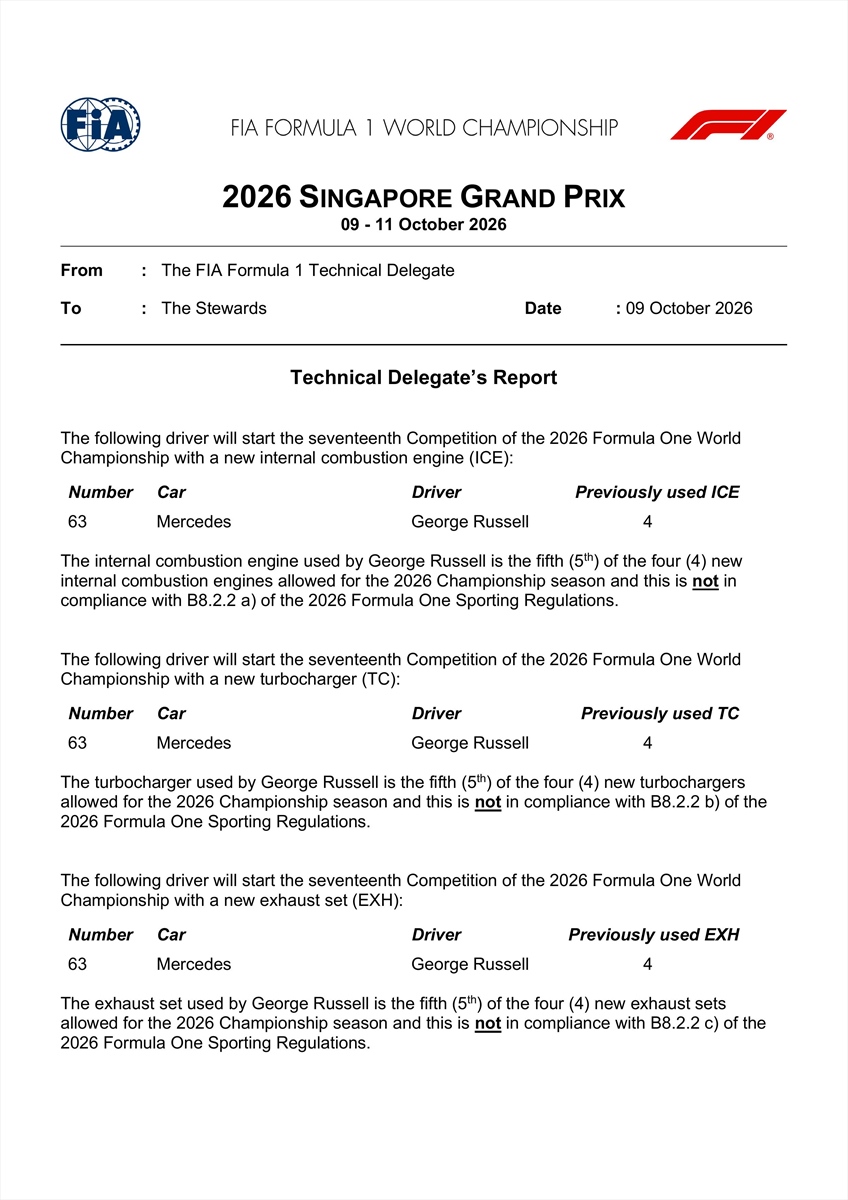
Having spent much of the season without exceeding the regulatory limits, George Russell has changed six power-unit components, taking a new internal combustion engine, turbocharger, exhaust system, MGU-K, Energy Store and control electronics. All are beyond his seasonal allocation, taking the number of drivers who have already exceeded at least one of the limits set out in the regulations to 11.
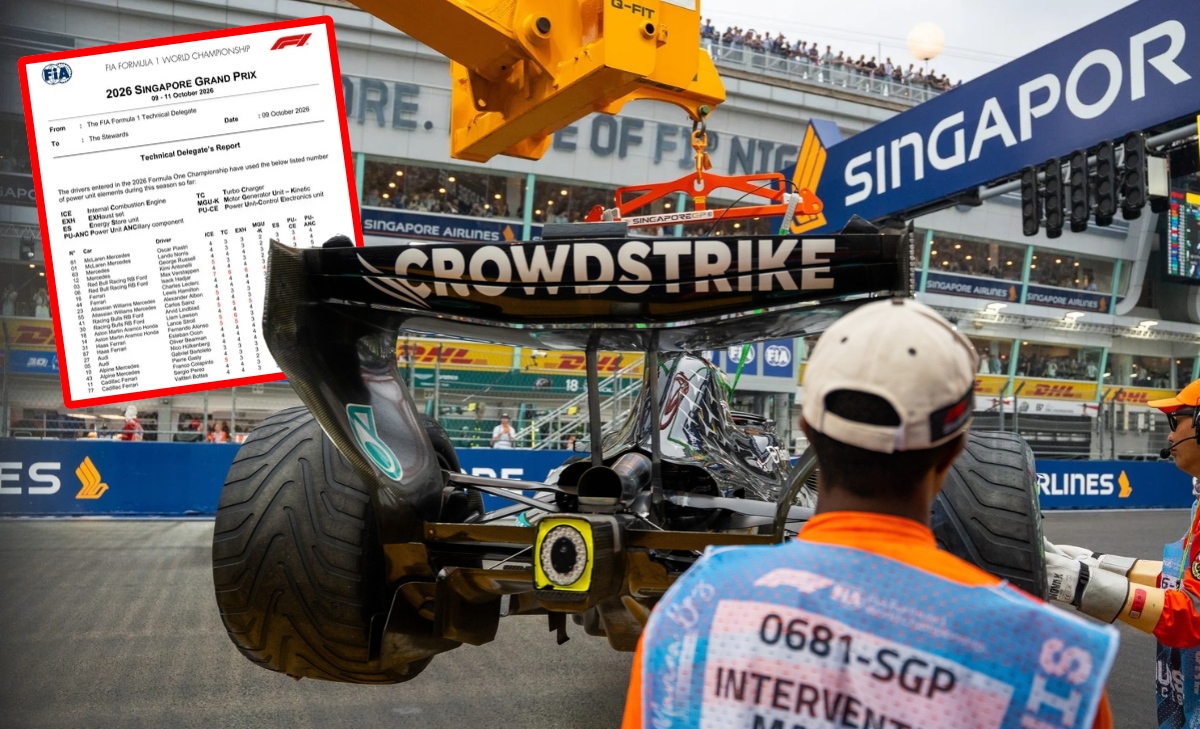
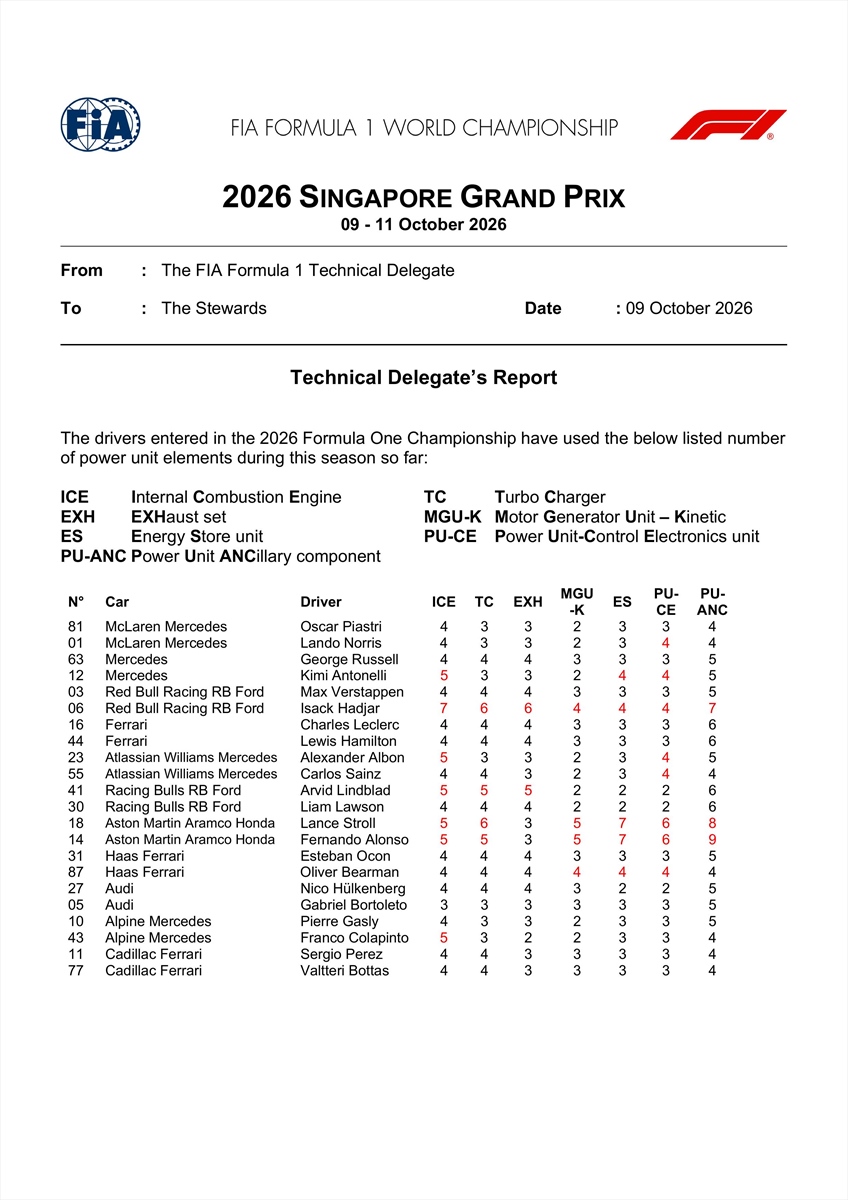
The 2026 regulations allow four ICEs, four turbos, four EXHs, three MGU-Ks, three Energy Stores, three PU-CEs and six PU-ANCs. To update the situation, we progressively considered all FIA documents published between 9 and 10 October, distinguishing between newly introduced components and those previously used and simply refitted to the cars.
F1 2026 power units: the updated situation in Singapore
Table updated using FIA Technical Delegate's Reports Nos. 10, 19, 38 and 57, published during the Singapore GP up to 10 October 2026.
| No. | Team | Driver | ICE | TC | EXH | MGU-K | ES | PU-CE | PU-ANC |
|---|---|---|---|---|---|---|---|---|---|
| 81 | McLaren Mercedes | Oscar Piastri | 4 | 3 | 3 | 2 | 3 | 3 | 4 |
| 01 | McLaren Mercedes | Lando Norris | 4 | 3 | 3 | 2 | 3 | 4 | 5 |
| 63 | Mercedes | George Russell | 5 | 5 | 5 | 4 | 4 | 4 | 5 |
| 12 | Mercedes | Kimi Antonelli | 5 | 3 | 3 | 2 | 4 | 4 | 5 |
| 03 | Red Bull Racing RB Ford | Max Verstappen | 4 | 4 | 4 | 3 | 3 | 3 | 5 |
| 06 | Red Bull Racing RB Ford | Isack Hadjar | 7 | 6 | 6 | 4 | 4 | 4 | 7 |
| 16 | Ferrari | Charles Leclerc | 4 | 4 | 4 | 3 | 3 | 3 | 6 |
| 44 | Ferrari | Lewis Hamilton | 4 | 4 | 4 | 3 | 3 | 3 | 6 |
| 23 | Atlassian Williams Mercedes | Alexander Albon | 5 | 3 | 3 | 2 | 3 | 4 | 5 |
| 55 | Atlassian Williams Mercedes | Carlos Sainz | 4 | 4 | 3 | 2 | 3 | 4 | 4 |
| 41 | Racing Bulls RB Ford | Arvid Lindblad | 5 | 5 | 5 | 2 | 2 | 2 | 6 |
| 30 | Racing Bulls RB Ford | Liam Lawson | 4 | 4 | 4 | 2 | 2 | 2 | 6 |
| 18 | Aston Martin Aramco Honda | Lance Stroll | 5 | 6 | 3 | 5 | 7 | 6 | 8 |
| 14 | Aston Martin Aramco Honda | Fernando Alonso | 5 | 5 | 3 | 5 | 7 | 6 | 9 |
| 31 | Haas Ferrari | Esteban Ocon | 4 | 4 | 4 | 3 | 3 | 3 | 5 |
| 87 | Haas Ferrari | Oliver Bearman | 4 | 4 | 4 | 4 | 4 | 4 | 4 |
| 27 | Audi | Nico Hülkenberg | 4 | 4 | 4 | 3 | 2 | 2 | 5 |
| 05 | Audi | Gabriel Bortoleto | 3 | 3 | 3 | 3 | 3 | 3 | 5 |
| 10 | Alpine Mercedes | Pierre Gasly | 4 | 3 | 3 | 2 | 3 | 3 | 5 |
| 43 | Alpine Mercedes | Franco Colapinto | 5 | 3 | 2 | 2 | 3 | 3 | 5 |
| 11 | Cadillac Ferrari | Sergio Perez | 4 | 4 | 3 | 3 | 3 | 3 | 4 |
| 77 | Cadillac Ferrari | Valtteri Bottas | 4 | 4 | 3 | 3 | 3 | 3 | 4 |
Orange = final component available before a penalty | Red = regulatory limit already exceeded at this or other Grands Prix. The presence of a red value does not necessarily mean a new penalty in Singapore.

Mercedes: Russell changes almost his entire power unit
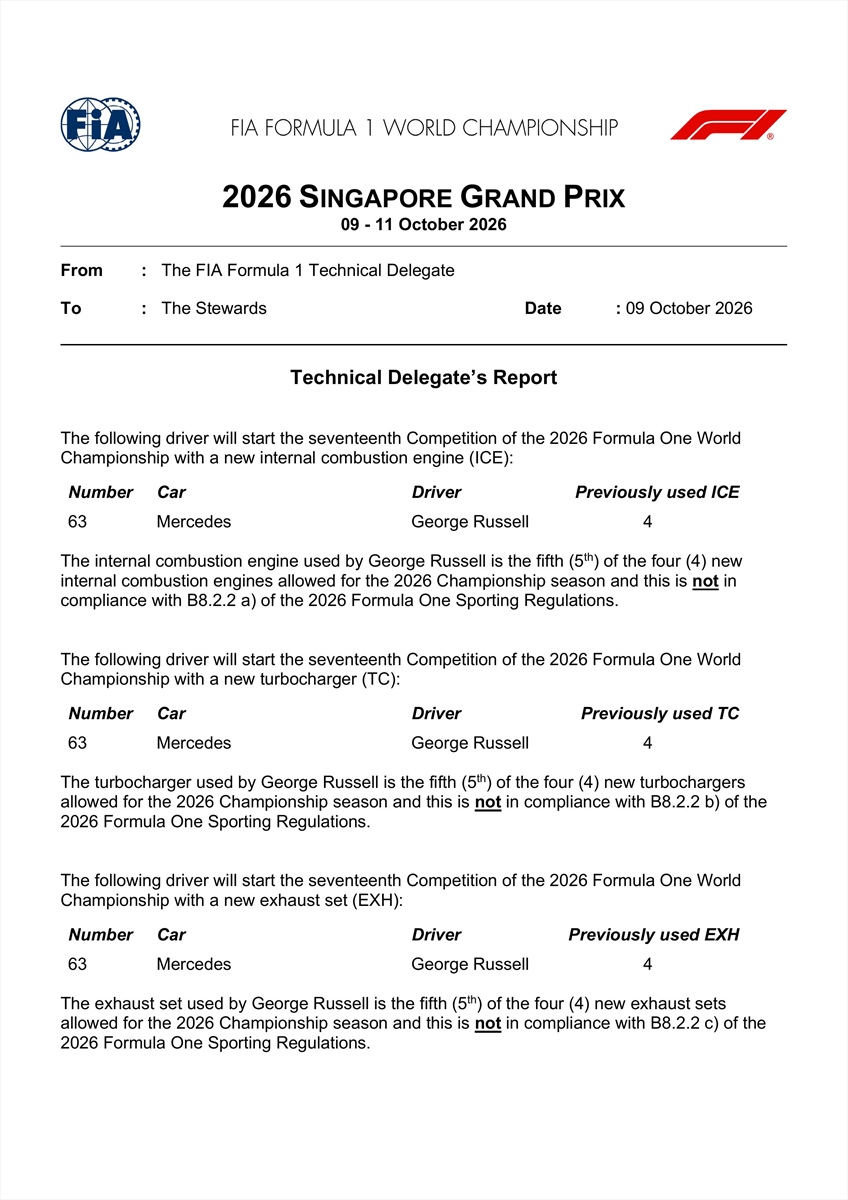
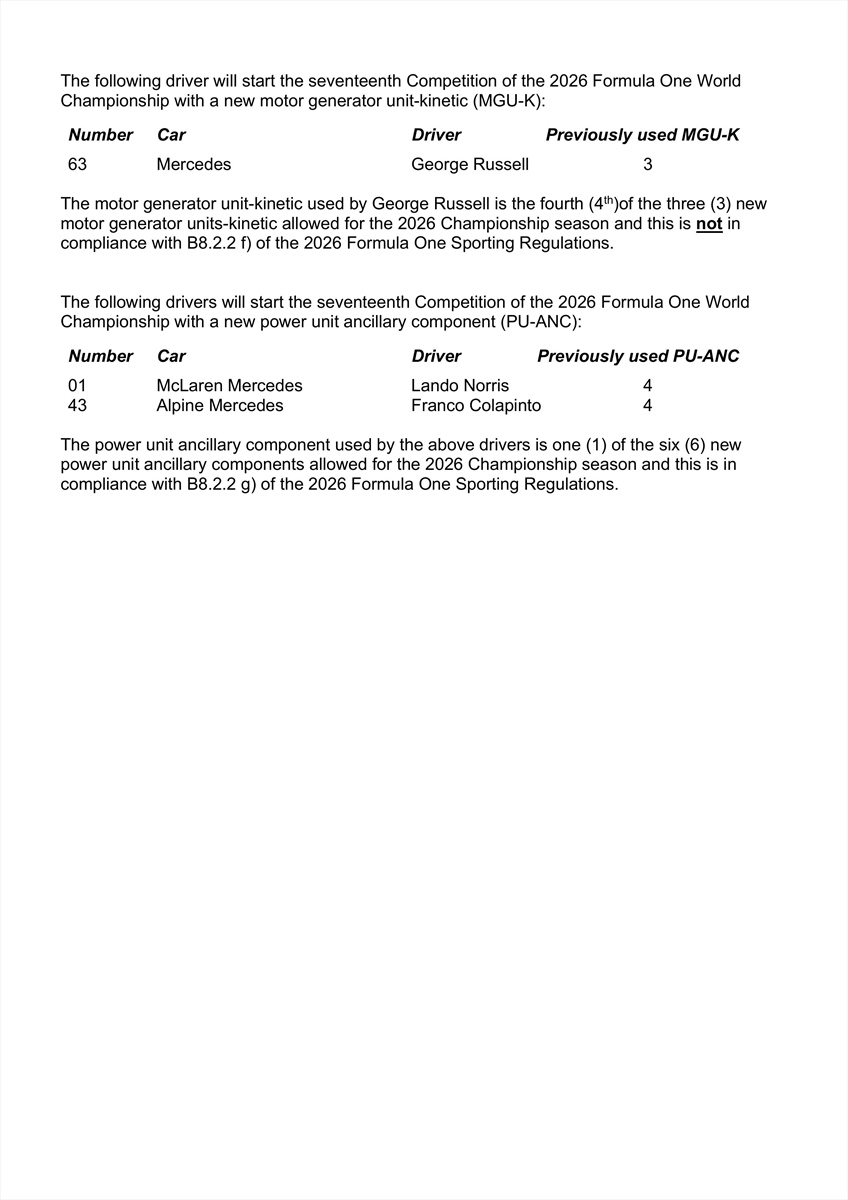
The weekend's most significant development concerns George Russell. On Friday 9 October, in FIA document No. 19, the Technical Delegate announced the introduction of a fifth ICE, fifth turbo, fifth exhaust system and fourth MGU-K. Those four components exceed their respective seasonal limits for the first time and represent a rather radical choice by Mercedes.
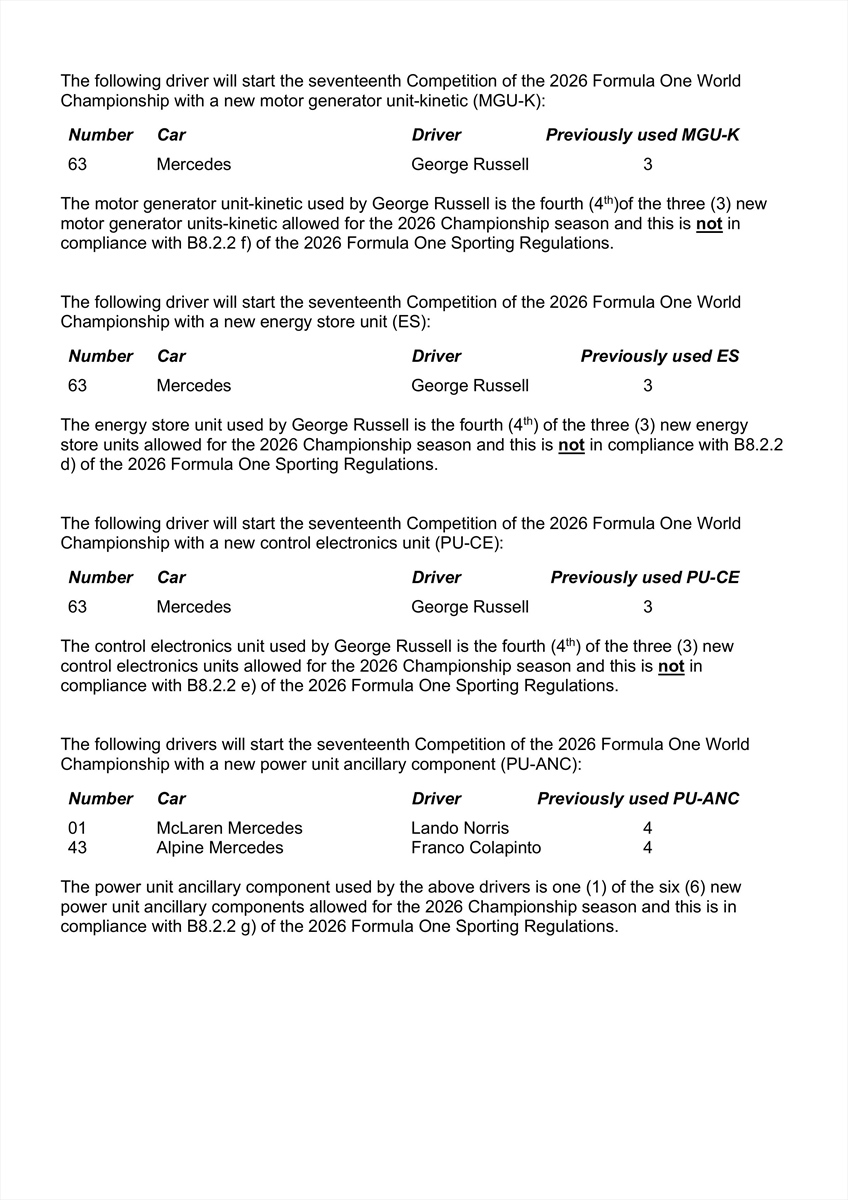
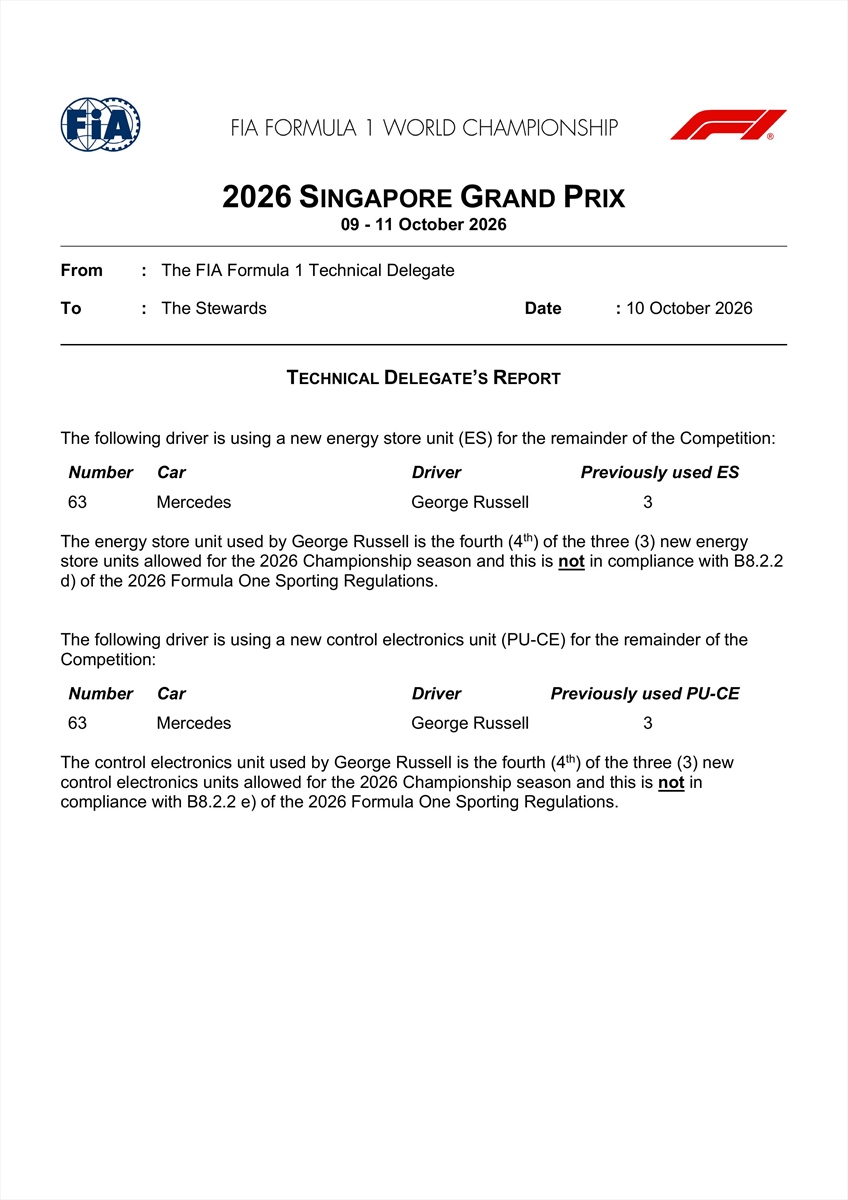
But the Brackley team did not stop there. In the subsequent Report No. 57, published on Saturday 10 October, the FIA also confirmed the introduction of a fourth Energy Store and fourth PU-CE. Russell therefore moves to five ICEs, five turbos, five EXHs, four MGU-Ks, four ESs and four PU-CEs, retaining headroom only on auxiliary components.
This is particularly significant given that Russell had managed to remain within all his seasonal allocations, effectively serving as a reliability test for Mercedes. That test, however, ended with his retirement in Malaysia, caused by power-unit problems. Kimi Antonelli's situation, meanwhile, remains unchanged: the Italian driver already took a penalty at Monza after using five ICEs, four Energy Stores and four PU-CEs, while still retaining headroom on turbos, exhaust systems and MGU-Ks.
Ferrari and Red Bull: no new components beyond the limit
Ferrari's position remains broadly unchanged from Sepang. Leclerc and Hamilton have used four ICEs, four turbos, four exhaust systems, three MGU-Ks, three Energy Stores, three PU-CEs and six PU-ANCs. Both are therefore exactly at the limit in every category, but have not yet exceeded any of them.
The picture is similar for Max Verstappen, who has reached the maximum allocation for ICE, turbo, EXH, MGU-K, ES and PU-CE, retaining only one PU-ANC. Once again, no value in the table is red: the Dutchman has not yet used components beyond the regulatory limit.
The situation is very different for team-mate Isack Hadjar, who has already reached seven ICEs, six turbos, six EXHs, four MGU-Ks, four Energy Stores, four PU-CEs and seven PU-ANCs. During the parc ferme period before the Sprint, Red Bull also replaced the internal combustion engine and turbocharger on his car, along with other fuel-system elements. One clarification is important here: FIA document No. 38 expressly specifies that the ICE and turbo had already been used previously. These were therefore not additional seasonal components, and the values shown in the table remain unchanged.
McLaren, Alpine and Aston Martin: the other situations
The document of 9 October also records the introduction of a new PU-ANC for Lando Norris and Franco Colapinto. Both move from a fourth to a fifth unit, remaining within the regulatory limit of six elements. These replacements bring no new penalties, although Norris remains over the limit with his fourth PU-CE and Colapinto with the fifth ICE introduced at the previous Grand Prix.
Oscar Piastri, meanwhile, retains a relatively less compromised situation than his team-mate. The Australian has reached the limit for ICE, Energy Store and PU-CE, but still has headroom in the other categories.
The highest overall figures continue to concern Aston Martin. Lance Stroll has reached seven Energy Stores and eight PU-ANCs, while Fernando Alonso has already used nine PU-ANCs, seven Energy Stores and six PU-CEs. Both have exceeded the limit in almost every category, but the documents reviewed do not list any new seasonal components introduced in Singapore.
Among the other drivers already over the limit are Albon, Sainz, Lindblad and Bearman. Lindblad's position is particularly noteworthy: following the replacements made in Malaysia, he has reached five ICEs, five turbos and five EXHs. Lawson, by contrast, has reached the limit with four units of each of these components but has not yet exceeded it.
Penalties at the Singapore GP
The main case inevitably concerns George Russell. The replacements reported by the FIA take the Mercedes driver over the limit for the first time in six categories: ICE, TC, EXH, MGU-K, Energy Store and PU-CE.
Applying the standard criterion of 10 positions for the first additional component in each category, the theoretical total reaches 60 places in grid penalties. This is, naturally, a purely regulatory figure: a penalty of this scale vastly exceeds the threshold for starting from the back of the grid.
For Norris and Colapinto, however, the introduction of a fifth PU-ANC remains fully within the regulations. Nor do the replacements made on Hadjar's Red Bull result in a new penalty, as the refitted internal combustion engine and turbo were components already used previously and the work was authorised by the FIA.
The penalty picture for the Grand Prix therefore remains subject to any further official decisions by the Stewards, which will be incorporated alongside subsequent updates on components used.
Article updated on 10.10.2026 at 20:51
All the news, photos, weather, session times and times from the Singapore GP 2026