 By:
By: In this now familiar in-depth feature, we first analyse the Grand Prix from every major technical angle, aerodynamics, energy, brakes and power unit, without overlooking mechanical management and the circuit’s particular characteristics. Our pit walk and the first images from the pit lane then allow us to take a closer look at the setup choices made by the various teams and understand the compromises adopted to tackle the unique demands of a street circuit such as Baku.
From a technical perspective, the Baku circuit demands one of the most extreme compromises of the season. The first sector is dominated by straights and heavy braking zones for the many 90-degree corners, while the middle sector becomes much slower and more technical, with the very narrow Castle section requiring precision, agility and, above all, low-speed traction. Everything changes again from Turn 16: the final corners are taken virtually flat out and lead into a section of more than two kilometres at full throttle, where speeds in excess of 350 km/h have been reached in the past. That benchmark will need to be assessed this year in light of the characteristics of the 2026 cars and, above all, the new energy management.
Electrical deployment is one of the most interesting aspects to watch. According to some simulations, in qualifying the cars could approach the final part of the lap with the battery almost fully charged, before using much of the available energy along the section leading to Turn 1. From this perspective, Baku represents a particularly demanding test, though perhaps slightly less so than Monza.
To reach the final straight with the greatest possible amount of energy, teams could choose to forgo electrical assistance during certain brief phases of the lap and save energy for an area that is far more rewarding in terms of lap time.
On the aerodynamic front, the 2026 cars can rely on active aerodynamics, which changes the angle of the front and rear wings according to the phase of the lap. On the straights, the wings are unloaded to reduce drag and increase top speed, while in the corners they return to producing more downforce. Baku remains an extreme circuit, however. Straight Mode broadens the window available to the engineers, but it does not eliminate the challenge of finding an effective setup in such varied conditions.
The circuit’s characteristics could also suit the new cars better than might be expected. Many corners are slow, often 90-degree turns, and therefore less dependent on aerodynamic downforce than high-speed sweepers, with significant energy recovery under braking. The 2026 cars could therefore suffer a relatively limited performance deficit in Baku compared with the previous generation. Early simulations place their lap potential around one to two seconds off the 2025 benchmarks, although the track will naturally provide the first real indication.
Mechanical management of the car also remains central. The rear end is continually stressed by acceleration out of slow corners, where the ability to put torque down can make a significant difference, while the braking system must withstand numerous high-energy decelerations.
Ferrari in Baku
The first images from the pit lane reveal an interesting choice from Ferrari. The SF-26 appears set to use the single-piece floor panel in Baku too, a solution already reintroduced at Monza. This configuration is designed to contain aerodynamic drag and is therefore particularly suited to the characteristics of the Azerbaijani circuit, where efficiency and speed on the extremely long straight are two decisive factors.

In Baku, Ferrari appears set to use the standard version of the FTM (the small wing ahead of the exhaust), without the particular modifications seen at Monza, in search of downforce where it carries a lower drag penalty.
 Ferrari FTM detail in Baku - Photo by @MateuszMrz8
McLaren in Baku
McLaren arrives in Baku with a major aerodynamic package, continuing the development work already pursued through the upgrades introduced at the Hungarian and Dutch Grands Prix.
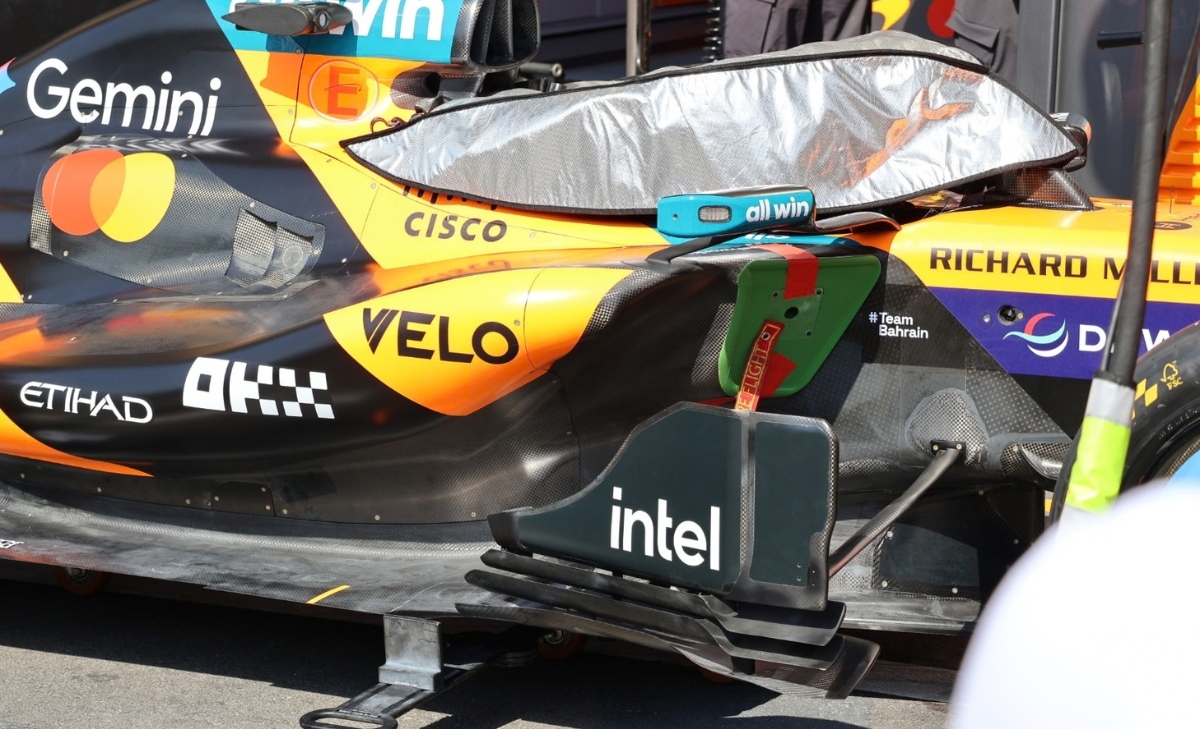
The most obvious new feature concerns the sidepod inlets, which are now noticeably narrower. The work is not limited to the inlet, however: the subsequent shape of the MCL40’s sidepods has also been redesigned, changing the way airflow is directed towards the rear of the car.


Detail of McLaren’s new sidepods in Baku - Photo by @carpentiers_f1
The work also extends to the floor. The images show a new geometry for the floor edge and a slight revision to the cut-outs ahead of the rear wheels, an area that is particularly important for managing turbulence generated by the tyres.


Detail of McLaren’s floor edge and rear sidepod section in Baku - Photo by @carpentiers_f1
A possible change to the diffuser’s vertical elements also remains to be confirmed, and will be assessed more clearly with more detailed images. Several free-practice sensors have meanwhile appeared on the MCL40, used by the team to gather data and verify the behaviour of the new package on track.

Detail of McLaren diffuser vertical elements in Baku - Photo by @carpentiers_f1
Williams in Baku
Williams brings an important package to Baku, although it mainly concerns weight reduction in non-visible areas of the monocoque, achieved using new moulding technologies. The visible bodywork changes are limited: the fences at the channel inlets on the floor have been revised, while the cut-outs in the area ahead of the rear wheels have been reshaped.


Details of Williams floor fences and floor edge - Photo by @carpentiers_f1
Racing Bulls in Baku
There is also something new on the Racing Bulls front wing. This year, active aerodynamics reduces the traditional compromise between the downforce required in the slower section and speed on the extremely long straight: teams can adopt greater wing incidence for the twistier sections, knowing that in Straight Line Mode the front wing also opens, reducing aerodynamic drag on the straights.

Racing Bulls front wing comparison - Photo by @MateuszMrz8
Article being updated...
Azerbaijan GP 2026: complete guide
This is the fourth of the six in-depth features we regularly publish on formula1.it in the build-up to every race weekend: alongside the first images from the pit lane and setup choices, they cover Pirelli’s research and information on tyres and strategies, analysis of brakes and energy management, the event’s TV and streaming schedule, official updates, and a table of the power unit components used.
All the news, photos, weather, session times and times from the Azerbaijan GP 2026