 By:
By: On Friday, January 16, Red Bull and Racing Bulls decided to host a shared event where we attended the unveiling of the livery of the two Formula 1 teams. The teams are united by intense collaboration. In fact, since 2014, the year in which the era of engines began, they have shared the same engine, with a profitable exchange (especially for the parent company) of technical solutions and drivers.
VCARB (this has been its current name since 2024 after being called AlphaTauri and Toro Rosso in the past) has long been seen as Milton Keynes' B team and will address regulatory change in 2026, installing the engine born from the ingenuity and interaction between the men involved in the Red Bull Powertrains department together with the Ford collaboration.
It should be noted that on January 16th we witnessed the presentation of two show cars, with standard solutions, at least in terms of overall aerodynamics (front wings, rear wings, barge, bottom, hood, etc.). However, there are technical solutions that have caught our attention and that should not change between now and the beginning of the year (unless problems are encountered during the testing phase).
One power unit, two different cooling systems
The new engine, in terms of hardware and internal layout, should be the same between the two cars, unless there are ‘’small’’ variations, and one of these appears to be the cooling system.
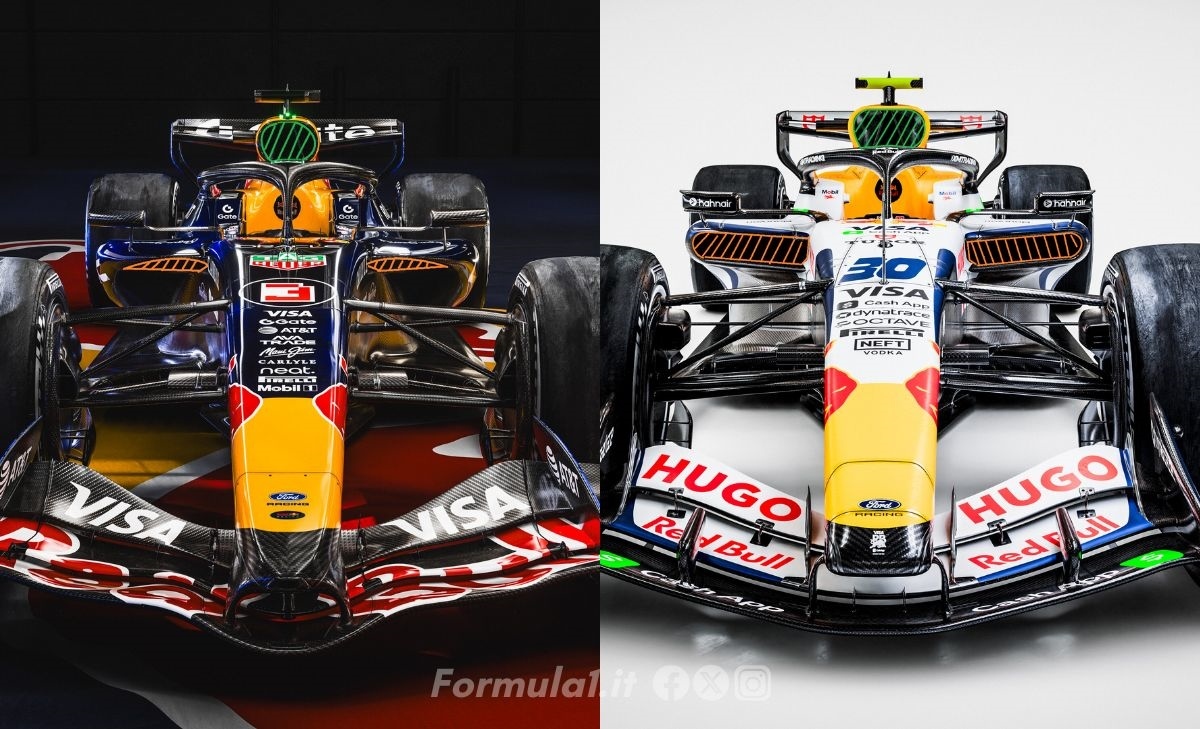
No measurements need to be taken. The eye is impressive. Even though the engine is the same, either Red Bull decided to be very extreme, or VCARB chose to be much more conservative. The upper part, placed above the pilot's head (airscope) of the VCARB-03, is already much larger in itself than was thought on the RB22. The air drawn in from above should go to ‘’feed’’ and cool the ICE internal combustion engine, while the air from the bellies will pass through the radiators and then go to the batteries (assuming the arrangement is more or less similar to last year's).

The substantial difference in cooling of the two power units lies in the surface where air enters the bellies. The VCARB-03 uses large mouths, while the RB22 has openings more similar to wound openings.
Hard to say who will be right about both. Having smaller openings certainly offers significant aerodynamic advantages, but incoming air will play an important role in managing temperatures in the new unit designed by Red Bull Ford Powertains.
Red Bull was certainly very extreme compared to VCARB, but we will have to wait for feedback from all the other teams before we can add anything else.
Cover and internal photo: Red Bull Racing
Read also in italian language: Red Bull molto estrema, VCARB più conservativa. Stessa power unit, diverse soluzioni

