 By:
The Mexican Grand Prix presents a unique test for the new 2026 cars. The Autódromo Hermanos Rodríguez sits at 2,238 metres above sea level, where lower air density affects power-unit operation, cooling and aerodynamic efficiency. This year, the unknowns are even greater because of the new regulations.
Turbochargers: everything changes without the MGU-H
As we wrote in our analysis, the thin air forces turbochargers to run at higher speeds to maintain boost pressure. With the disappearance of the MGU-H, which allowed the turbo to be electrically accelerated, turbine size becomes crucial again: a smaller solution improves response under acceleration, while a larger one can offer advantages in peak power.

Ferrari began the season with the smallest turbocharger and Audi with the largest, but both manufacturers subsequently homologated new components. Their current specifications are not known. The start will also be particularly delicate, when reaching the required boost pressure could take longer.
Cooling and aerodynamics: Mexico's compromises
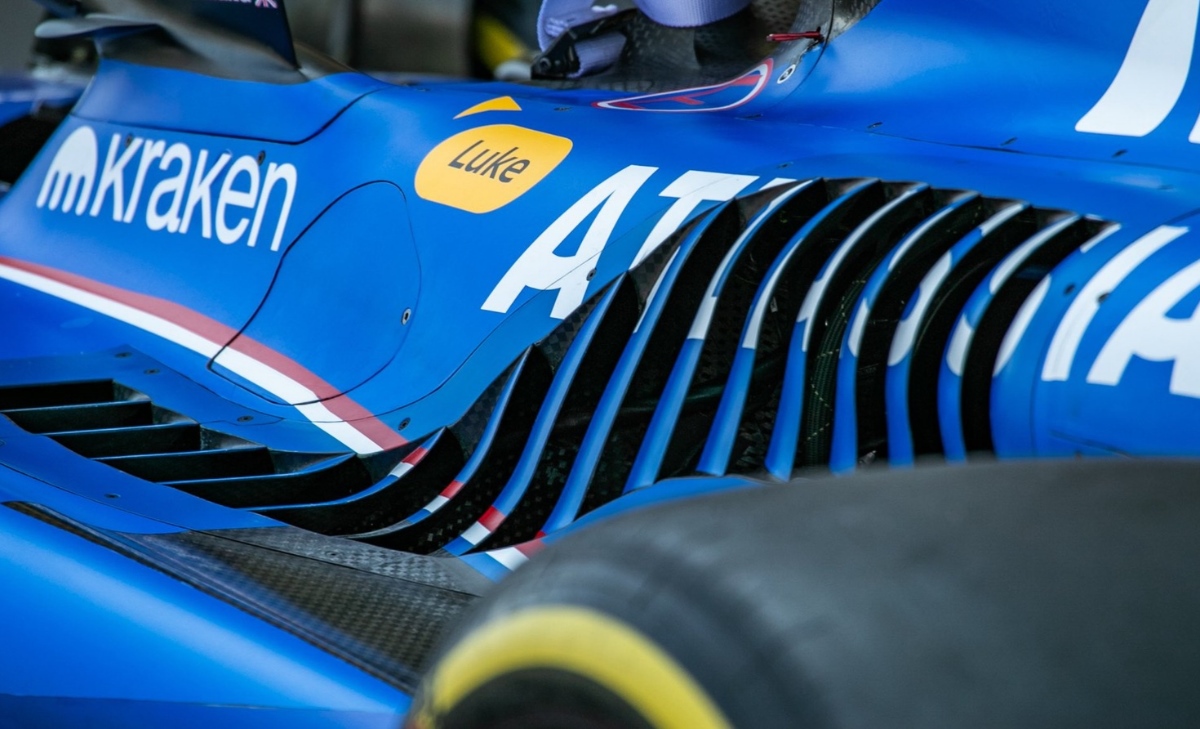
 Detail of the openings on the Williams engine cover - Photo by @xaviAeroporn
The lower air density also reduces the ability to cool radiators and brakes, forcing teams to enlarge openings in the bodywork, with inevitable aerodynamic penalties. In this context, despite some concerns, Ferrari could benefit from a power unit designed to tolerate relatively high intake-air temperatures, although much will depend on the actual cooling requirements.
Ferrari in Mexico: extreme cooling and aerodynamic developments
Altitude also causes a downforce loss of close to 20%. Teams therefore use maximum-downforce wings, similar to those used in Monaco, while still reaching speeds above 350km/h thanks to reduced air resistance. In this scenario, the SF-26 could exploit its ability to generate downforce, further improved by the updates introduced in Austin. However, the Ferrari power-unit deficit remains, especially in terms of peak power and hybrid efficiency. Mexico could reduce its impact, but turbocharger response under acceleration from slow corners remains a major unknown.
 The large vents on the SF-26 - Photo by Finlay Williams / WHYOUT images
Ferrari has arrived in Mexico City with one of the most aggressive cooling configurations yet seen on the SF-26. The upper bodywork has been literally filled with oversized vents, needed to help expel hot air at a circuit where lower atmospheric density significantly reduces heat-exchanger efficiency.
Also of interest is a new view of the sidepod inlet modified in Austin, which will also be used in Mexico alongside the updated bodywork. Comparison with the previous version chiefly highlights the enlargement of the lower section of the inlet, part of a broader aerodynamic intervention that also affected the floor and diffuser.
 New inlet geometry on the SF-26 - Photo by Finlay Williams / WHYOUT images
To address Mexico City's particular conditions, Ferrari has also enlarged the rear exit of the engine cover, helping hot air escape from the bodywork. The change is necessary to compensate for the lower cooling efficiency caused by altitude, but it entails an aerodynamic compromise, altering the airflow around the rear of the car.
 Enlarged rear engine-cover outlet on the SF-26 - Photo by Finlay Williams / WHYOUT images
Red Bull in Mexico
Red Bull has also adopted particularly open bodywork to tackle conditions at the Autódromo Hermanos Rodríguez. The priority is to ensure adequate evacuation of hot air, preventing operating temperatures from becoming a limitation on reliability and performance. Every additional opening requires an aerodynamic compromise: more cooling also means greater interference with the airflow directed towards the rear of the car.
 New sidepod geometry on the Red Bull - Photo by Finlay Williams / WHYOUT images
Red Bull has also revised the sidepod geometry and the transition line to the floor, particularly in the area beneath the radiator-duct inlet. The aim is to improve airflow management and increase local downforce without compromising stability. It is a targeted update integrated into the existing bodywork, intended to deliver more downforce without radically changing the sidepod design.
McLaren in Mexico
McLaren has also increased its cooling openings, even compared with other “scorching” Grands Prix. The difference is especially visible around the Cisco logo, where more numerous and larger vents have appeared. In Mexico City, it is not so much the heat that is the concern as the thin air: for the same volume, the mass of air available to draw heat away from the radiators is lower.
 Large gills on the McLaren in Mexico - Photo Pirelli Media
Alpine in Mexico
Alpine has also increased the number of cooling vents compared with other configurations. Less hot ambient conditions are expected for the Mexican Grand Prix than at other Grands Prix, yet all the teams are increasing their openings.
 Large gills on the Alpine in Mexico - Photo Pirelli Media
Mercedes in Mexico: two cooling solutions together?
Mercedes has a particularly interesting configuration, because images from the pitlane show both sets of cooling outlets available on the W17 open. During the season, the team has generally favoured the vents in the upper section of the sidepods at hotter events, such as Austria, Italy, Madrid, Hungary, Barcelona and Singapore, in the latter case only on Russell's car. In cooler temperatures, it has instead preferred to use the openings in the engine cover.
 Double gills on the Mercedes in Mexico - Photo by Finlay Williams / WHYOUT images
In Mexico, the two systems are visible simultaneously, a combination not previously used on track. The need for cooling is clear, but giving away aerodynamic drag to its rivals for free is certainly not part of Brackley's plans.
Racing Bulls in Mexico
Racing Bulls has also enlarged the main hot-air exit in the upper-rear section of the engine cover. The modification, specific to the Mexican Grand Prix, makes it possible to increase the heat-dissipation capacity of the power unit, compensating for the lower cooling efficiency caused by the thin air.
 On the VCARB-03, the main rear air outlet has been enlarged - Photo by Finlay Williams / WHYOUT images
Article updated on 31 October 2026 at 09:47
All the news, photos, weather, session times and times from the United States GP 2026