 By:
Kimi Antonelli’s pole position lap for the United States Grand Prix was a genuine statement of intent, especially given that the top five drivers on the grid are covered by just three tenths of a second. His margin over Verstappen, who will start alongside him on the front row tomorrow, is almost two tenths.
Leclerc’s Q3 remains a mystery: his Q2 time would have put him on the front row.
There is no mystery for Ferrari, however: it has been down on power throughout the 2026 season despite having a chassis capable of matching the opposition.
Antonelli’s pole was not just about outright power
It is therefore worth examining where and how the Italian driver was able to build such a gap over the Dutch champion, who appeared far from satisfied with his final qualifying session.
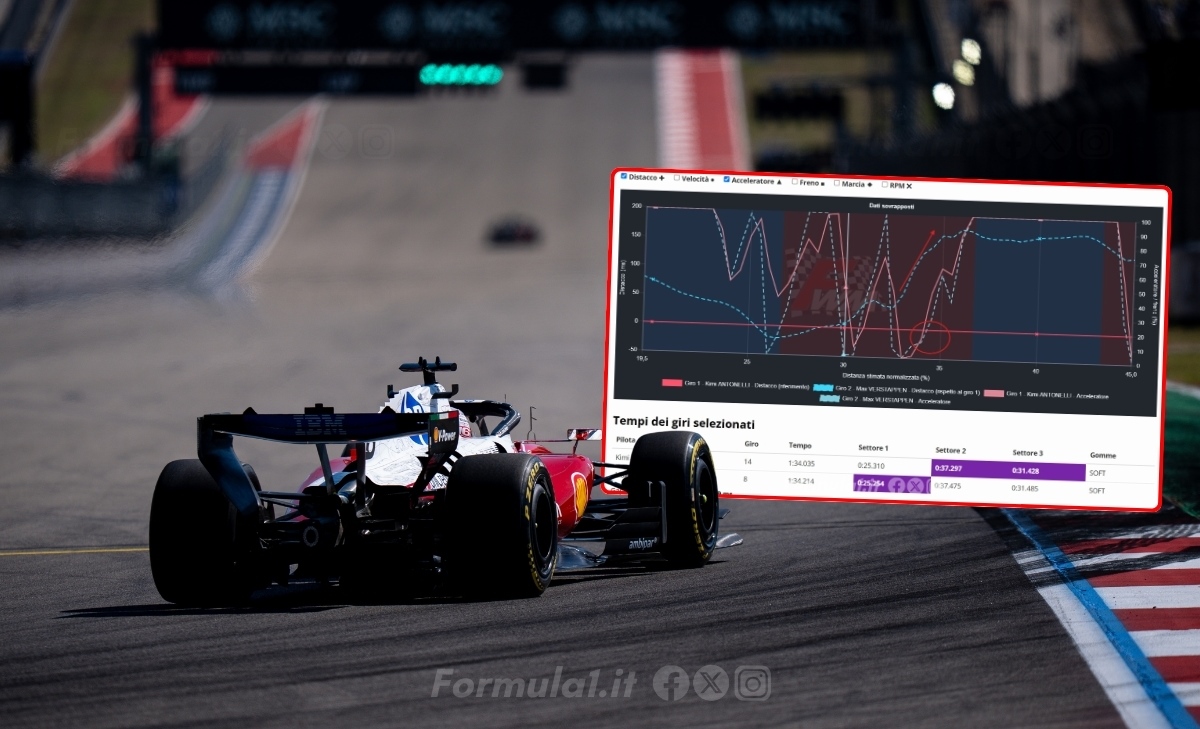
Under acceleration after Turn 1, Antonelli’s W17 puts almost a tenth between itself and the RB22, but Verstappen is able to move ahead through the Esses, even holding an advantage of 0.050s.

From that point, however, Verstappen has to concede.
Between Turns 7 and 11, Antonelli delivers the first decisive blow, earning himself the near two-tenth advantage he will carry to the end of the lap.
As well as being far less smooth through the final corners of the Esses, Verstappen is much less ready on the throttle out of Turn 9 and is also less able to exploit the electric power.

Verstappen might have hoped to hold on through the slower section between Turns 12 and 15, but this is where the lack of grip complained of by the Dutchman at the end of the session becomes apparent. It costs him almost a tenth to the Italian, who instead appears perfectly at ease.
At that stage, Antonelli has the energy to accelerate more effectively than Verstappen through the horseshoe between Turns 15 and 19, gaining further ground and reaching around Turn 20 with a three-and-a-half-tenth advantage.
From there, Antonelli appears less effective than Verstappen, probably because of how he chose to manage the available energy. Indeed, he crosses the line more than 10km/h slower, losing almost half of his advantage.

Ferrari, as ever, down on power
For Ferrari, a theme that has recurred since the start of the season emerges once again.
From a chassis perspective, the SF-26 is the equal of its rivals and perhaps even has something more, but the data from the sections where outright power is required is discouraging.
By Turn 11, Leclerc has a two-tenth advantage over Antonelli.
On the straight between Turns 11 and 12 alone, Leclerc loses three tenths overall, being comprehensively beaten under acceleration and giving away more than 15km/h in top speed.
Antonelli lands another similar blow under acceleration between Turns 19 and 20.
Proof that Antonelli produced a truly outstanding lap and that this pole position was not simply the result of the Mercedes power unit is that the gap to Ferrari also grows in the slow section, showing how uncomfortable Leclerc was with the car on his final attempt.

The mystery of Leclerc’s Q3. Could he have been on the front row?
But what happened to Charles Leclerc?
The Monegasque had set a 1:34.198 in Q2, a time that would have earned him a front-row start.
Where was another opportunity squandered, enough to test the patience of Maranello’s number 16 driver?
There were two critical points: the first between Turns 8 and 9, the second on the exit of Turn 15, before the horseshoe leading to Turn 19.

In the first instance, Leclerc makes an error, probably through a loss of grip, given that the gap increases while at the same time he is applying much more throttle than on his best lap.
It could simply have been driver error or a loss of grip, but in any case this is the first point at which Leclerc is unable to replicate his performance in the third qualifying session.

It is more difficult to understand what happened at Turn 15, which is the most obvious peak in terms of the time loss.
Leclerc approaches the corner carrying much less speed, more than 10km/h down; there are no substantial differences in throttle percentage, but on the Q3 lap the Monegasque is forced to select first gear slightly earlier.

These are probably the points at which the rear-locking issues Leclerc complained about over the radio at the end of his in-lap occurred.
It is possible that track grip changed during the final phase of qualifying and that Ferrari suffered more than the other cars, something Ferrari’s engineers will in any case need to investigate carefully.
Another missed opportunity for Ferrari, which has no clear explanation.
The article in two minutes
Kimi Antonelli’s pole position lap for the United States Grand Prix was a genuine statement of intent, especially given that the top five drivers on the grid are covered by just three tenths of a second. His margin over Verstappen, who will start alongside him on the front row tomorrow, is almost two tenths.
From a chassis perspective, the SF-26 is the equal of its rivals and perhaps even has something more, but the data from the sections where outright power is required is discouraging. On the straight between Turns 11 and 12 alone, Leclerc loses three tenths overall, being comprehensively beaten under acceleration and giving away more than 15km/h in top speed.
But what happened to Charles Leclerc?
The Monegasque had set a 1:34.198 in Q2, a time that would have earned him a front-row start.
Where was another opportunity squandered, enough to test the patience of Maranello’s number 16 driver?
There were two critical points: the first between Turns 8 and 9, the second on the exit of Turn 15, before the horseshoe leading to Turn 19.
All the news, photos, weather, session times and times from the United States GP 2026