 By:
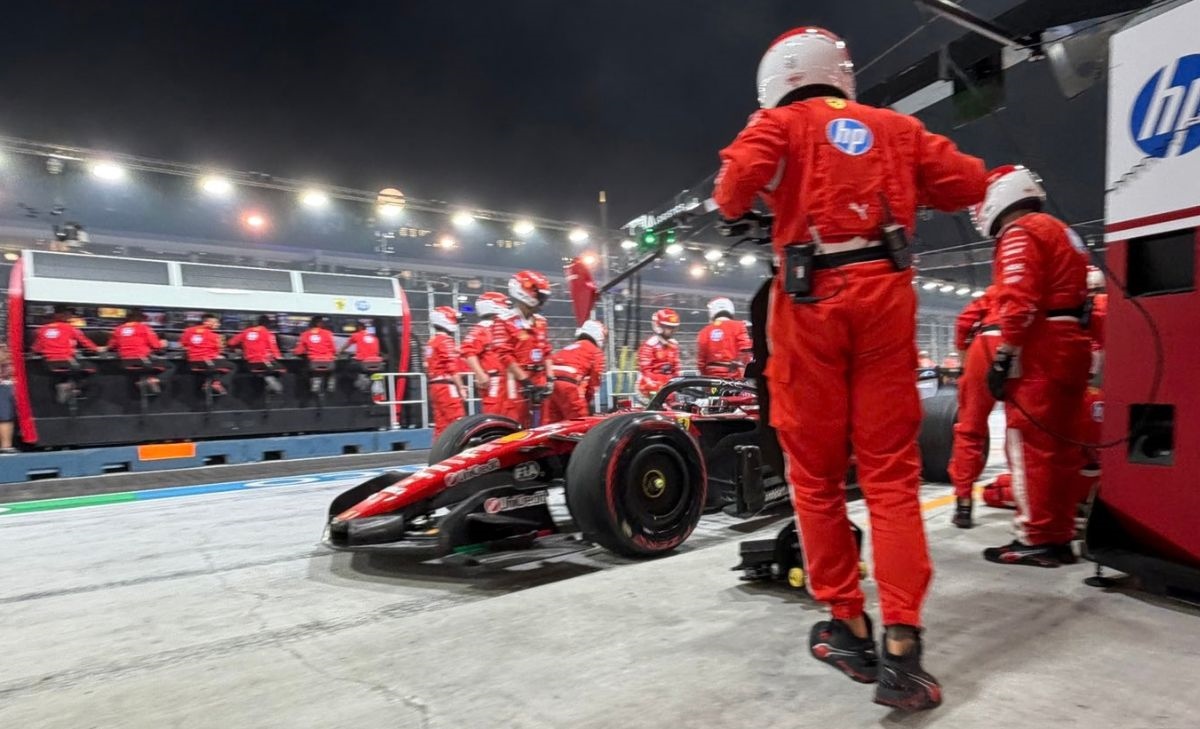
By: We face a strategy analysis that is straightforward in some respects and very complicated in others. First, let us take stock of the overall picture, before looking more closely at what went wrong for Hamilton and why we do not feel the seven-time world champion should shoulder all the blame for missing out on the podium.
Let us take it step by step. First and foremost, Max Verstappen’s (Red Bull) victory showed us two things today: firstly, that the quickest tactic was to tackle the GP with a one-stop strategy, which was the preferred option. Secondly, however, not everyone would have been able to complete the race on C4 Mediums and C5 Softs while maintaining a competitive pace until the finish. The proof did not come from Verstappen, but from Lewis Hamilton (Ferrari).
Strategy recap
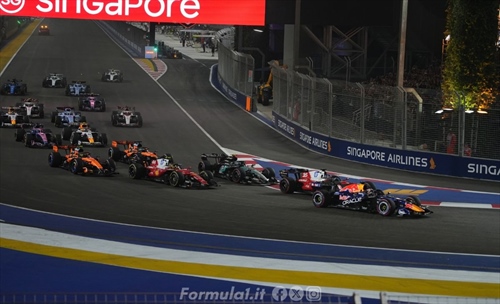
Today’s strategy recap is rather simple. Verstappen won the event on a Soft C5-Medium C4 strategy, with an opening stint of 32 laps. This was also the choice successfully executed by Lando Norris (McLaren) and Liam Lawson (VCARB), both of whom achieved an excellent result. We would even say better than expectations. Alongside them, but outside the points, were Bearman (Haas), Ocon (Haas), Sainz (Williams) and Alonso (Aston Martin). Seven drivers in total.
Level with that, with another seven drivers taking it, was its exact mirror image: C4 Medium tyres for the opening stint and C5 Softs for the second part. The best on this strategy—and best is a big word—was Hamilton (Ferrari), sixth at the flag. Alongside him were Hulkenberg (Audi), Russell (Mercedes) and Hadjar (Red Bull), in the points, followed by Gasly (Alpine), Lindblad (VCARB) and Bottas (Cadillac).
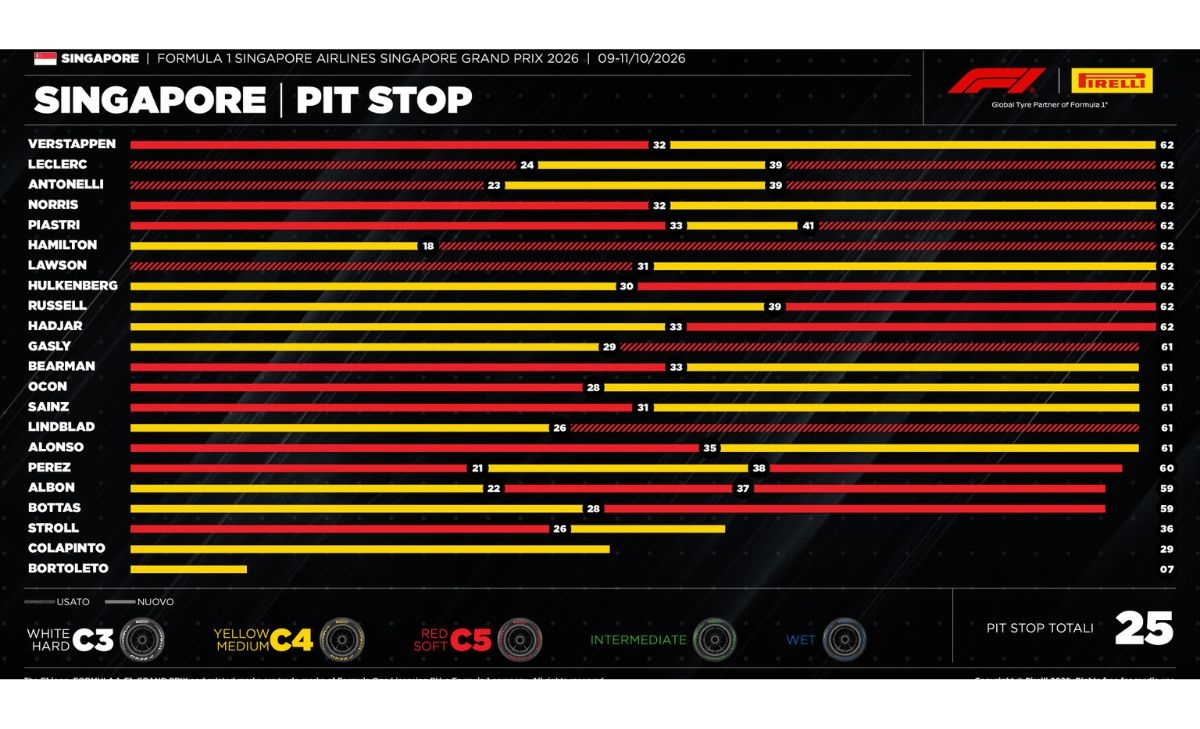
On an alternative but highly promising strategy, which took advantage of the Virtual Safety Car deployed on lap 39 following Lance Stroll’s (Aston Martin) retirement, were Leclerc (Ferrari), Antonelli (Mercedes), Piastri (McLaren) and Perez (Cadillac). All ran a two-stop Soft-Medium-Soft strategy. These drivers had stopped after around 20 laps to fit Mediums, and the yellow-walled tyre was not allowing them to be as competitive as they had hoped. For them, the VSC was a godsend. They fitted Softs for the final stint and were able to be far more effective than those who did not use the VSC to make their stop.
The race also featured 4 retirements: Albon (Williams), Stroll (Aston Martin), Colapinto (Alpine) and Bortoleto (Audi).
Hamilton’s error stemmed from a series of circumstances
The race did not feature many incidents to analyse, so we can move straight on to the Hamilton case. It is such a particular case, moreover, that it allows us to examine every aspect we had set out to address.
By now, it is an established fact. It is not only Ferrari that does not want to use the C3. The middle compound in the range supplied by Pirelli, marked with white sidewalls at Singapore as the Hard, was shunned by everyone. Nobody considered it. The running it was given in Friday’s FP1 had already made the situation clear.
That led teams to opt to complete the race on a one-stop Medium C4-Soft C5 strategy, or at most Soft C5-Medium C4. At least, that was the general idea at the outset.
The two strategies proved equally quick, so Ferrari’s decision to split Leclerc and Hamilton’s strategies at the start was not a mistake in itself; on the contrary, it opened the door to more options.
Here, though, we come to the first problem Hamilton encountered. Lewis began on C4 Mediums, which meant he should have run a much longer first stint than Leclerc, who was on Softs. Instead, that was not the case. While Charles was able to match Verstappen’s times for much of the stint, Hamilton was never competitive and chose to pit on lap 18 for Softs. Far too early to contemplate doing 44 laps on Softs. And yet… that is exactly what he would do.
When the VSC was deployed on lap 39, Hamilton was 2.7 seconds behind Leclerc and 8.6s behind Verstappen. Ferrari called both its drivers into the pits. Charles came in, but Lewis, perhaps through experience, stayed out. The accounts differ. It is not entirely clear whether it was a mistake or a decision made by the driver. We are more inclined to believe the latter. Hamilton saw an opportunity. On a street circuit, VSCs usually become Safety Cars, so had he pitted he would certainly have remained behind Leclerc, whereas by staying out he would have had a chance, in the event of a Safety Car, to pass his team-mate and then attack Verstappen once the field had bunched up. Unfortunately for him, Stroll stopped in a favourable position, the recovery crews were quick and the VSC lasted barely a lap.
At that point, it was clear that if he pitted, he would lose the podium, given that both Leclerc and Antonelli had changed tyres. Charles took six laps to close the 13-second gap to Lewis and pass him. By lap 46, therefore, it was equally clear that the Soft tyres would inevitably deteriorate towards the end and that making a second stop would have been the right call.
Hamilton makes a mistake, but Ferrari was completely absent
Hamilton can now be blamed for deciding not to pit with Leclerc, but the question we want to ask is this: where was Ferrari for the remainder of the race? Had Hamilton pitted during lap 46, he would have rejoined in fifth place on fresher Soft tyres. With 15 or 16 laps still to run, perhaps he could have closed in on Norris, who was on Mediums, or at worst he would have finished fifth, but certainly in a far more dignified and competitive manner.
Instead, Ferrari left Hamilton alone and at the mercy of his fate. The team watched its driver drown without even throwing him a lifebuoy. An attitude unworthy of the Maranello team. A group absent both during and after the race, even when Hamilton admits his own mistakes. Lewis made an error on lap 39: there was almost half the GP still to complete. Hamilton has made important and correct decisions many times over the course of the year. Today was one of the few mistakes he has made this season, and he certainly did not deserve such treatment. Perhaps at Ferrari, the phrase “we win and lose together” only applies when things are going well. The only person who showed some character today, by taking responsibility, was Hamilton.
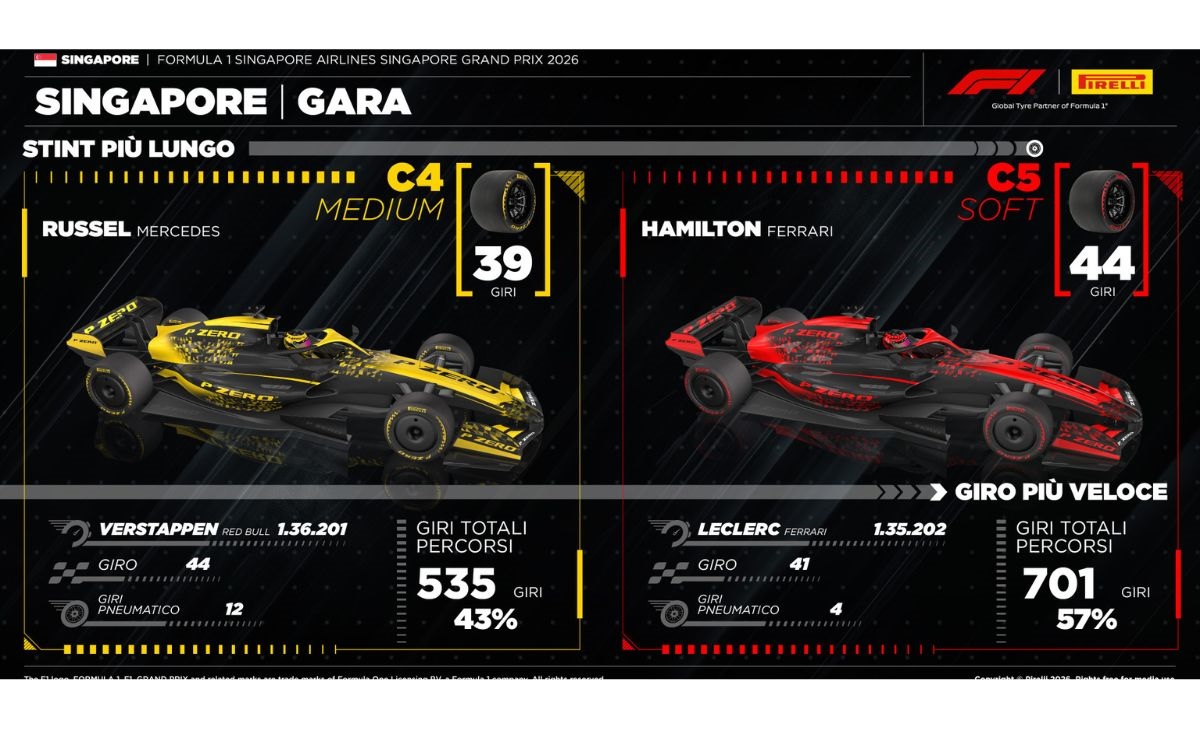
Pirelli’s report
Comments from Dario Marrafuschi, Pirelli motorsport director, after the race: “The one-stop strategy worked as expected. The C5 was the main protagonist. It allowed for very long stints while maintaining a good level of performance. Drivers who used it for around half the race only experienced a drop in performance in the final stages.”
“The Hard was not a strategically interesting choice for the teams. It offered little grip, while the C4, despite being softer, showed virtually no degradation, but did not provide any concrete advantages in a race already geared towards a one-stop strategy. Tyre degradation was in line with what we had already observed in free practice. Wear proved manageable, although it required some attention, especially on the right-rear.”, the Italian concluded.
Cover photo: X, Ferrari
Photos in the article: X, Ferrari
Graphics in the article: Pirelli
All the news, photos, weather, session times and times from the Singapore GP 2026