 By:
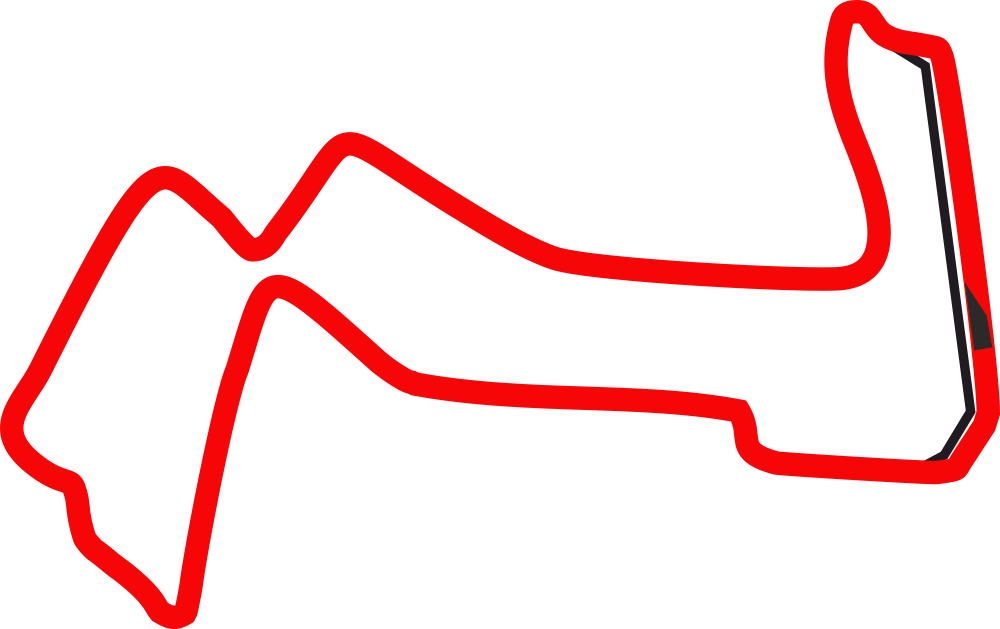
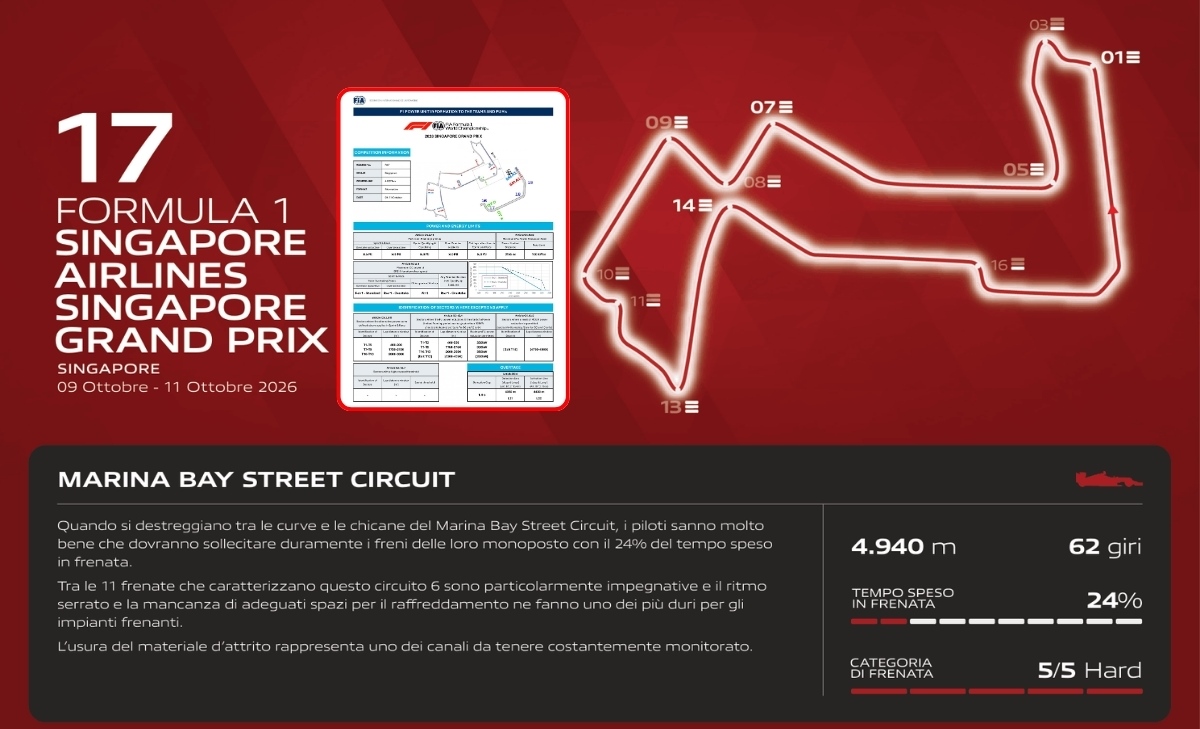
By: Singapore is THE circuit where the brakes are truly put under pressure, along with the drivers. At Marina Bay, the braking zones are numerous, closely spaced and demanding, making this one of the toughest events of the entire season. According to simulations by Brembo engineers, the 4.940-kilometre Marina Bay Street Circuit reaches the highest level on the difficulty scale, with a rating of 5 out of 5.
The most significant figure concerns the time spent braking: over the course of a lap, drivers use the brakes 11 times for a total of 21.6 seconds. That means spending around 24% of the race braking, the highest figure of the entire championship. Of the 11 braking zones, six are classified as Hard, one as Medium and four as Light.
The most demanding braking zone is at Turn 1, the Benjamin Sheares: the cars arrive at around 298 km/h and must slow to 144 km/h in just 1.9 seconds, over a distance of 107 metres. Deceleration reaches 4g in this phase, while the driver must apply around 110kg of pressure to the pedal. Braking power reaches 1,660kW.
A comparison with 2025 immediately highlights the differences between the previous and current cars. At Memorial Corner, Turn 7, drivers last year had to withstand 4.9g of deceleration and apply 151kg of pedal force; in 2026, simulations indicate 3.8g and 107kg respectively. It is a significant reduction in instantaneous effort, with substantially longer braking distances (also useful for recharging the batteries): from 96 metres in 2025 to an expected 117 metres this year, while the time needed to complete the braking phase rises from 1.90 to 2.15 seconds.
Energy management
From an energy-management perspective, Singapore presents a rather unique picture: Marina Bay’s constant braking offers numerous opportunities to recharge the battery, and the FIA has therefore set the maximum limit at 8.5MJ per lap in the race without Overtake and 9MJ when the system is active. The same 9MJ figure is also allowed in qualifying and free practice sessions. These are the highest values of the season, a sign that the FIA is not concerned about the much-feared phenomenon of superclipping.
The most interesting aspect is also how this energy can be used over the lap. The Power Limited Distance is set at 2,185 metres, a relatively low figure compared with the circuit length, with a maximum Power Unit power reduction rate of 100kW/s. The FIA has also identified several sections, between Turns 1 and 5, between Turns 7 and 9, and between Turns 10 and 13, in which an alternative power curve is used during the Sprint and the race. Specific exemptions from power reduction are also provided at several points around the circuit, along with the possibility of resetting the MGU-K reduction after Turn 18.
With the MGU-K curve planned for this weekend, which allows the full 350kW only up to around 200km/h before progressively falling to zero at roughly 310km/h, the simulation indicates that only around 7MJ of the 9MJ theoretically available per lap can actually be used. Of this, around 3.6MJ would come from braking and another 3.4MJ from partial-throttle phases. All of this makes it clear that this will be a Grand Prix in which recovery will not be an issue, while WHERE the available energy is used will be important.
The comparison with Baku is particularly interesting because these are two street circuits that tell almost opposite stories from an energy perspective. In Azerbaijan, the recovery limit was essentially identical, at 8.5MJ without Overtake and 9MJ with the system active, but the Power Limited Distance reached as much as 3,796 metres, compared with Singapore’s 2,185, while the power-reduction limit was 50kW/s rather than 100. In Baku, the real problem was therefore making the deployment last along the interminable high-speed section from Turn 16 to the finish line; in Singapore, with much lower average speeds and constant braking, energy can be recovered more frequently, and the challenge shifts primarily to distributing it across the many acceleration phases separating one corner from the next.
The simulations help further explain why Singapore is such a particular case for the 2026 cars. Pole position is forecast to be in the region of 1:32.1, with the usual margin of error of around one second, and therefore still almost three seconds slower than the 2025 benchmark. The interesting point is where that difference comes from: the new cars would gain around four tenths on the straights, but lose more than three seconds under braking and through the corners.


All the news, photos, weather, session times and times from the Singapore GP 2026