 By:
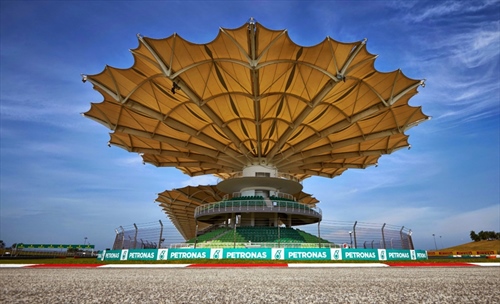
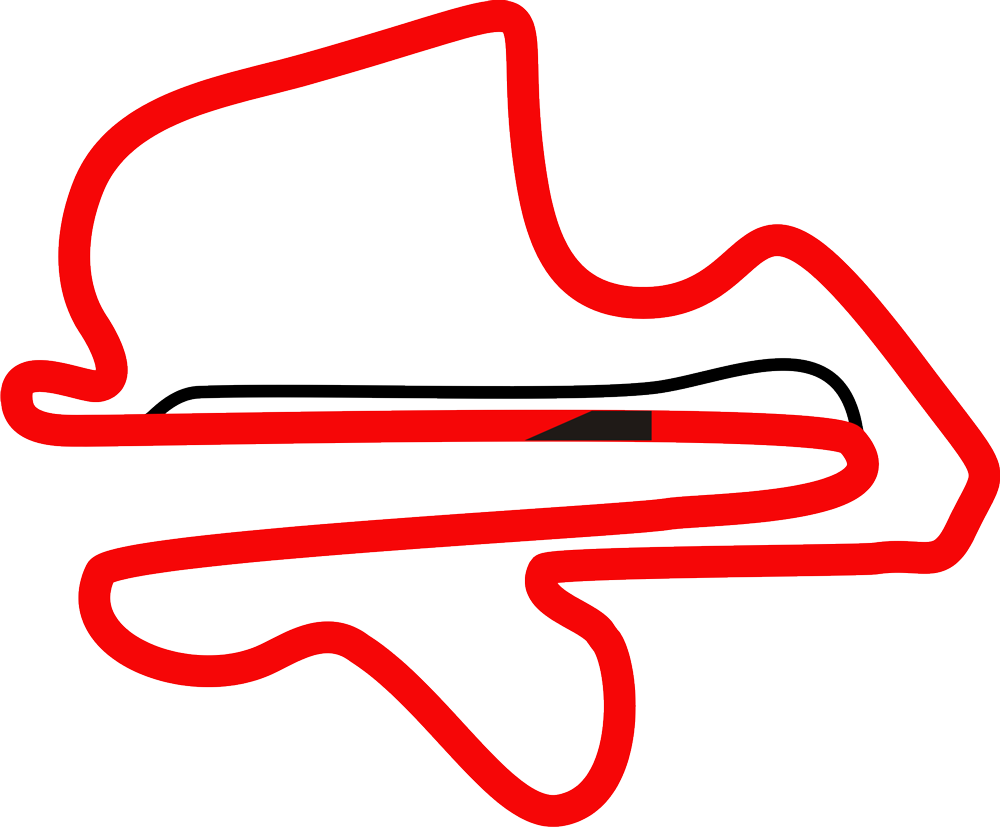
By: Formula 1 heads to Sepang for the Bahrain GP in Malaysia after Baku, for the 16th round of the season. The Malaysian circuit offers a highly varied mix of long straights, fast corners and heavy braking zones, although it is less demanding on the braking system than Azerbaijan.
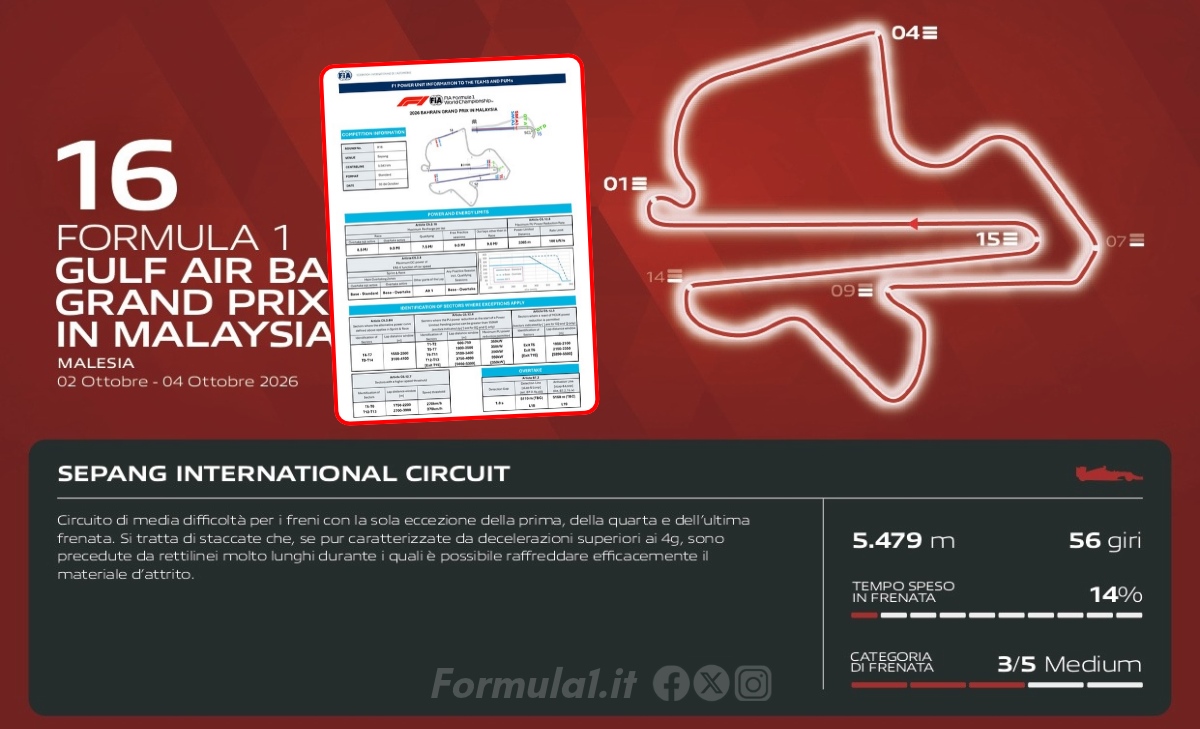
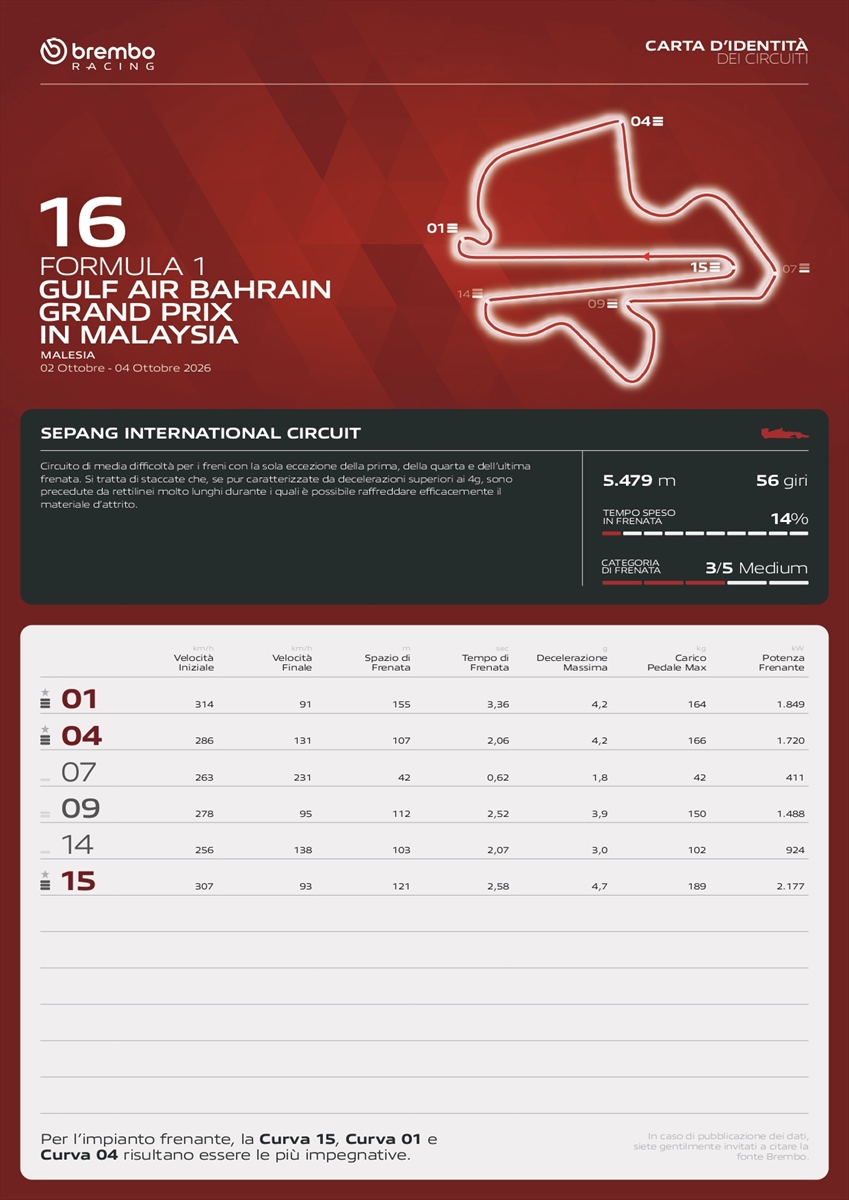
According to Brembo engineers, the Sepang International Circuit falls into the category of circuits that are moderately demanding on brakes, with a difficulty rating of 3 on a scale of 1 to 5. The brakes are used six times per lap for a total of 13.2 seconds: three braking zones are classified as Hard, one as Medium and two as Light. In five of these, deceleration reaches at least 3g.
The most demanding braking zone
According to Brembo simulations, the toughest point for the braking system is Turn 15, the final corner before the main straight. The cars will arrive there at around 307km/h before slowing to just 93km/h. The braking phase will last 2.58 seconds and cover 121 metres. During this phase, drivers will have to apply an impressive 189kg of force to the brake pedal, reaching deceleration of 4.7g. Braking power will peak at 2,177kW.
Energy management
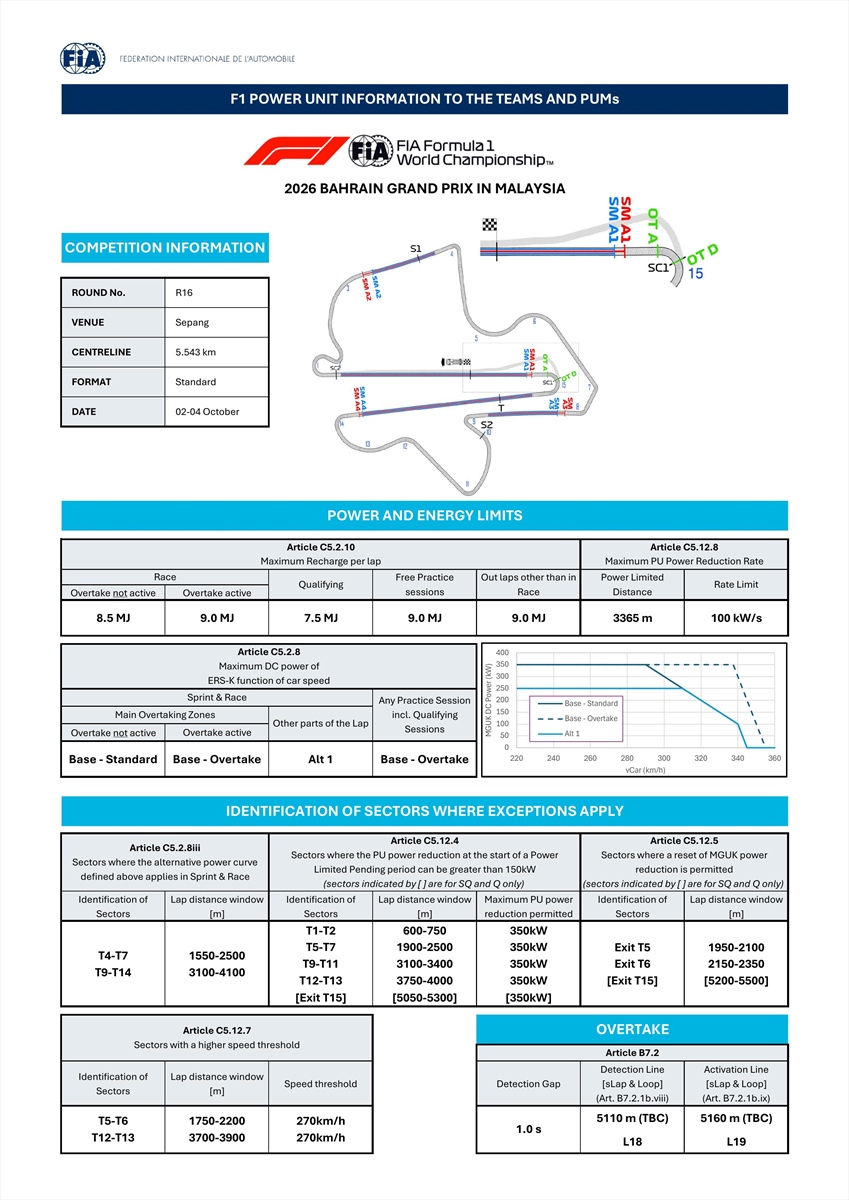
From an energy perspective, Sepang presents a rather different scenario to Baku. The Malaysian circuit combines long straights with numerous braking zones and a much more flowing middle sector, offering several opportunities for energy recovery. The FIA has set Maximum Recharge per Lap at 7.5MJ in qualifying, while in the race the limit rises to 8.5MJ without Overtake and 9.0MJ with Overtake active. In free practice, it will be possible to reach 9.0MJ.
Predictive simulations help explain where this energy could come from. Around half of the recovery would be generated under the main braking zones, concentrated particularly at Turns 1, 4, 9, 14 and 15, while an equally significant share could come during acceleration phases on corner exits. When ICE power exceeds what the tyres can still transfer effectively to the track, part of the surplus can be recovered through the MGU-K rather than simply being delivered to the wheels.
The most interesting figure, however, concerns deployment. According to these simulations, Sepang may not require genuine super clipping at the end of the straights. With 7.5MJ available in qualifying and four Straight Mode zones, the projected management instead sees the MGU-K progressively stop contributing electrical power over the final 100-300 metres of the main straights. From that point, the car would continue essentially with the ICE’s 400kW, gradually losing speed due to aerodynamic drag.
It is an important difference compared with more energy-critical circuits: the issue would not be reaching a drastic reduction in electrical power so much as deciding where to end deployment in order to make the most profitable use of the available energy over the entire lap. The four Straight Mode zones, on the two main straights and the other fast sections identified by the regulations, also help reduce drag precisely during the phases of greatest energy demand.
The FIA has set a Power Limited Distance of 3,365 metres, lower than the 3,796 metres used in Baku, while the Maximum PU Power Reduction Rate rises from Azerbaijan’s 50kW/s to 100kW/s at Sepang. Specific exceptions to electric power management are also предусмотрены and, between Turns 5-6 and Turns 12-13, there is a high-speed threshold of 270km/h.
The section between Turns 5 and 6 will also be interesting from a pure performance perspective. Simulations suggest it could be taken flat-out at around 290km/h, but this prediction should be treated with caution: models tend to be more optimistic in high-speed corners, and data gathered on track will clarify just how hard the drivers can really push.
Sepang therefore appears to offer less extreme management than Baku: the numerous recovery opportunities should limit the risk of exhausting the electrical component too early, leaving engineers primarily with the task of optimising energy recovery and distribution over a lap characterised by very different demands.
Bahrain GP 2026: complete guide
This is the third of six in-depth features we regularly publish on formula1.it in the build-up to every race weekend: alongside Brembo’s analysis of braking and energy management, there is Pirelli’s study and information on degradation and strategies, the event’s TV and streaming schedule, official updates, the first images and set-ups from the pit lane, as well as the table of power unit components used.
All the news, photos, weather, session times and times from the Bahrain GP 2026