 By:
By: Qualifying for the Azerbaijan Grand Prix offered several interesting insights. While Mercedes had been expected to shine, nobody could have imagined such a crushing performance against the opposition.
The W17's devastating statement of strength

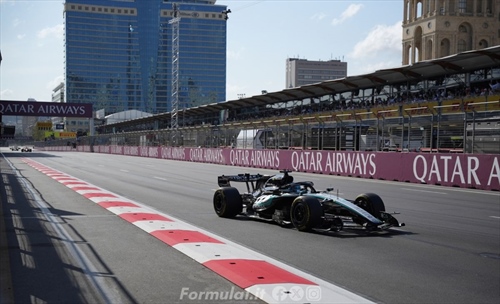
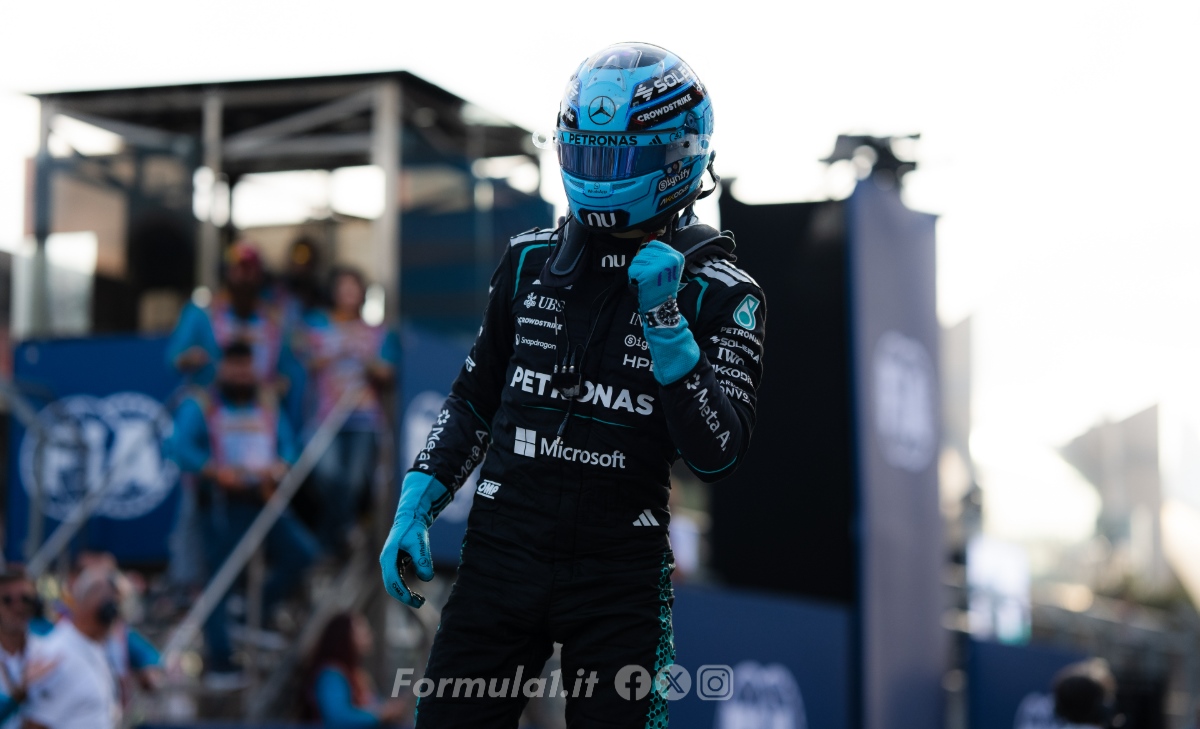
The most striking figure is undoubtedly the devastating pole position delivered by George Russell.
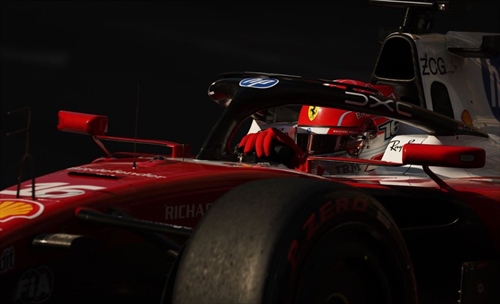
The more than eight-tenths advantage the Mercedes driver put over the runner-up is a huge blow, especially considering that Charles Leclerc is a genuine specialist around this circuit.
Leclerc almost manages to match the pace in the first sector, but things become extremely difficult as early as the second sector.
The Monegasque is forced to lift much earlier before every corner to recharge the battery, while Russell appears to have no need to do so at all.
It is as if the SF-26 is constantly on the limit of its available energy and, indeed, after Turn 12 Mercedes comprehensively outclasses its rival in both traction and top speed, reaching Turn 15 up to 10km/h faster and with an advantage of around four tenths.
Russell can therefore lift much earlier and downshift sooner to recharge before the final display of strength.

Then comes the main straight, where the W17 literally leaves the SF-26 behind, outclassing it in traction thanks to its greater available electrical power and gaining the other four tenths that make up the enormous final gap.
Mercedes' performance is a demonstration of the brute strength of its power unit, but not only that, as in every sector the W17 was superior to every other car thanks to a chassis entirely at the service of the power available and capable of putting that power down with maximum efficiency.
Hadjar makes an excellent return in fourth. Major problems for Verstappen
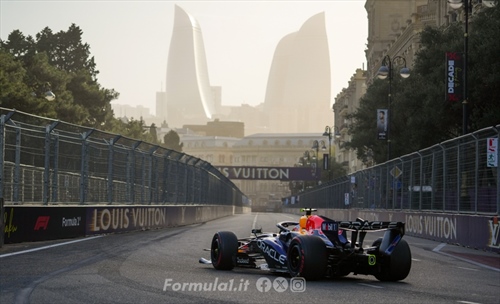
Isack Hadjar's return was an important moment for the French Red Bull driver, both to assess his physical condition and for the inevitable comparison with the performance of Lawson, who replaced him, given that the Anglo-Austrian team has never shown any hesitation in changing the driver alongside Verstappen, even during the season.
The 22-year-old Parisian produced an excellent lap, less than two tenths behind Leclerc, finishing ahead of his team-mate and beating him by more than half a second.
Without taking anything away from the Dutchman, however, something does not add up in his performance, as he complained extensively about the state of charge of his power unit's battery.
This is confirmed by the significant gaps opening up during every acceleration phase, where electrical power plays a leading role. It must also be said that a large delta develops in the tight Turn 5 and 6 chicane, a sign that Hadjar was very effective through that section or that Verstappen made a small mistake.

Hamilton less effective than Leclerc in energy management
As mentioned earlier, Leclerc is a specialist at this circuit, but Hamilton has shown this season that he is up to the task and is often even faster than the Monegasque.
Although Ferrari's number 16 received a slight benefit from a small tow from Hamilton, and although the latter complained that he had no tow to pull him along, the differences between the two drivers lie mainly in hybrid management.
Leclerc produced a truly remarkable first sector, using more energy than his team-mate.

The situation shifts slightly in the second sector, where the seven-time world champion makes greater use of electrical power between Turns 12 and 14, recovering much of the deficit to Leclerc who, as mentioned earlier, tries to recharge the batteries as much as possible before the final run.
The difference in acceleration in the final section suggests that the strategy of Ferrari's number 16 paid off more than that of his team-mate.
All the news, photos, weather, session times and times from the Azerbaijan GP 2026