 By:
By: Formula 1 returns at Zandvoort for what could, barring any future change of heart, be the final Dutch Grand Prix: Formula 1 and the organisers have already announced that the contract will not be renewed beyond this season. The farewell will also coincide with the Sprint format making its debut at the Dutch circuit.
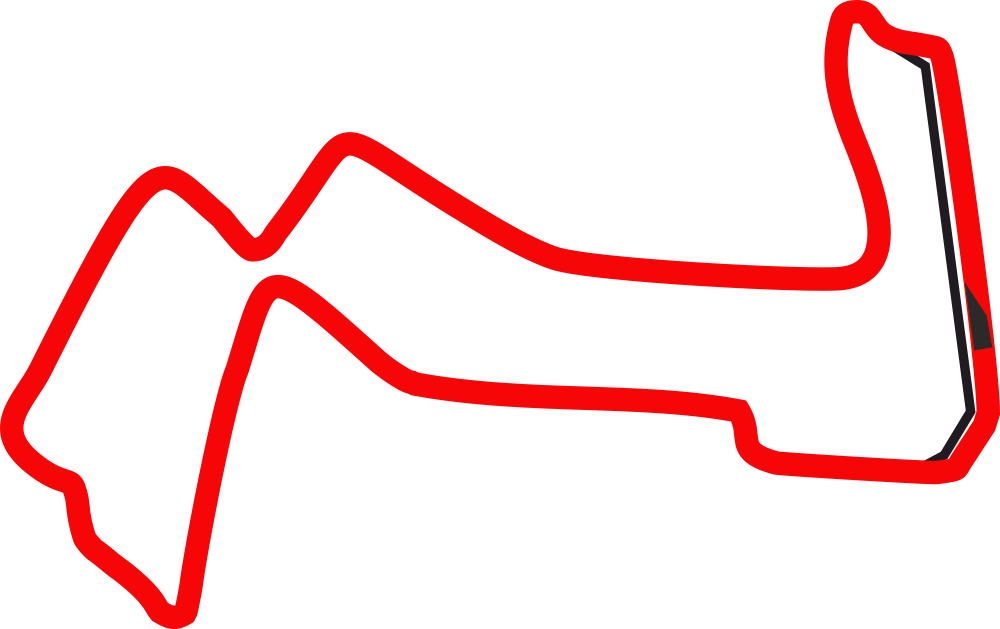
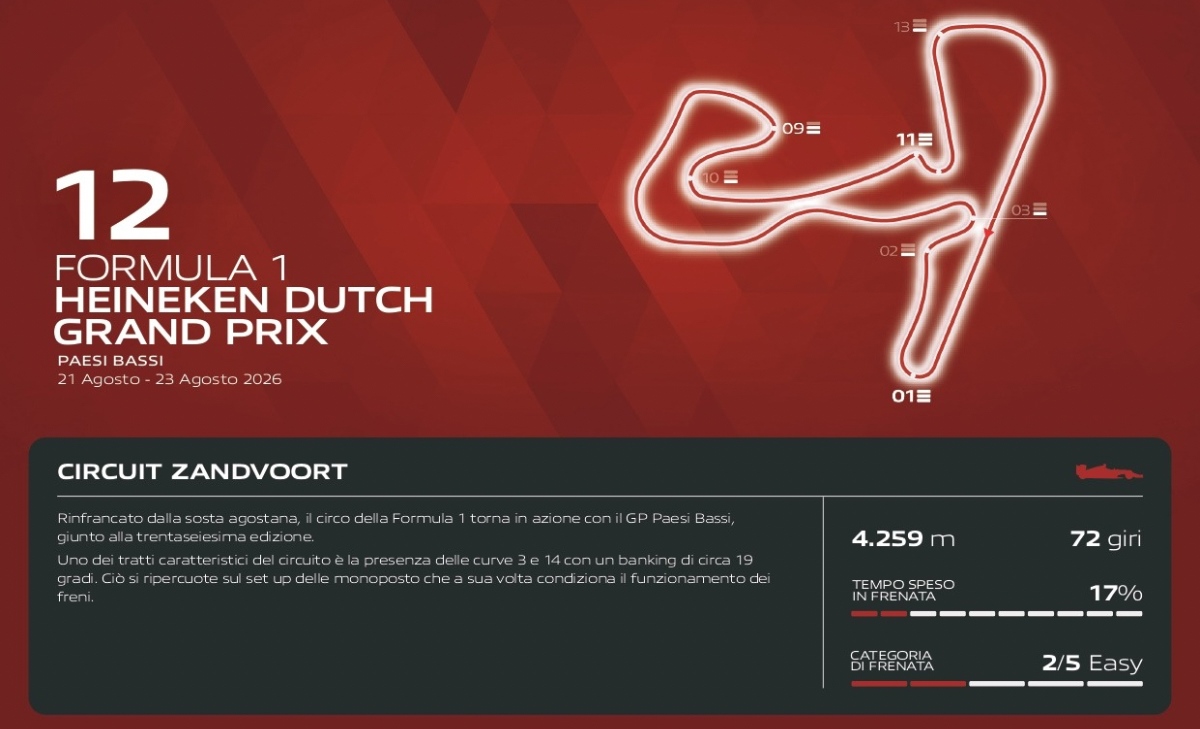
Yet Zandvoort will be particularly interesting from a technical perspective. The 4.259km circuit has traditionally been associated with high downforce levels, with loaded corners, changes of direction and banked sections placing particular demands on tyres and aerodynamics. Braking, by contrast, is a relatively limited concern. With the 2026 cars, however, that very aspect is intertwined with another variable that has become crucial: energy management.
Zandvoort is not demanding on brakes
According to Brembo simulations, Zandvoort receives a braking-system difficulty rating of 2 out of 5. There are expected to be seven braking events over a lap, amounting to just over 12 seconds of use in total: only two are classified as Hard, one as Medium and four as Light.
The most demanding braking zone remains Turn 1, Tarzan. The cars are expected to arrive at around 323km/h before slowing to 126km/h, shedding almost 200km/h. The braking phase lasts 2.97 seconds and covers 171 metres, with 4g of deceleration, 114kg of pedal force and braking power of 1,659kW.
These are significant figures, but they also illustrate just how much the cars have changed from the previous generation. A particularly interesting comparison is Turn 11: in 2025, the cars lost 175km/h in just 2.22 seconds and 107 metres, with 4.5g of deceleration and as much as 152kg of pedal pressure. In 2026, the projected speed loss is almost identical at 172km/h, but it will take 2.68 seconds and 146 metres, while deceleration will fall to 3.2g and pedal force to 91kg. This is a consequence of the different characteristics of the 2026 cars, whose braking dynamics have changed profoundly because of the energy recovery system.
The real battle is over energy
However, the technical document distributed by the FIA to the teams shows that Zandvoort's most intriguing challenge concerns management of the electrical component. The comparison with Hungary is particularly meaningful, as both circuits require high-downforce configurations.
For the Sprint and the race, the FIA has set a Maximum Recharge per lap of 8.5MJ at Zandvoort when Overtake is not active, rising to 9MJ when it is used. So far, the configuration is the same as that seen in Hungary. The clearest difference, however, comes in qualifying.
At the Hungaroring, the FIA limit was 9MJ per lap in qualifying as well. At Zandvoort, however, the figure falls to just 7.5MJ in Sprint Qualifying and conventional qualifying, in an effort to limit clipping as much as possible. In free practice and on out-laps other than those for the Sprint and race, it remains set at 9MJ. This will make it even more important to decide where to recover energy and, above all, how to construct the lap in order to reach the most sensitive points with the necessary electrical energy available.
There is also a second figure that clearly distinguishes the two circuits. The distance over which Power Unit power reduction can occur under the limit set out in Article C5.12.8 rises from 1,885 metres in Hungary to 2,411 metres at Zandvoort: the FIA prefers to further limit energy use so that it is distributed more evenly and excessive use of clipping is avoided.
Two Straight Mode zones
The FIA document also highlights two Straight Mode zones. The first naturally covers the main straight, while the second is located on the opposite side of the circuit.
Finally, there is Overtake, with the detection gap set, as always, at one second. The detection line is positioned before Turn 20, while activation is before Turn 21, in preparation for the final part of the lap and the main straight.
A short but complicated circuit
Zandvoort could therefore become one of the most interesting circuits for understanding just how far the new Formula 1 has become a matter of compromises. Downforce remains high, the tyres are subjected to heavy lateral loads, and braking zones are relatively few and less aggressive than in 2025. For precisely that reason, recovering and deploying energy correctly could become even more delicate.
The 7.5MJ qualifying limit, the three windows for the alternative corner and a Power Limited distance more than half a kilometre longer than at the Hungaroring show that, although both are high-downforce tracks, Zandvoort requires different energy management. And with a Sprint weekend, meaning just one practice session before getting straight into the action, teams and drivers will have very little time to find the ideal compromise.


All the news, photos, weather, session times and times from the Dutch GP 2026