 By:
From the long straights of Las Vegas to the fast corners of Lusail, Formula 1 faces a completely different technical challenge in Qatar. The circuit, defined by long sequences of medium- and high-speed corners, demands high aerodynamic downforce and places particularly intense lateral loads on the tyres. Managing electrical energy will also be important, but aerodynamic efficiency could have a greater impact on the performance differences between the cars at this track.
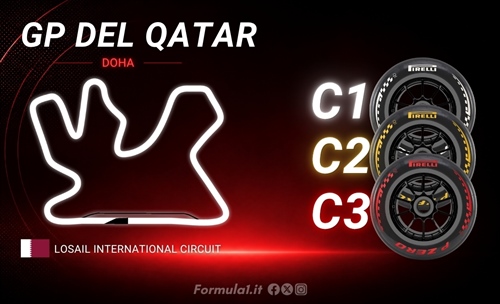
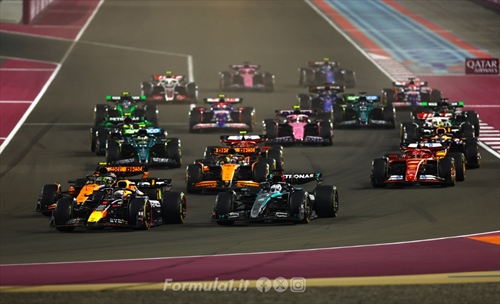
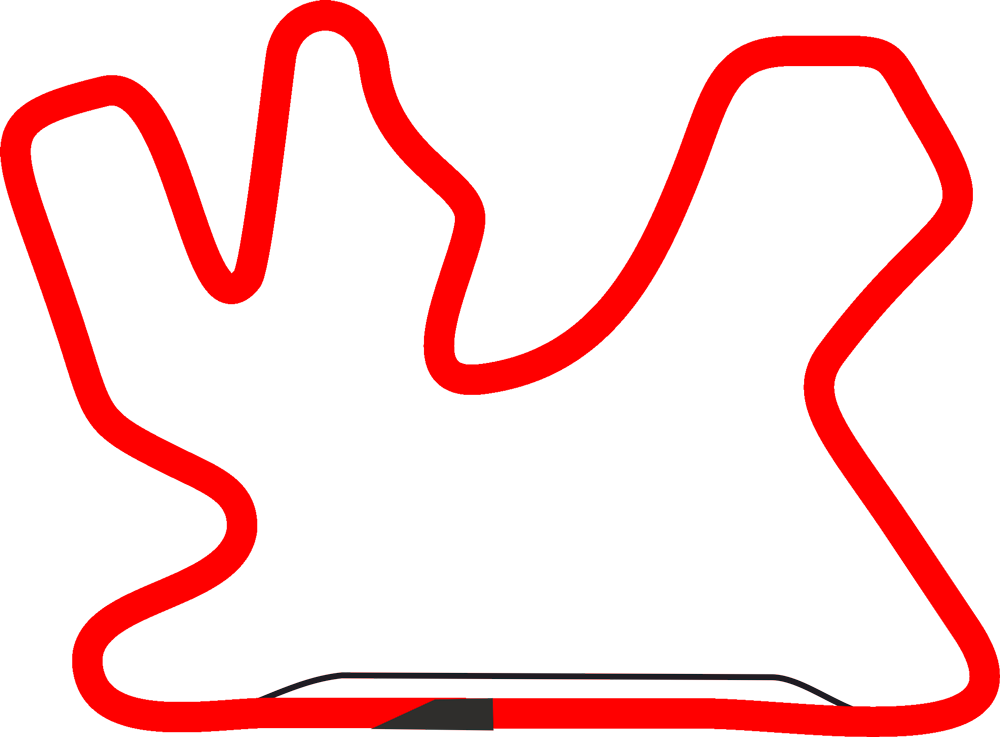
The Lusail International Circuit is 5,419 metres long, features 16 corners – 10 right-handers and six left-handers – and is run clockwise. The 1,068-metre main straight offers the main overtaking opportunity, while the rest of the circuit rewards driving precision and aerodynamic stability.
The second sector, from Turns 6 to 11, features a series of direction changes where maintaining high minimum cornering speeds is crucial. The final section is even more demanding, with Turns 12, 13 and 14 placing particularly high and sustained loads on the front-left tyre.
Because of the stress placed on the tyres, Pirelli has set a maximum limit of 27 laps per set, compared with 25 in 2025, making at least two pit stops mandatory. The three hardest compounds in the range – C1, C2 and C3 – will be used.
The Qatar GP will be contested over 57 laps, covering a total distance of 308.611km.
Brakes: less stress, but longer braking phases
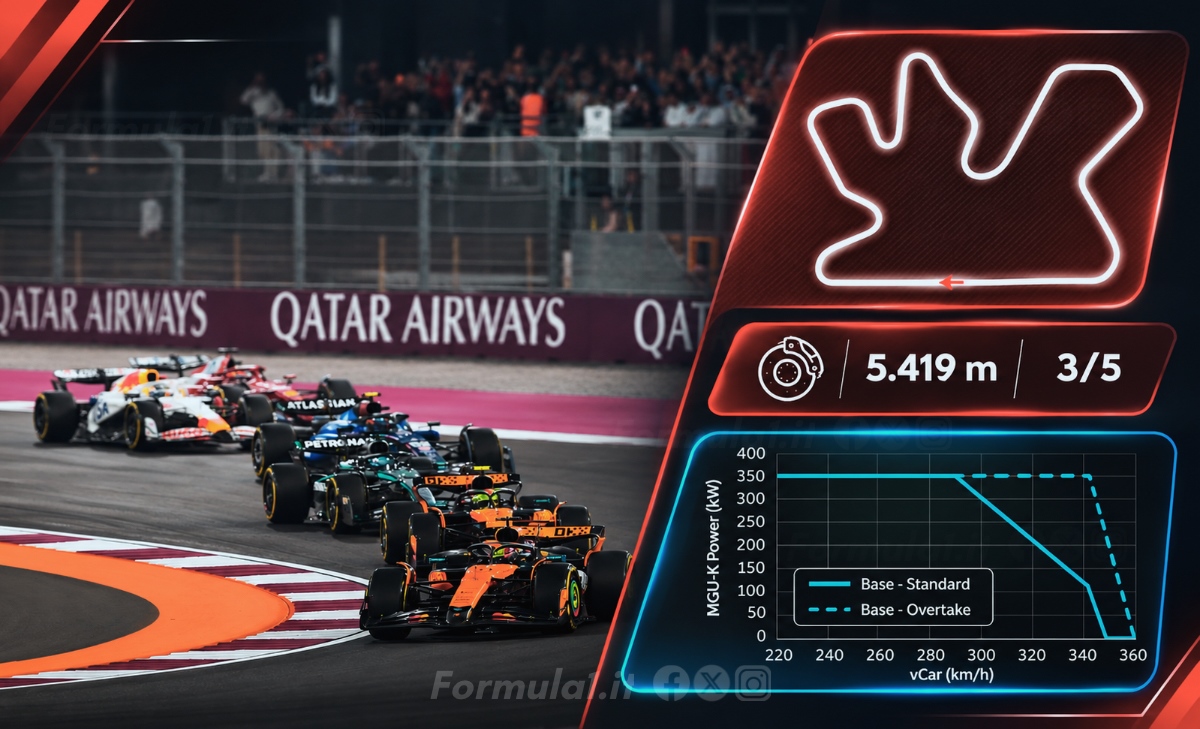
According to simulations by Brembo engineers, Lusail falls into the category of circuits that are moderately demanding on the braking system, with a difficulty rating of three out of five.
Drivers use the brakes seven times per lap, for a total of 11.3 seconds. Two braking zones are classified as Hard, four as Medium and one as Light. The most demanding is at Turn 1, where the cars slow from 322 to 178km/h in 1.9 seconds over 121 metres. Deceleration reaches 4g, with 113kg of pedal load and braking power of 1,735kW.
The comparison with 2025 highlights some of the differences introduced by the new cars. At Turn 16, the predicted deceleration falls from 4.1 to 3.4g, while pedal load drops from 123 to 101kg. Braking distance, however, increases from 75 to 101 metres, while the time required to slow down rises from 1.22 to 1.72 seconds: half a second more than last season.

Brembo's Qatar GP 2026 data sheet
Power unit: 6.5MJ of recovery in qualifying
The official Power Unit Information document published by the FIA for Qatar sets a maximum electrical energy recovery limit of 6.5MJ per lap in qualifying, half a megajoule more than at Las Vegas and restoring the limit to the same figure used at Interlagos.
The other parameters remain unchanged: 8MJ per lap in the race without Overtake Mode, 8.5MJ with the system active and during free practice, and 9MJ on out-laps outside the race. It should be remembered that these are energy recovery limits, not limits on the amount of energy that can be deployed over a lap.
The Power Limited Distance falls from 4,448 metres in Las Vegas to 3,108 metres at Lusail, equivalent to 57.4% of the circuit length. As we have already explained, this percentage does not represent the portion of the lap in which the cars will actually suffer a reduction in power.
MGU-K: three zones with power limited to 250kW
In the race, in the main overtaking zones, the Base Standard curve provides for a progressive reduction in maximum electrical power from 290km/h, falling to zero at 345km/h. With Overtake Mode active, 350kW can be maintained up to 337.5km/h, while the limit falls to zero at 355km/h. The latter curve is also used during free practice and qualifying.
To activate Overtake Mode, the driver must, as always, be within one second of the car ahead. The gap will be measured 5,020 metres from the start of the lap, while the activation line is positioned just 58 metres further on, at the exit of the final corner on the main straight. The actual benefit will naturally also depend on the energy available in the battery.

The FIA Power Unit Information document for Qatar
Qualifying simulation: more than three seconds slower than 2025
Engineer Marek Lubieniecki's simulation indicates a lap time of 1'22"59, 3.2 seconds slower than the 2025 pole position of 1'19"39, with a qualifying prediction between 1'21"5 and 1'22"6.
At Lusail, where much of the lap is driven above 200km/h, the aerodynamic limitations of the 2026 cars are particularly evident. According to the model, compared with the previous generation the cars lose around 20km/h in fast corners and only 3km/h in slow ones. Each additional percentage point of aerodynamic downforce is worth around 0.130 seconds per lap: assuming a 10% increase, the simulated time falls to 1'21"31.
On the energy front, Lubieniecki estimates a recovery potential of 8MJ per lap, of which 4.4MJ comes under braking, 1.9MJ during partial-throttle acceleration phases, 1.1MJ when off-throttle and just 0.6MJ through superclipping – recovery at full throttle – before Turns 1, 4 and 16.
Braking therefore provides 55% of the energy recovered in the model, while superclipping contributes only 7.5%. However, it should be noted that the estimated 8MJ exceeds the FIA's actual qualifying limit by 1.5MJ. A more accurate simulation may be published in the coming hours.
Cover photo by Brembo and FIA
All the news, photos, weather, session times and times from the Qatar GP 2026