 By:
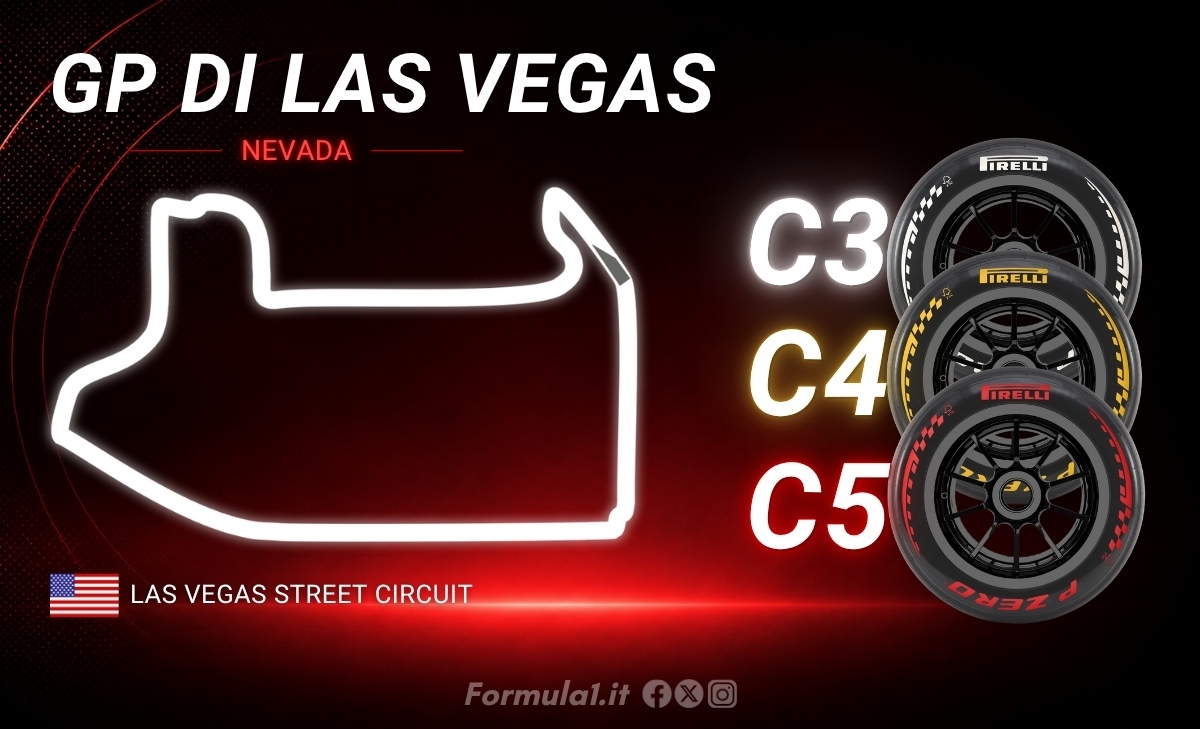
Formula 1 is preparing to tackle one of the most unusual events on the calendar, the Las Vegas Grand Prix, which is also the third-to-last round of the 2026 season. The 6.201-kilometre Nevada street circuit features three long straights and 17 corners. As in previous editions of the event, the first two free practice sessions will take place on Thursday, followed by FP3 and qualifying on Friday, while the race is scheduled for 20:00 on Saturday evening. All times stated are local. In Italy, because of the time difference, the weekend will run as usual from Friday to Sunday. CLICK HERE to view the TV schedule.
The compounds selected by Pirelli for this weekend are the softest in the range: the C5 as the Soft, the C4 as the Medium and the C3 as the Hard.
The main technical challenge will be tyre management in ambient conditions that are highly unusual for Formula 1, with air temperatures expected to range between 10 and 15°C due to the wide temperature swings between day and night in the world capital of gambling. As is typical of street circuits, grip levels in Las Vegas will initially be limited.
The track will reopen to public traffic every day and is therefore subject to constantly changing surface conditions, with dust and sand accumulating on the asphalt and making it particularly difficult to predict how grip will evolve over the weekend. Only minor resurfacing work has been carried out this year, including at the entry to Turn 13 and on the right-hand side of the straight leading to Turn 14.
Long flat-out sections are a defining feature of the Las Vegas Strip Circuit. The high speeds reduce the energy transferred to the tyres, making it more difficult to keep them within the correct operating window. For this reason, tyre warm-up will be one of the key factors throughout the weekend, particularly in qualifying.
Preparation for a flying lap could therefore become even more important than at other circuits, especially given the low grip levels. It cannot be ruled out that some teams may opt for consecutive preparation and timed laps, limiting cooling laps in order to retain tyre temperature.

Loads on the tyres are not particularly high, with the exception of the middle sector, which features several high-speed corners. Graining could reappear because of the low grip levels and cool temperatures, as seen in previous editions of the race. In that case, the degradation would be predominantly mechanical in nature. Another factor to monitor will be brake lock-ups. The long straights end in demanding braking zones, where the risk of flat spots can become significant in both qualifying and the race. Drivers will therefore need to avoid locking the front wheels at the circuit's most critical points in order not to compromise a set of tyres.
On paper, the fastest strategy should be a one-stop race, with all three compounds potentially in play. The C5, which in its current specification has demonstrated good versatility, could also be a viable option for a race stint.
The characteristics of this circuit also reduce the effectiveness of the traditional undercut strategy. After a pit stop, tyres tend to lose temperature quickly along the long section between the pit exit and the more demanding parts of the lap, reducing the advantage normally associated with fresh tyres.
Last year
The 2025 edition was affected by rain during qualifying, resulting in extensive use of wet-weather tyres. Should similar conditions occur again, the Full Wets could prove particularly effective. The low temperatures and circuit layout favour a tyre with a deeper tread pattern, capable of generating and retaining temperature more easily than the Intermediate.
Last year's Las Vegas Grand Prix was also characterised by one-stop strategies, with the Medium and Hard compounds covering the entire race distance. All three drivers who finished on the podium started on the yellow-marked tyres before switching to the C3 for the remainder of the race. The only driver to start on Softs was Kimi Antonelli, who changed them for a set of Hard tyres on lap two.
A special Podium Cap
The starry skies of the Nevada desert are the inspiration behind the Las Vegas Grand Prix "Podium Cap". Created for Formula 1's night race, it celebrates the constellations visible above the American city, reflecting the unique atmosphere that defines the most dazzling weekend of the season. This special edition "Podium Cap" was designed by Denis Dekovic for Pirelli Design and combines the appeal of the night sky with the identity of the Las Vegas Grand Prix. As always, the cap is already available to purchase on Pirelli's dedicated platform.


Photo courtesy of Pirelli
Photo courtesy of Pirelli
All the news, photos, weather, session times and times from the Las Vegas GP 2026