 By:
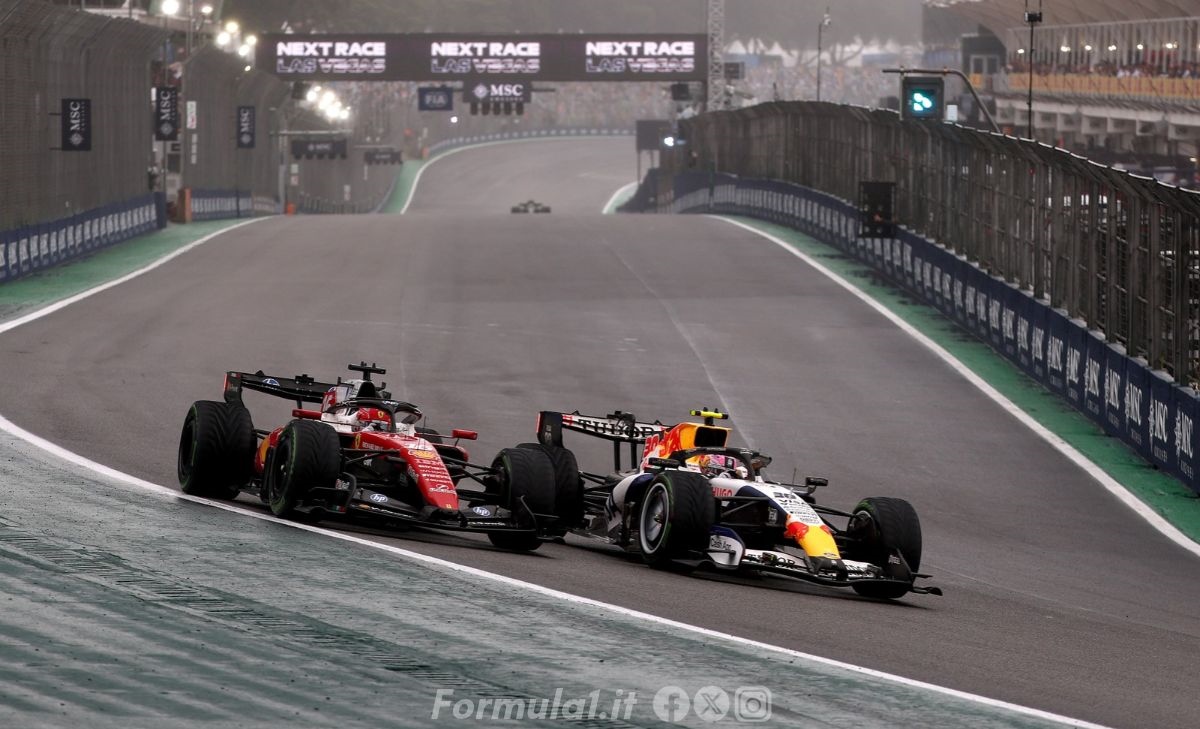
The penalty handed to Charles Leclerc after the Brazilian GP for his contact with Liam Lawson raises a perfectly legitimate question: are on-track battles still allowed? Let us rewind and retrace the incident.
In recent hours, the internet has turned on the decision by the International Federation to deem the Monegasque driver's actions, while struggling with a difficult-to-drive SF-26, as “damaging” behaviour.
Although the contact was deemed minor, as stated in the official FIA document, Leclerc was handed a full five-second penalty, dropping from seventh to eighth. In light of this, neither driver was fighting for important positions, yet such a significant ruling has still prompted conflicting opinions to persist.
According to the FIA, the aggravating factor that made the Ferrari driver culpable was the damage to the left-rear wheel rim on Lawson's VCARB03. Indeed, in the official document, the Federation acknowledged that: “after reviewing the on-track battle between the two cars, we conclude that car No. 16 was able to close in and subsequently overtake car No. 30 precisely because of the contact”. And so we return to our starting point, and the initial question.
Are on-track battles really still allowed?
From Gilles Villeneuve and René Arnoux, through Ayrton Senna and Alain Prost to Michael Schumacher and Mika Häkkinen: they are just some of the many drivers who, in the past, gave us intense duels right down to the final corner.
In modern Formula 1, it still happens, but it is also true that on-track battles have suffered a major setback after being judged unfair or excessively dangerous.
While safety and fairness must always be guaranteed, the adrenaline that naturally surrounds overtaking and competition must also be preserved. Had Leclerc not been penalised, he would not have won the race or even secured a podium place, but he would at least have kept what he had managed to earn: a position pursued, planned and fought for.
If even such slight contact is deemed unfair, what will really remain of racing battles? Will they become merely a surgical exercise in which it is no longer permitted to overstep the mark?
Perhaps we should sterilise less of what the track offers and enjoy the spectacle much more—the spectacle that is worth getting excited about, discussing and enjoying.
After all, that is the true essence of Formula 1.

