 By:
The Mexican Grand Prix has reignited debate over the 2026 power units and, in particular, the system that progressively reduces electrical power at high speeds. As we reported in recent days, Lando Norris said the mechanism was «ruining the racing», while Lewis Hamilton called it «the worst engine management configuration» he has ever seen in Formula 1. But what would happen if those limitations were removed? Would the cars really be faster and, above all, would overtaking become easier?
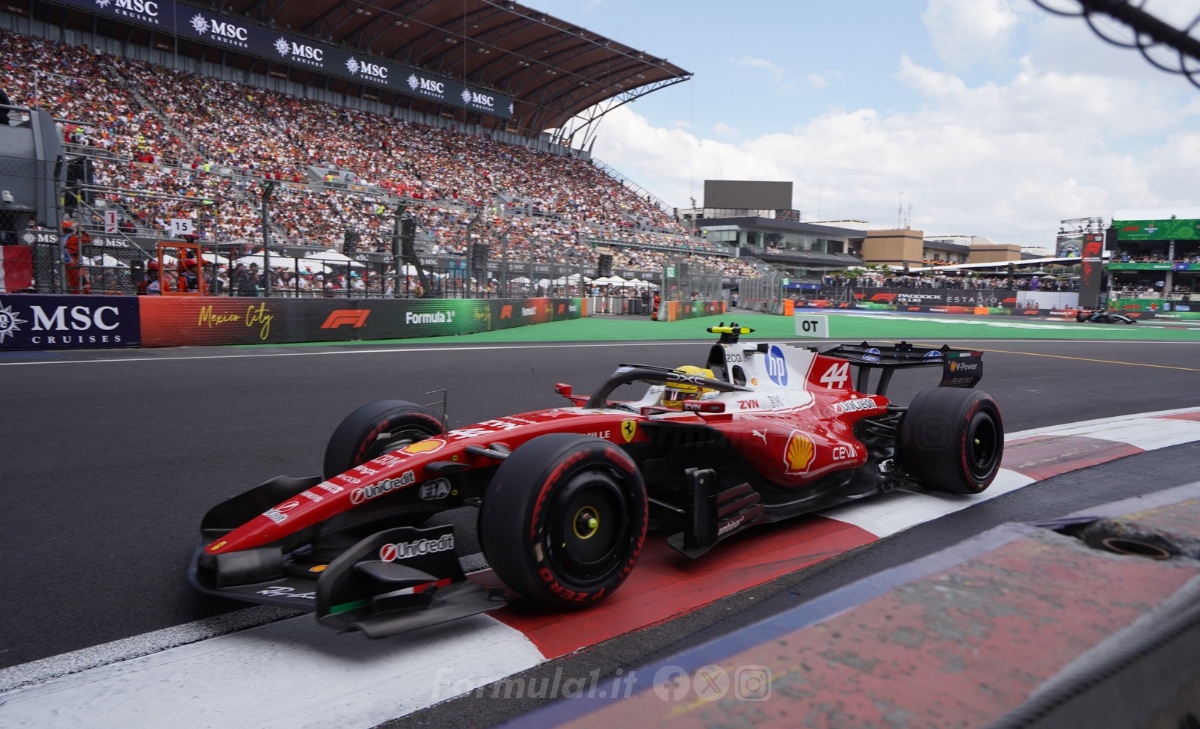
Engineer Marek Lubieniecki, who specialises in modelling and simulation, attempted to answer those questions with an interesting experiment on X: simulating a lap of the Mexican circuit without the electrical power cut which, even with Overtake Mode active, falls to zero at 355 km/h.
The results are highly significant. In a qualifying-lap simulation, without that limitation, top speed rises from 350 to 370 km/h, delivering a three-tenth gain on the main straight. The price, however, is an additional consumption of 0.76 MJ of electrical energy.
In race trim, though, the picture changes dramatically. Simulating a lap with a neutral energy balance, in which the energy used must be recovered, the advantage falls to just one tenth of a second. To use more battery power on the straight, less would have to be used around the rest of the circuit.
«At present, the deployment curves largely determine where energy is used at high speed. Without these limitations, it would be up to the driver and team to choose, but the car ahead could also go faster,» the engineer noted.
The outcome could therefore be very different from what Norris and Hamilton are hoping for: «An overtake would depend on who had saved more battery for the straight. I would therefore expect competition based on energy saving.»
In short, removing the limit would restore top speeds more in keeping with Formula 1, but it would not automatically guarantee more overtaking opportunities. The risk would be replacing one problem with another: rather than everyone ending up at the same speed, drivers could spend much of the lap saving energy before putting everything on the line on the straight.
But the issue, on closer inspection, runs far deeper. By removing the MGU-H and massively increasing the weight of the electrical component, the 2026 regulations have created cars which, at many circuits, cannot recover enough energy to fully exploit the MGU-K's 350 kW. The deployment curves can be changed, speed limits can be removed or drivers can be given greater freedom, but an obvious design flaw remains: these power units have impressive electrical power on paper, yet on track they must constantly ration it. And if going faster on the straight necessarily means going slower elsewhere, perhaps the problem is not how the energy is managed, but how this generation of Formula 1 was conceived.
Cover photo by Ryan fleming / WHYOUT Images
All the news, photos, weather, session times and times from the Mexican GP 2026