 By:
Older viewers, like this writer, will certainly know the film ‘Days of Thunder’. Today’s headline is inspired by the scene in which crew chief Harry Hogge tries to persuade the arrogant yet talented Cole Trickle to drive according to his instructions. In truth, Hogge tells Trickle: “Tyres win races”, but since victory was never within Ferrari’s reach, we decided to adapt it to the situation.
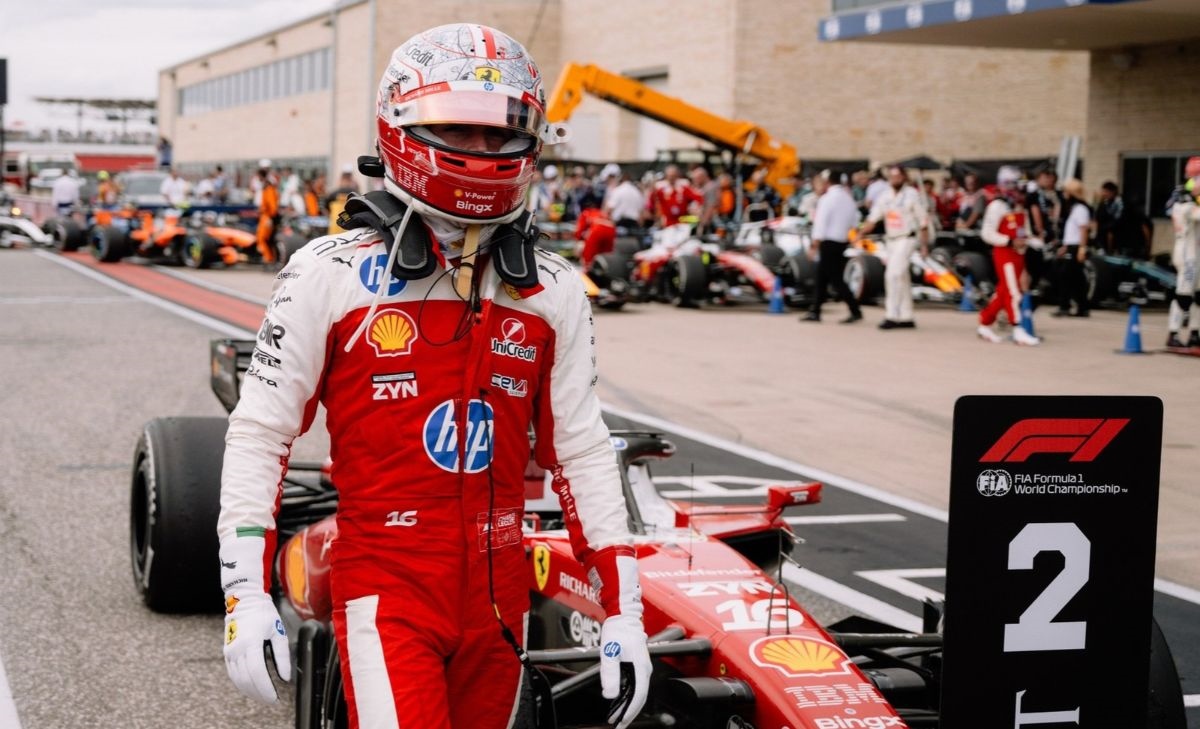
Leclerc may have been highly competitive during his stint on the Hard C2, lapping almost consistently one second faster than race leader Antonelli. The trouble was that Kimi won the GP, his ninth victory of the season, keeping Leclerc at a safe distance: 13 seconds, to be precise. Ferrari could not have fought for victory even with different choices. The reason? We will explain after reviewing the strategies adopted by the drivers during the United States GP.
The strategy recap
First of all, we can say that our prediction proved broadly consistent with the decisions made by the teams (read here). Before the race, we had already discussed some teams’ difficulties in managing the C3 compound, the yellow-walled tyre on this occasion. It was therefore more than logical to expect limited use of it during the GP.
That was indeed the case. Only five drivers chose to start on the C3: Antonelli, Russell, Piastri, Norris and Stroll. Colapinto and Bottas opted for the Hard C2, while everyone else selected the Soft C4.
The five sets of C3 used at the start were joined by another six, for a total of just 11 sets of C3 used in the race. Leclerc and Hamilton used it during the middle phase of the race, alongside Lindblad and Alonso. Verstappen used it for his third stint, with little success, while Bearman was running it at the time of his retirement.

The other 11 drivers instead opted for strategies involving only Soft and Hard tyres, even in the case of two-stop races. So, half the grid believed in the C3 in some way, while the other half decided to rule it out altogether.
All things considered, Antonelli won the GP with a one-stop Medium-Hard strategy, with Norris, Piastri and Russell following the same route without much success. Hadjar, Lawson, Gasly, Hulkenberg, Ocon and Perez also made one stop, using Soft-Hard.
Among the two-stop runners was Leclerc, who finished second with a Soft-Medium-Hard strategy, a solution used only by team-mate Hamilton. Verstappen finished third with a two-stop Soft-Soft-Medium strategy: no Hard tyres for him, just as for Lindblad and Alonso, who went Soft-Medium-Soft. There were also Soft-Hard-Soft strategies for Bortoleto and Sainz; Medium-Soft-Soft for Stroll; and Soft-Soft-Hard for Albon.
The Medium C3 was the least-used tyre, with 11 sets, while drivers used 18 sets of Hard C2s and 25 sets of Soft C4s. Bottas, Colapinto and Bearman retired from the race.
Mercedes still holds too great an advantage over Red Bull and Ferrari
Leclerc, Verstappen and Hamilton produced strong performances in Austin, but the picture to emerge from the United States GP is that Mercedes, particularly with Antonelli, holds a huge advantage over its most dangerous rivals. For a start, it had no hesitation in using the Medium C3, a tyre that worked brilliantly on its W17 from the opening laps to build a margin over Verstappen and Leclerc, who started on Softs. The performance on the Mercedes was so good that Kimi was able to cover 24 laps on it and make just one stop.
And this brings us back to the line from ‘Days of Thunder’: “Tyres win races.” Leclerc and Verstappen would never have been able to complete the race with one stop while maintaining the same level of competitiveness. A two-stop strategy was the right choice for them, unfortunately the only viable way of showing such a high level of performance.
Ferrari: a successful race considering the C3 stint
We can describe the American round as a successful event for Ferrari. Taking into account its use of the Medium C3 as well, the race result was very, very good. The Maranello team has often struggled with this tyre during the year and perhaps wanted to conduct a test. The difficulties generally emerge with track temperatures above 40°C, and Ferrari may have wanted to assess its behaviour, aided also by the 35°C track temperature.

In the opening part of the stint, its pace suffered somewhat compared with the Soft fitted by Verstappen; we are talking about the middle phase of the race. But Max then began to suffer degradation, from which Leclerc and Hamilton benefited. All in all, they were two good stints, better than expected, although Ferrari only held a significant advantage over Red Bull once it fitted the Hard C2. The white-walled tyre proved to be the perfect tyre for the SF-26.
The performance gap to Verstappen on the Medium C3 was enormous. There were two reasons for this: the first was the quality of the compound, and the second was Ferrari’s excellent choice to execute a powerful overcut on Max, lasting seven laps with Hamilton and eight with Leclerc. Had the teams had two sets available, we would have seen a far more interesting race. Unfortunately, no team considered that possibility.
Ferrari, all things considered, made no mistakes in its tyre selection. Choosing the Medium allowed the team to conduct an important test, even if it was not entirely representative: another would need to be carried out with higher track temperatures to assess any progress.
There were no mistakes to report in strategic terms either. The call to put Hamilton on the Hards before Leclerc was dictated by the fact that Lewis was battling Hadjar from a distance in an attempt to avoid having to overtake him after the stop. Unfortunately, he failed by a gap of two seconds, as the pair were lapping at exactly the same pace: the difference was in the order of a few tenths per lap. Once on the Hards, it was very easy for him to clear Isack.
Leclerc was always faster than Hamilton, in almost every phase of the weekend. Second place was thoroughly deserved for Charles. It was a shame about the late VSC, which denied Hamilton the chance to pass Verstappen and join his team-mate on the podium. The overall performance is there, but to win, you must also know how to manage the tyres. As long as there is a team that manages its tyres better, it will be difficult for that to happen.

Red Bull gets its tyre choice wrong at the end
For once, it was Red Bull that got its strategy wrong. Verstappen and his team did everything right until the third stint. The choice to complete two stints on Softs was bold, but still effective. The Dutchman mainly paid the price for having to tackle the final part of the race on Medium C3s, when the performance difference to the Hard C2 was truly enormous. Perhaps, with a different choice, we would be discussing a different result. Antonelli would have won regardless, but the fight for second place would have been even more compelling.
Marrafuschi: "Verstappen triggered a chain reaction"
As always, we conclude with the final comment from Pirelli motorsport director Dario Marrafuschi: “The United States GP was particularly interesting from a strategic point of view. All three compounds played a crucial role in the race and their behaviour was in line with the predictions derived from the work of recent days. The degradation levels confirmed what we had estimated after practice, and the one-stop strategy proved to be the most effective.”
“The two-stop strategies, on the other hand, were influenced by Max Verstappen’s decision to make an early pit stop. This generated a chain reaction. Those who had clear track, meanwhile, made good use of the benefits offered by a single stop. The level of wear was fairly high and essentially uniform among the teams. From the point of view of tyre appearance, too, the overall picture was very homogeneous, with some more evident differences especially on the Medium. The Hard rewarded those who decided to include it in their strategic plan. Leclerc was able to overtake Verstappen precisely thanks to its use,” concluded the Italian manager.
Cover and in-article photos: Ferrari
Graphics: Pirelli
All the news, photos, weather, session times and times from the United States GP 2026