 By:
As the current season draws to a close, definitively consigning to the archives, disappointingly, all hopes of a Formula 1 evenly split between electric and internal-combustion power, fresh indications are emerging of the pillars of the next regulatory cycle.
At the heart of the future Formula 1 will be a V8 internal-combustion engine, as already confirmed by the Federation’s technical and political leadership, while electrification will play a marginal role.
But what will future Formula 1 cars look like?
Which aspects will be affected by the proposals put forward so far?
As not even a draft of the next regulations has yet been written, imagining the shape of the cars for the next regulatory cycle is a cost-free exercise in imagination, but no less interesting for that.
At the centre of it all: the V8 internal-combustion engine

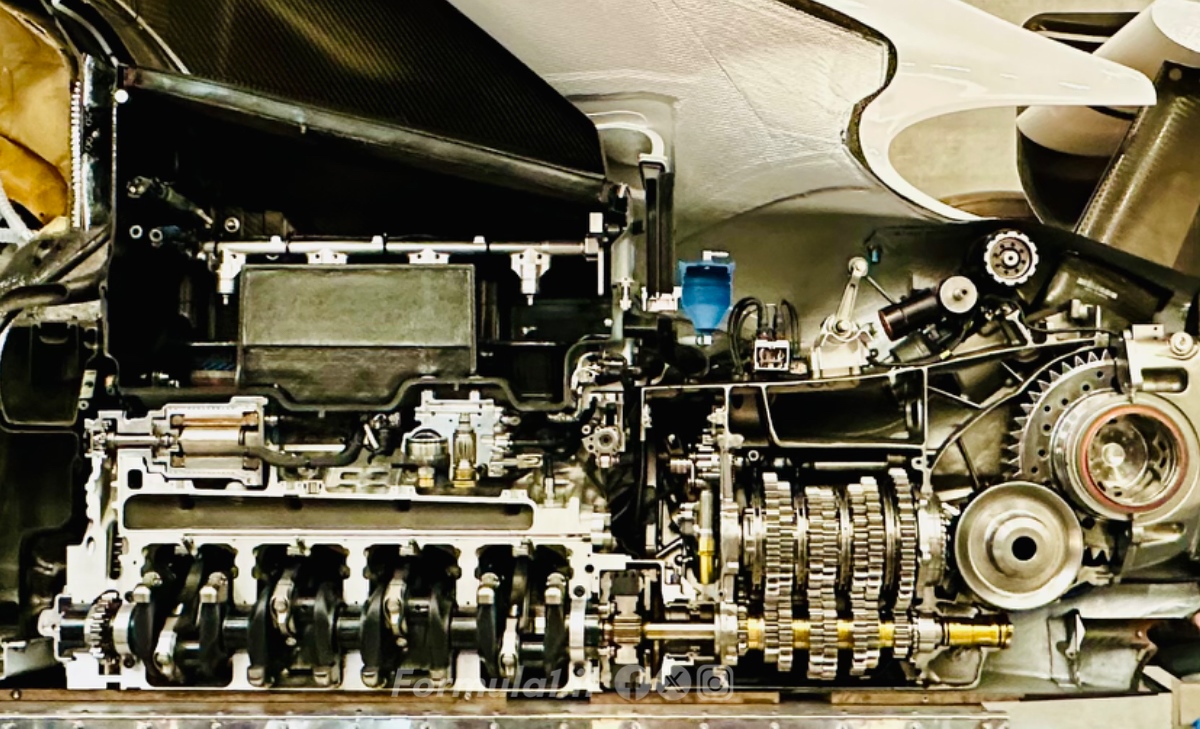
The new power unit will finally return to being called simply an engine, given the very marginal role electrification will play in the next regulatory cycle.
Removing the huge battery currently used would free up significant space behind the driver’s shoulders, while also greatly simplifying the overall installation.
The new V8 internal-combustion unit will certainly be bulkier than the current one, taking up some of the space presently allocated to the battery, but it will also be compact enough to reduce the overall volume that must be housed beneath the bodywork.
If we were to assume an eight-cylinder engine derived directly from current internal-combustion units, it would have a displacement of just over 2,000cc and, based on current regulatory dimensions, be around 250-300mm longer.
In reality, the Federation would like to introduce a 3,000cc unit: if that were the case, and if the V8s raced between 2006 and 2013 were taken as inspiration, slightly more space would probably be required, given that those engines had a bore exceeding 90mm, while the current bore is fixed at 80mm.
Much will depend on which parameters the Federation wants to retain, such as the now-infamous compression ratio; however, if turbocharging is indeed retained, the dimensions will be more compact than those of the V8s of the past for the same power output.
Reducing weight to race again, including through the corners
If the Federation really intends to remove the battery, it will gain a twofold advantage, as already mentioned: less space will be needed to house this component, benefiting the car’s compactness, and less weight.
To put it into perspective, the current minimum battery weight is around 35kg, certainly no negligible figure when considering that the FIA described the 30kg reduction for the current cars compared with 2025 as a major success.
Compactness and lightness will make future Formula 1 cars exceptionally agile through sequences of corners, whereas at present, weighed down and with a very long wheelbase required to accommodate the current power units, they are relatively sluggish in changes of direction.
Cooling will remain a significant factor
The increased displacement of the internal-combustion unit can only increase cooling requirements, even though the current requirements of the electrical components will be removed. It is difficult to strike a balance at present, but the radiators may increase in size and become heavier.
This could make it less favourable to position the cooling masses high up, above the power unit, as all manufacturers except Ferrari currently do.
Concentrating the cooling masses lower down, in the sidepods, will probably once again represent the most beneficial compromise not only in cooling terms but also dynamically, thanks to the lower centre of gravity.
This could result in slightly more generous sidepod shapes and larger inlet sections, while the air intake above the driver’s head, currently split into three sections, would most likely return to a single, fairly triangular form.
Aerodynamics: always important, but not necessarily active
The use of a traditional internal-combustion unit, with no need for energy management, would immediately remove the need for active aerodynamics.
It cannot be ruled out that the FIA may retain it, but it is highly likely there will be a move away from this complication, which has been one of the few positive features of the current regulations.
It is difficult to say what will happen at the front of the car, but it is possible to envisage that the rear could be influenced by the new regulations concerning the internal-combustion unit.
According to statements from FIA leadership, the internal-combustion unit will not be naturally aspirated but turbocharged, to produce an appealing sound while maintaining an intensity suitable for street races.
The increase in displacement will bring with it a larger turbocharger assembly, which is expected to remain a single unit, and there will inevitably be an increase in the cross-section of all ducting, including the exhaust.
This increase could lead to the exhaust being repositioned upstream of the rear-wing support, for example faired into the engine cover, perhaps with a bodywork-flush profile typical of the early 2000s.
Based on the current indications, a twin-turbo architecture is not ruled out either, which would lead to a twin-exhaust configuration centralised or, alternatively, spaced further towards the outside of the car, but always highly appealing.
The reduced wheelbase will necessarily result in less floor area available for development, which would translate into a substantial reduction in downforce: a direction always welcomed by the FIA’s regulatory bodies, both to keep performance within acceptable limits and to highlight the driving abilities of the best drivers.
Less weight and less reliance on downforce also mean greater scope and ability to use the kerbs.
By contrast, the ground-effect cars of the 2022-2025 four-year period, heavy and dependent on ground effect, suffered significantly over every bump, while the situation has improved slightly with the 2026 cars.
Less weight could return the suspension to its proper role, without the excesses and compromises seen in recent seasons, increasing adjustment possibilities and allowing tyre operating windows that are less difficult to hit.
A return to the past?
Do the 2031 regulations represent a return to the past?
Not necessarily.
Many key points have not been defined and, depending on them, the hypothetical car of the future would change radically in concept.
What matters is the desire to return the essence of a racing car to the centre of the top category: lightness and simplicity.
The excessive complexity of the current regulations has created the paradox of cars that are slow both on the straights and through the corners, and not at all “nimble”, as the current regulations promised.
The fact that 2031 is already being discussed while the first season of the current regulations is still under way suggests just how urgently the current top category needs to rediscover its lost direction.
The article in 2 minutes
As the current season draws to a close, definitively and disappointingly consigning to the archives all hopes of a Formula 1 evenly split between electric and internal-combustion power, fresh indications are emerging of the pillars of the next regulatory cycle.
At the heart of the future Formula 1 will be a V8 internal-combustion engine, as already confirmed by the Federation’s technical and political leadership, while electrification will play a marginal role.
As not even a draft of the next regulations has yet been written, imagining the shape of the cars for the next regulatory cycle is a cost-free exercise in imagination, but no less interesting for that.
Removing the huge battery currently used would free up significant space behind the driver’s shoulders, while also greatly simplifying the overall installation.
It would also save the current minimum battery weight of around 35kg, certainly no negligible figure when considering that the FIA described the 30kg reduction for the current cars compared with 2025 as a major success.
The Federation would like to introduce a 3,000cc V8 unit. If that were the case, and if the engines raced between 2006 and 2013 were taken as inspiration, slightly more installation space would probably be required, given that those engines had a bore exceeding 90mm, while the current bore is fixed at 80mm.
Compactness and lightness will make future Formula 1 cars exceptionally agile through sequences of corners, whereas at present, weighed down and with a very long wheelbase required to accommodate the current Power Units, they are relatively sluggish in changes of direction.
The use of a traditional internal-combustion unit with no need for energy management would immediately remove the need for active aerodynamics.
What matters is the desire to return the essence of a racing car to the centre of the top category: lightness and simplicity. The excessive complexity of the current regulations has created the paradox of cars that are slow both on the straights and through the corners, and not at all “nimble”, as the current regulations promised.
All the news, photos, weather, session times and times from the United States GP 2026