 By:
By: The first qualifying session at Madrid’s brand-new circuit delivered an exceptionally close finale: the top six drivers were covered by just over three tenths, while Norris snatched pole from Antonelli by only 11 thousandths.
In such a tight contest, every detail matters enormously, and an analysis of the telemetry available online can help explain how each driver approached their fastest lap.
The comparison between the two Ferraris is surprising
While acknowledging Norris’s masterclass, it is worth starting with the Ferrari pair, with Hamilton fourth, just six thousandths ahead of Leclerc.
As we know, Hamilton’s SF-26 was fitted with a power unit featuring the ADUO2 upgrades; Leclerc, meanwhile, had to forgo them following his Monza accident and ran the previous specification.
One would expect a significant difference between the two specifications, yet that is not the case.
The differences are minimal, particularly considering that we are theoretically comparing a new ADUO2 unit with Leclerc’s used ADUO1 unit.
Hamilton builds an advantage of almost four tenths through the slow sequence of Turns 1-2 and Turn 5; Leclerc then gradually eats into that advantage all the way to Turn 22, the final corner, and at every stage of this driven section he appears able to accelerate harder, perhaps thanks to a fuller battery than the Briton.
It can be said that the two drivers are evenly matched and, in a sense, so are their cars.
This raises doubts over the expected tenth-and-a-half that Ferrari’s new engine could have given Leclerc, putting him in contention for pole.


Superb Norris takes pole despite the error
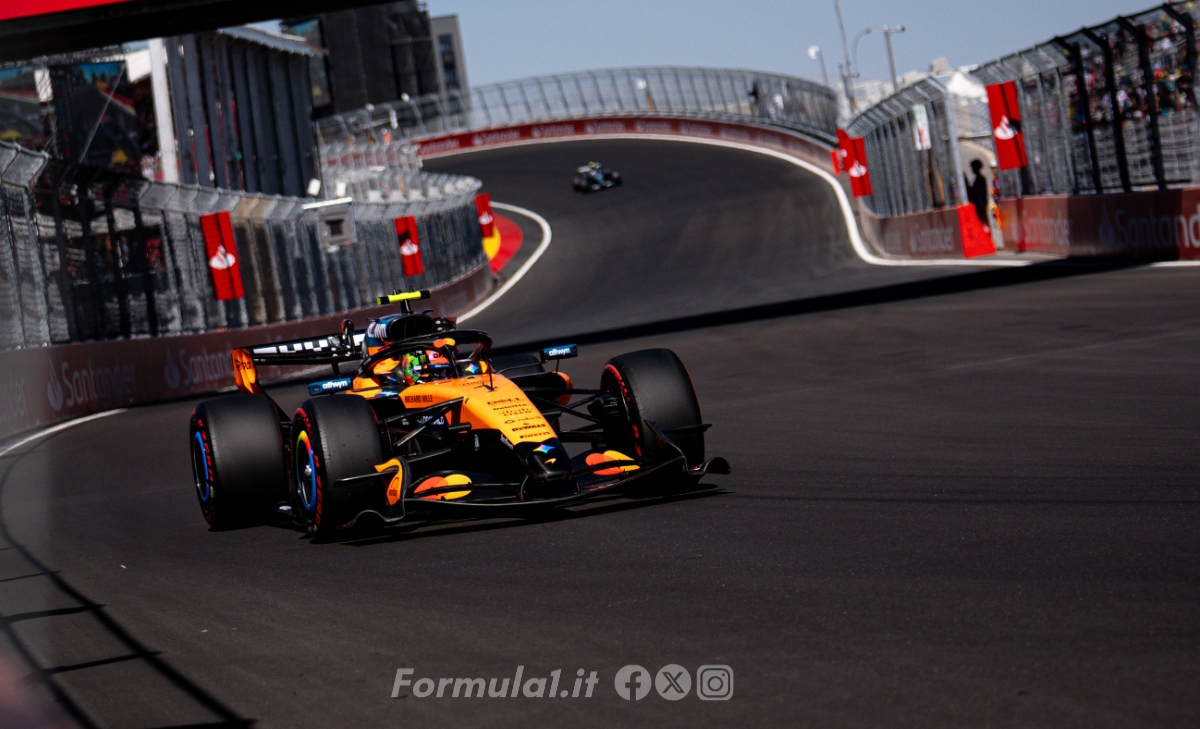
Norris’s pole position now deserves proper attention.
McLaren’s strategy with the World Champion is clear: maximise the available energy on the run after the first corner, then rely on the MCL40’s considerable chassis strengths for the rest of the lap.
The difference in energy deployment in the opening phase is striking, unlike what was seen between the two Ferraris in the previous comparison.

From there, Norris builds his advantage over Antonelli corner by corner in a linear fashion and, before the final right-hander, his margin stands at 373 thousandths.
At that point, the Briton made the error that he himself admitted over the radio.
Although he and Antonelli brake at virtually the same point, the Mercedes driver’s acceleration is clearly more immediate and progressive than the Briton’s more abrupt return to the throttle, evidence of a mistake.
The Briton in fact lost the rear right at the end of the lap, brushing the wall.

Where does Ferrari stand?
Comparing Hamilton’s lap with the pole lap helps us understand where Ferrari stands.
Hamilton deploys a great deal of energy on the pit straight but, after Turns 1-2, as already noted, McLaren responds emphatically and the gap grows to around two and a half tenths by the end of the first sector.
From that point, McLaren and Norris build their advantage steadily to four and a half tenths, particularly between Turns 13 and 20.
The MCL40 is superior not only through the two right-handers but also under acceleration, perhaps indicating greater energy availability at the end of the lap, which penalises the SF-26.
At Turn 19, Norris is up to 8 km/h faster than Hamilton despite no obvious mistake from the Ferrari driver, evidence of the excellent work done by the Woking technicians on a car carrying a great deal of aerodynamic downforce.
The exceptions, however, are the "Monumental", where Hamilton appears considerably more effective with equal throttle application and engine revs, and naturally the final corner, characterised by Norris’s error already mentioned.

Source www.gp-tempo.com
All the news, photos, weather, session times and times from the Spain GP 2026