 By:
By: The Italian Grand Prix weekend at Monza has historically been a particularly special event for the engineers of every team.
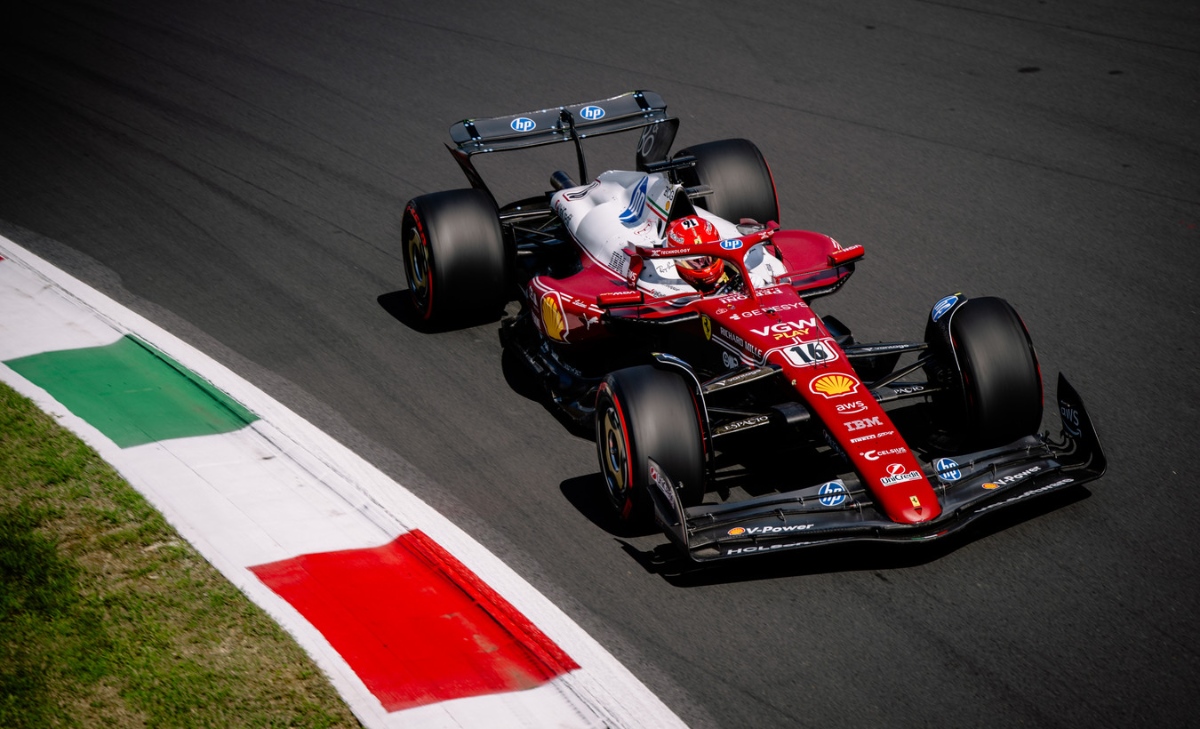
The long straights of the Brianza circuit have always provided a unique technical challenge within the Formula 1 World Championship, to the extent that cars were almost always equipped with aerodynamic configurations specifically designed for this track alone.
To minimise aerodynamic drag and maximise speed along the straights, the front and rear wings were adapted by reducing their angle of attack, camber and chord as much as possible.
The era of developments dedicated solely to the Monza circuit
All teams, to a greater or lesser extent, prepared a so-called “Monza package”, which often included bold and interesting solutions that were either raced or discarded depending on their effectiveness.
In this respect, perhaps the most striking case was the Williams FW19.
In 1997, the historic British team tested at Monza a rear wing featuring only the lower element, attached to the deformable structure connected to the gearbox, with no upper element at all (video).
The extreme configuration was never used in a race, but it remains an example of the creativity deployed in the relentless pursuit of higher top speed on Monza's straights.
Without going to such extremes, it is worth recalling the many solutions featuring a single-plane upper flap, most notably that used by the Renault R26, winner of both the Drivers' and Constructors' World Championships, which featured a single, almost neutral element in the centre that sloped slightly at the sides.
More recently, Red Bull raced in 2024 with a standard wing visibly cut back to reduce its chord in certain strategic areas.
Last year, Verstappen himself won the Italian Grand Prix with a rear wing that was again unloaded in the central section, starting from a low-downforce wing taken to an even greater extreme.

A technical era comes to an end
The current regulations, characterised by an equal split between electric and combustion power, the relentless search for energy to recharge the battery, and which have led to the introduction of active aerodynamics, could make dedicated configurations for this highly distinctive circuit redundant.
The presence of Straight Line Mode, which drastically changes the wing angle of the aerodynamic elements at both ends of the single-seater, should theoretically allow adequate downforce in the corners to coexist with extremely low aerodynamic drag on the straights.
Low-incidence solutions are therefore redundant or even disadvantageous under the current regulations.
We must therefore resign ourselves to saying goodbye to the so-called “Monza packages” and, perhaps, to many imaginative solutions too. These now remain the preserve of the Monaco Grand Prix alone, where this year there was no shortage of specific solutions precisely because they were aimed at the opposite objective: finding more downforce.
All the news, photos, weather, session times and times from the Italian GP 2026