 By:
By: With the championship reaching the 12th of the 22 rounds currently on the calendar, power unit management is entering an increasingly delicate phase. The Dutch Grand Prix effectively marks the start of the second half of the season, and the new FIA documents published at Zandvoort show that several drivers have now reached the maximum permitted allocation in one or more categories.
Teams do not fit a new unit only when the previous one can no longer be used. Components are rotated between practice, qualifying and the race, with the less worn items saved for the more demanding events and higher-mileage parts used in less important sessions. The raw count is therefore not solely an indicator of reliability; it also reflects the component rotation strategy selected by each team.
Adding further complexity is the ADUO variable. The mechanism introduced to allow struggling power unit manufacturers to recover some of their deficit can accelerate the introduction of new specifications and indirectly affect engine-pool management.
Several new components have been introduced at Zandvoort, but none of the changes notified by the FIA brings an additional automatic race penalty. The situation is nevertheless becoming more delicate for several drivers: Russell, Albon, Stroll, Alonso and Hülkenberg have reached four units in at least one of the ICE, turbo and EXH categories, while Verstappen and Lawson have used their third available MGU-K.
With (probably) 10 Grands Prix still to be held after the Dutch round, the remaining margin is becoming increasingly significant. Those who have reached their limit will have to complete the season by rotating the units already in their pool, or accept a penalty when an additional component becomes necessary.
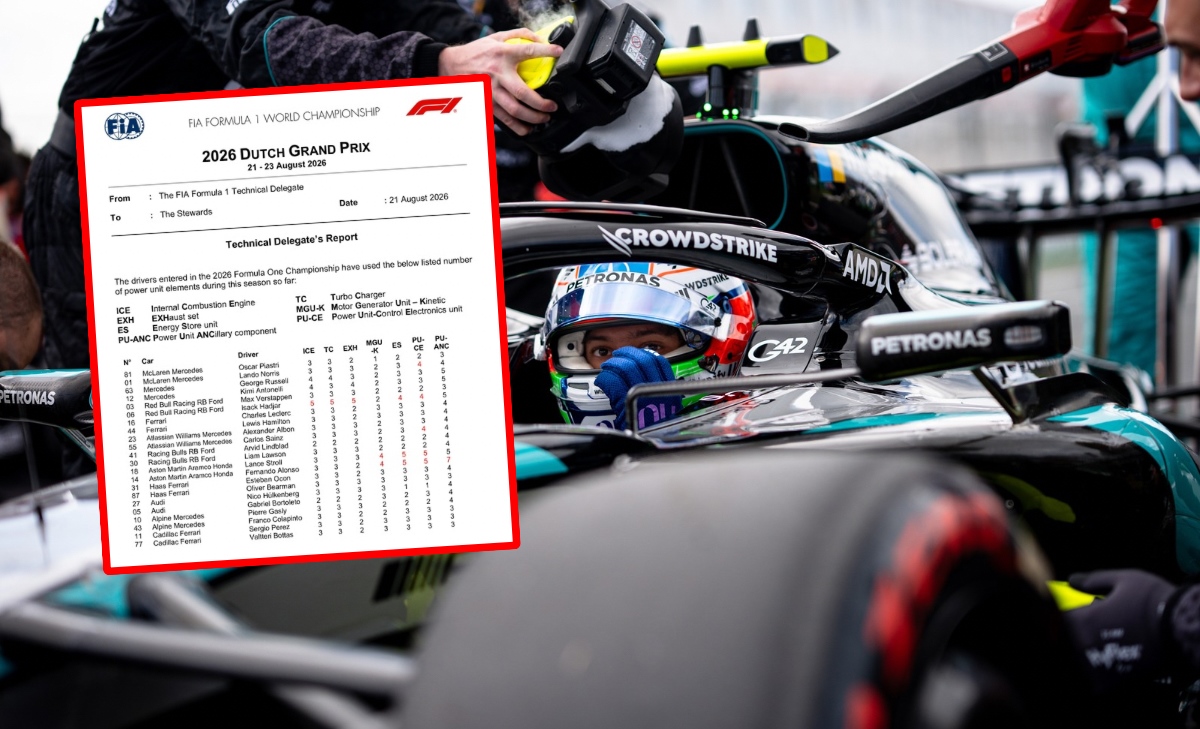
Updated table of components used by each driver in 2026
(Data updated on the basis of FIA documents covering PU elements used up to 22 August 2026 during the Dutch GP)
| No. | Team | Driver | ICE | TC | EXH | MGU-K | ES | PU-CE | PU-ANC |
|---|---|---|---|---|---|---|---|---|---|
| 81 | McLaren Mercedes | Oscar Piastri | 3 | 3 | 2 | 2 | 2 | 2 | 3 |
| 01 | McLaren Mercedes | Lando Norris | 3 | 3 | 3 | 2 | 3 | 4 | 4 |
| 63 | Mercedes | George Russell | 4 | 4 | 4 | 2 | 3 | 3 | 5 |
| 12 | Mercedes | Kimi Antonelli | 4 | 3 | 4 | 2 | 3 | 3 | 5 |
| 03 | Red Bull Racing RB Ford | Max Verstappen | 3 | 3 | 3 | 3 | 2 | 2 | 3 |
| 06 | Red Bull Racing RB Ford | Isack Hadjar | 5 | 5 | 5 | 2 | 4 | 4 | 5 |
| 16 | Ferrari | Charles Leclerc | 3 | 3 | 3 | 3 | 3 | 3 | 4 |
| 44 | Ferrari | Lewis Hamilton | 3 | 3 | 3 | 3 | 3 | 3 | 4 |
| 23 | Atlassian Williams Mercedes | Alexander Albon | 4 | 3 | 3 | 2 | 3 | 3 | 4 |
| 55 | Atlassian Williams Mercedes | Carlos Sainz | 3 | 3 | 3 | 2 | 2 | 4 | 4 |
| 41 | Racing Bulls RB Ford | Arvid Lindblad | 3 | 3 | 3 | 2 | 2 | 2 | 4 |
| 30 | Racing Bulls RB Ford | Liam Lawson | 3 | 3 | 3 | 3 | 2 | 2 | 4 |
| 18 | Aston Martin Aramco Honda | Lance Stroll | 4 | 4 | 3 | 4 | 5 | 5 | 6 |
| 14 | Aston Martin Aramco Honda | Fernando Alonso | 4 | 4 | 2 | 4 | 5 | 5 | 7 |
| 31 | Haas Ferrari | Esteban Ocon | 3 | 3 | 2 | 3 | 3 | 3 | 4 |
| 87 | Haas Ferrari | Oliver Bearman | 3 | 3 | 3 | 3 | 3 | 3 | 3 |
| 27 | Audi | Nico Hülkenberg | 4 | 4 | 4 | 3 | 1 | 1 | 5 |
| 05 | Audi | Gabriel Bortoleto | 2 | 2 | 2 | 3 | 2 | 3 | 4 |
| 10 | Alpine Mercedes | Pierre Gasly | 3 | 3 | 3 | 2 | 2 | 2 | 4 |
| 43 | Alpine Mercedes | Franco Colapinto | 3 | 3 | 2 | 2 | 3 | 3 | 3 |
| 11 | Cadillac Ferrari | Sergio Perez | 3 | 3 | 2 | 3 | 3 | 3 | 3 |
| 77 | Cadillac Ferrari | Valtteri Bottas | 3 | 3 | 2 | 3 | 3 | 3 | 3 |
Orange = final component available before a penalty | Red = regulatory limit exceeded
The current situation: who is at risk of a penalty?
The regulatory framework is set out in Article B8.2 – Power Unit Limitations & Usage, which defines the maximum number of components that may be used, the counting criteria and the penalties applied for exceeding the limits. For 2026 only, the first year of the new technical cycle, the regulations allow one additional component in each category. The seasonal limits therefore rise to 4 ICEs, 4 TCs, 4 EXHs, 3 MGU-Ks, 3 ESs, 3 PU-CEs and 6 PU-ANCs.
When a driver exceeds the permitted allocation, grid penalties apply: 10 places for the first additional unit and five places for every further component added in the same category. The penalties are cumulative and are applied at the event in which the new component is fitted. If more than one additional unit of the same type is introduced during the same weekend, only the last may be reused at subsequent Grands Prix without incurring another sanction. Certain EXC or minor parts may still be replaced without penalty, provided the work is carried out under FIA supervision and with compliant components.
The FIA documents published for Zandvoort show a relatively significant use of new units, but no additional penalties. Albon, Lindblad, Stroll and Alonso have introduced a new ICE; Lindblad, Stroll and Alonso have also taken a new turbo. Russell, Leclerc, Hamilton and Lindblad have instead fitted new exhausts (EXH). On the electrical side, Piastri moved onto his second MGU-K, while Verstappen and Lawson introduced their third and final available unit.
A further FIA document dated 22 August concerns Nico Hülkenberg. Audi fitted his fourth ICE, fourth turbo and fourth EXH, taking the German to the regulatory limit in all three categories simultaneously. Hülkenberg also introduced his fifth PU-ANC, still within the permitted allocation of six.
Lance Stroll also received a new PU-ANC, moving from his fifth to his sixth. The Canadian has therefore used all the auxiliary components permitted for 2026. His position nevertheless remains critical in the MGU-K, ES and PU-CE categories, where he had already exceeded the limit.
The drivers who have already exceeded at least one regulatory limit remain Lando Norris, Carlos Sainz, Isack Hadjar, Lance Stroll and Fernando Alonso. Norris and Sainz have used four PU-CEs against the permitted three. Hadjar has the most compromised situation, with five ICEs, five TCs, five EXHs, four ESs and four PU-CEs, putting him over the limit in five different categories.
Aston Martin's management situation also remains particularly delicate. Stroll has reached four ICEs, four TCs and six PU-ANCs, in addition to already using four MGU-Ks, five ESs and five PU-CEs. Alonso has reached four ICEs and TCs and remains over the limit with four MGU-Ks, five ESs, five PU-CEs and seven PU-ANCs. For both drivers, the remaining margin for the second half of the season is therefore very limited.
Among the drivers who have not yet gone over the limit, George Russell is one of the most delicate cases: at Zandvoort he reached four ICEs, TCs and EXHs, and has also used three ESs and three PU-CEs. Antonelli has likewise exhausted his margin on ICEs and EXHs, as well as reaching his third ES and third PU-CE. Albon has reached his fourth ICE and is at the limit on ES and control electronics.
Ferrari have not yet exhausted their margin on the internal combustion engine components, but both Leclerc and Hamilton have now used all three available MGU-Ks, ESs and PU-CEs. At Zandvoort, both also moved onto their third EXH. Verstappen and Lawson, meanwhile, have reached the three-MGU-K limit, while retaining at least one replacement in the other main categories.
At Audi, Hülkenberg's position has changed significantly. The German is now at the limit on ICE, TC, EXH and MGU-K, although he retains a particularly large margin on the electrical side, having used just one ES and one PU-CE. Bortoleto, meanwhile, has exhausted his margin on MGU-K and PU-CE, but still has ample availability in the internal combustion components.
Ocon, Bearman, Perez and Bottas have reached three units for MGU-K, ES and PU-CE, while Colapinto is at the limit on ES and control electronics. Norris, already over the limit on PU-CE, has also used all three available ESs.
The situation is more favourable for Piastri, Gasly and Lindblad. The McLaren driver introduced only his second MGU-K at Zandvoort, while Gasly has not yet reached the limit in any of the main categories. Lindblad has taken his ICE, TC and EXH totals to three, leaving one unit available in each of the three internal combustion component categories.
2026 Dutch GP: complete guide
This is the sixth of the six technical features we regularly publish on formula1.it to accompany each race weekend. At Zandvoort, the power unit situation sits alongside our analysis of the new developments seen in the pitlane, the updates officially declared by the teams, tyre and strategy analysis, the event's TV and streaming schedule, and an examination of brakes and energy management at a circuit that is particularly demanding aerodynamically.
The article in two minutes
The Dutch GP marks the start of the second half of the championship, and power unit management is becoming increasingly delicate. The new FIA documents published at Zandvoort show several component changes, but none of the replacements made this weekend brings an additional automatic race penalty.
The situation remains critical, however, for five drivers already over the limits: Norris and Sainz have exceeded the PU-CE allocation, while Hadjar is over the maximum in five different categories. Aston Martin's situation is even more complex: Stroll has already exceeded the MGU-K, ES and PU-CE limits, while Alonso is also over the limit on PU-ANCs.
Among those who have not yet incurred penalties, the margin has nevertheless reduced significantly. Russell has reached four ICEs, turbos and EXHs; Antonelli is at the limit on ICE and EXH; Hülkenberg has exhausted his margin on ICE, TC, EXH and MGU-K. Verstappen and Lawson, meanwhile, have used their third and final available MGU-K.
With (probably) 10 Grands Prix still to be held after Zandvoort, many teams will therefore have to manage the rotation of the units already used carefully. MGU-Ks, energy stores and control electronics remain the most delicate areas, but the margin on internal combustion components is also beginning to shrink rapidly.
All the news, photos, weather, session times and times from the Dutch GP 2026