 By:
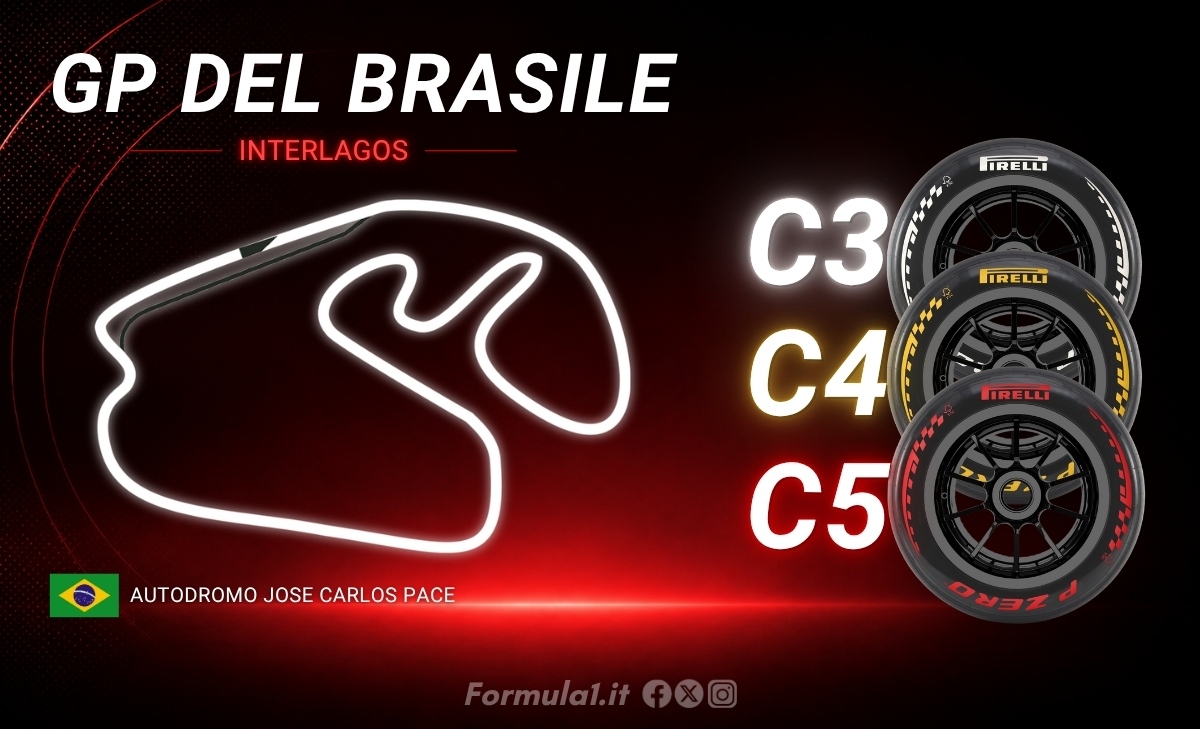
The final round of the American triple-header will be the São Paulo Grand Prix, held at the José Carlos Pace circuit in Interlagos. For this iconic venue, Pirelli has opted for the softest compounds in its range: the C3 as Hard, the C4 as Medium and the C5 as Soft – one step softer than last year, when the weekend featured the Sprint format.
The Brazilian circuit has undergone several changes since last season. During the year, resurfacing work was carried out between Turns 3 and 5, and between Turns 8 and 9. These newly resurfaced areas could affect grip levels and track evolution over the weekend, particularly influencing tyre behaviour during longer stints. The three practice sessions will provide an opportunity to assess track evolution and understand how the new surface affects degradation and wear.
In 2025, tyre degradation was one of the key technical factors at São Paulo. Although graining was less pronounced than initially expected, the C2 compound, used as the hard tyre, showed some tendency to slide, while the C3 and C4 compounds suffered significant degradation, although they still allowed competitive stints. As a result, the most effective strategy proved to be a two-stop race.
In terms of tyre loads, Interlagos generates overall average lateral forces, while combining several high-speed corners with long straights. The circuit therefore does not place extreme demands on the tyres, with loads distributed fairly evenly between the front and rear axles.

The numerous overtaking opportunities offered by the circuit’s flowing layout give teams a degree of strategic flexibility, but managing degradation traditionally remains the key factor in maximising race performance. Finding the right balance between single-lap pace and tyre management over longer stints will be one of the teams’ main objectives during the Brazilian weekend.
It is also worth remembering that, given the event’s position on the calendar, Interlagos is a circuit where rain and significant temperature swings are often decisive factors. Intermediate and wet tyres could therefore come into play in Brazil again this year.
Last year
The Medium and Soft compounds were the most widely used at the 2025 São Paulo Grand Prix, which featured a wide variety of strategies. The most common approach was a two-stop race, adopted by most teams due to tyre degradation levels and a series of early pit stops prompted by an early neutralisation period. Pit-stop windows varied from driver to driver, creating different gaps that encouraged overtaking opportunities. Only two drivers completed the race with a single pit stop. The Hard compound was used only for a few short stints.
A special podium cap
In Brazil, too, the cap worn on the podium by the top three finishers will be a special version, created for Pirelli Design by designer Denis Dekovic. This weekend’s edition is inspired by the blue shirt worn by the Brazilian national football team in 1958. The cap features a jaguar pattern, recalling the coat of this iconic animal, which is widespread throughout the country and, as always, will be available for fans to purchase via Pirelli’s dedicated website.


Internal photo f1pressarea.pirelli.com
All the news, photos, weather, session times and times from the Brazilian GP 2026