 By:
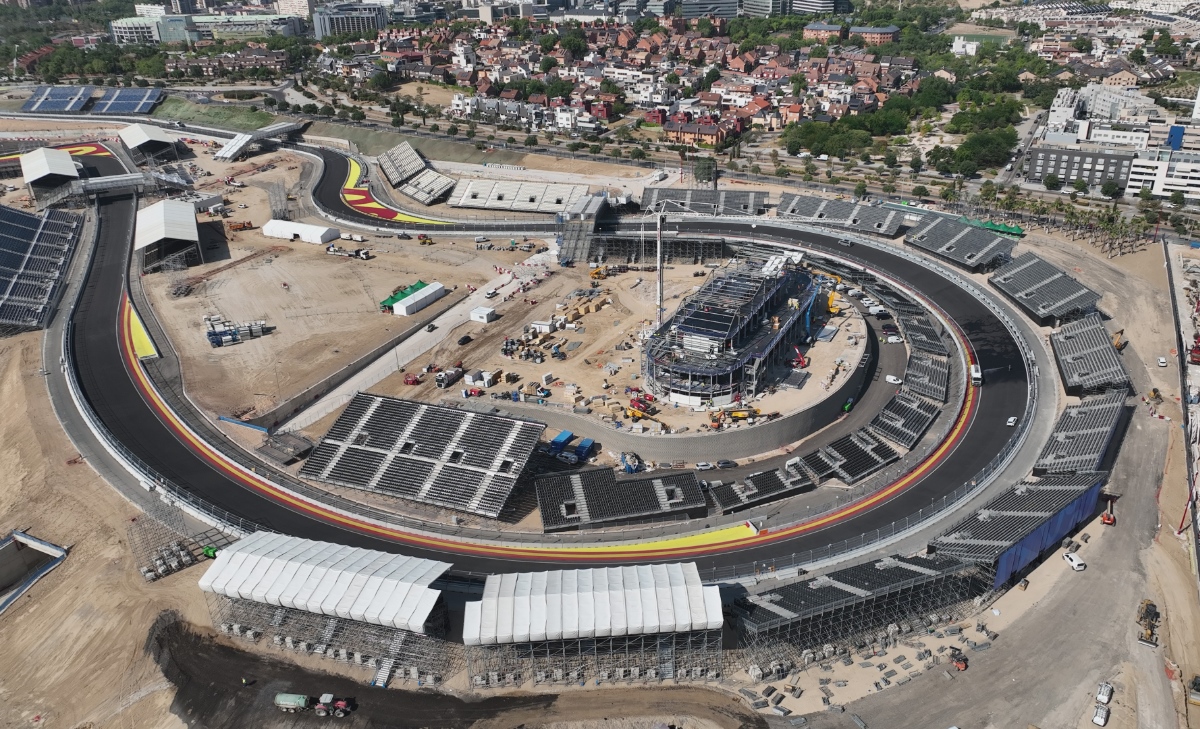
By: The first Spanish Grand Prix held at the new Madrid circuit left mixed feelings in its wake. The Madring arrived in Formula 1 as one of the most ambitious projects of recent years: a technically distinctive track set within a complex urban environment, featuring compelling solutions, above all the spectacular banked Monumental corner.
On paper, all the ingredients were there for something different. Once the 2026 cars took to the track, however, the reality proved considerably more complicated. The race offered limited spectacle, with just four overtakes, above all highlighting the cars’ difficulties in following closely and finding genuine opportunities to attack.
Inevitably, discussions about the circuit’s future began in the hours following the Grand Prix, with the track set to remain on the calendar until 2035. There has been talk of the need to alter certain sections of the layout, with criticism directed primarily at those who designed the circuit, as the Madring layout quickly came under scrutiny.
But how much of what we saw during the Madrid weekend actually corresponds to the original project?
That was precisely the question from which we started. Formula1.it spoke exclusively to Dromo, the Italian company that designed the Madring and worked on the circuit’s development before its supervisory relationship was terminated in September 2025.
The result was a long conversation in which Jarno Zaffelli explained every detail of a project that proved far more complex than it might appear from simply looking at the circuit plan.
Dromo’s position is clear: the circuit plan is the one designed by the Italian company, but a project is not merely a line viewed from above. Three-dimensional geometry, cambers, transitions, kerbs and run-off areas all contribute to determining how a track behaves, and several of these elements are said to have subsequently been changed.
Asphalt, camber, gradients, kerbs, run-off areas and even surface preparation are just some of the aspects over which Dromo raises important questions. Added to these is another crucial variable: the characteristics of the new 2026 cars and energy management which, according to the designers, further altered the conditions around which the circuit had been developed.
It is a story we have chosen to tell from the beginning.

Is the Madring seen during Formula 1’s first Spanish Grand Prix really the circuit designed by Dromo? Yes, when viewed in plan. But the plan alone is not enough: according to those who designed the track, what was ultimately built features important differences from the original intentions.
"Is the track as we designed it? Absolutely, yes. If you look at it vertically, the plan is the one we designed. But a track is not just its plan," Jarno Zaffelli told us. The issue, however, is said to lie in everything that happened afterwards.
"We created that layout from scratch and we know how to do these things. The problem, however, is that when you are dealing with projects as big as Formula 1, there are many people who get involved: the FIA tells you one thing, Formula 1 tells you another and we, as designers, are always very reluctant, after making a decision, to accept a change without first understanding the overall logic behind it."
"I’ll give you an example: when we left the supervision contract in September 2025, we had not yet started laying the asphalt and, as happens in every project, methodologies, technical details and proprietary know-how follow precise development stages and a contractual framework."
"After we left the supervision contract, the project continued to evolve and in several areas the configuration that was built no longer corresponds to the design intention with which we developed it. The plan remains recognisable, but a track is not just its plan. I will continue to put my name to it because I have nothing to hide and I know we did the best possible job within the limits we had been given."
To understand the story, however, we need to go back a few years. Contrary to what the images of the IFEMA area might suggest, the Italian designers never had a completely blank sheet of paper on which to create the track – quite the opposite.
The layout had to coexist with existing roads or those already planned as part of the area’s development, as well as with the Plan Especial planned for the Valdebebas area.
"The main objective set by the organisers for this track was for it to wind around the IFEMA exhibition halls precisely because they had to be showcased. When we arrived, the first concept called for the pit building to be in the north, right where Formula 1 believed nothing had been developed."
"Essentially, F1 had created a project with a straight, a big Indianapolis-style sweeping corner and then another straight entering the tunnel and returning, with only a chicane to create a braking point."
"What they did not know, however, was that there was a major problem. Even before Covid, what is still called the Plan Especial had been approved in the Valdebebas area: an urban development plan setting out that IFEMA halls, ancillary buildings for other purposes, a large number of car parks and the roads to reach those areas would have to be built there."
"There is nothing secret about this because it is a public plan, which everyone knows about and can consult online, where you can also see the images with the halls overlaid that we then removed from the final project. That does not mean they would not have been there, but rather that at that time they had not yet been built."
According to ElDiario.es, as early as 30 July 2024 there was talk of a figure of €47.5 million, with most of the sum intended for the construction of three new halls at the exhibition site, which were then expected to house facilities such as the paddock or workshops.

Photo: studiodromo.it
Halls 11 and 12 had an estimated cost of €10,371,585 each, while Hall 14 was expected to require an investment of almost €15 million. Added to this were more than €2.5 million for a new heavy-vehicle car park and more than €3 million for urban development works.
Looking at Dromo’s plans, it is clear that everything had already been scheduled, including buildings and technical areas that are still not present in Madrid today but will soon be built in the future.
Continuing on this subject, Zaffelli added: "We were asked to use exclusively existing roads, so as not to create too many that would then remain unused during the year. The only exception granted to us concerned the Monumental section from Turn 10 to Turn 13."
"People think we had a blank sheet of paper because they do not know that half the city still had to be built at that time, to the extent that a large part of our work was the creation of a genuine exhibition district, the one to the north, which has still not been built today."
"That was our real blank sheet of paper, obviously in plan. We were then able to make a couple of changes, but since we could not build things that would not be used during the year, we had to adapt. The only freedom was being able to create the Monumental area, because it was in an area where no other construction was planned and we were therefore freer from constraints."
"Even there, however, the difficulty was using the full creative process, typically Italian, needed to work within highly restrictive constraints and build a track with balls. When the drivers went out on Thursday, they were shocked and, on Friday and Saturday, when they ran at full power in practice, they said it was a fantastic track."
Another unknown further complicated the work: Formula 1’s new technical regulations. When the layout began to take shape, the 2026 cars were still being defined. Dromo therefore says it worked alongside the FIA and Formula 1 while the characteristics of the cars continued to change.
"Try to imagine being a client who has to spend hundreds of millions of euros to build a racing circuit, referring to regulations that do not yet exist, or worse still, relying exclusively on the rules. When designing a circuit, you must never look exclusively at the regulations; you have to create the layout for the client’s business and for the type of racing that will be held there."
The break in 2025
The turning point came in September 2025, when Dromo left the supervision contract. From that point onwards, the configuration that was built contained several changes from Dromo’s reference project.
"After we left supervision, the project continued to evolve and some choices no longer correspond to our solution."
Dromo cites a specific example: the section between Turns 1 and 5. "For us, that was a section that had to be built entirely in asphalt, in all layers. As soon as they removed us, they decided to build it in concrete, which has completely different stiffness and a different level of flatness."
But the issue is said not to concern only the construction of the roadbed. Camber, gradients and asphalt treatment are also said to have been changed from the original intentions. Dromo gives a very specific example: "We had designed that track with continuously variable crossfall.

For example, Turn 11, the one leading into the Monumental, was completely off-camber in our project; in the built configuration it became on-camber."
"If I design a track with low grip, with Turn 11 leading into the Monumental and made difficult because it is off-camber, I ensure that drivers are inclined to make mistakes on entry so that, when they reach Turn 13, they can fight for an overtake on a low-grip surface.
But if you change the asphalt and change the entry geometry, the dynamics are already different from what we designed. Then, during the weekend, the issue of Power Unit management was also added: the FIA document provided for Alt 1 mode from T5 to T22, from 1,500 to 5,100 metres, meaning 3.6km of the 5.416km lap. But that is an additional factor: the geometric differences already existed and were enough to change our design intention."
The contractual issue
During our long conversation, an even more delicate issue was then raised concerning the contractual relationship with IFEMA. Zaffelli focused above all on the licence agreement, which was separate from the supervision relationship: "Modifying a project does not automatically create a new and independent chain of rights."
"The licence did not give IFEMA an unlimited position over Dromo IP Rights, nor over their subsequent versions, modifications and derivatives; uses requiring our consent did not become unrestricted simply by assigning them to a third party. And today, it is not only us saying this, but also the Cologne judges who examined the case. The use, versions, modifications and derivatives of Dromo IP Rights remain within the scope of the licence and, where provided for, require our authorisation."
According to findings from the forensic investigation in the German proceedings, Dromo materials were already present in the systems of the Tilke companies involved in the proceedings in February 2025, several months before Dromo left supervision. "This is the chronological fact that matters to us: our materials were already there while we were still involved in the project. I am not attributing further motives or responsibilities here: those are for the courts."
This is, naturally, the account provided by Dromo, within a matter involving contractual relationships and decisions taken by several parties. The Cologne decision is interim and has been appealed, but its reasoning expressly addresses the limits of the licence and the principle that IFEMA could not transfer to third parties more rights than it had acquired.
One thing, however, is asserted strongly: Dromo does not disown the Madring. On the contrary, as already stated, Zaffelli has nothing to hide because he is aware that his team did the best possible job within the constraints imposed upon it.
The Italian designers’ argument is another one: the drawing remained theirs, but some of the elements that determine the track’s real-world behaviour are said to have changed. It is precisely by examining the details of Turn 5, Turn 11, the Monumental, the asphalt and the gradients that one understands how great the difference can be between designing a circuit and actually building it.
We thank Jarno Zaffelli and Studio Dromo for their kindness and availability during the interview. Partial reproduction of this exclusive content is permitted provided the author (Giuseppe Cianci) and Formula1.it are credited, with a link to the original content.
Photo: Madring