 By:
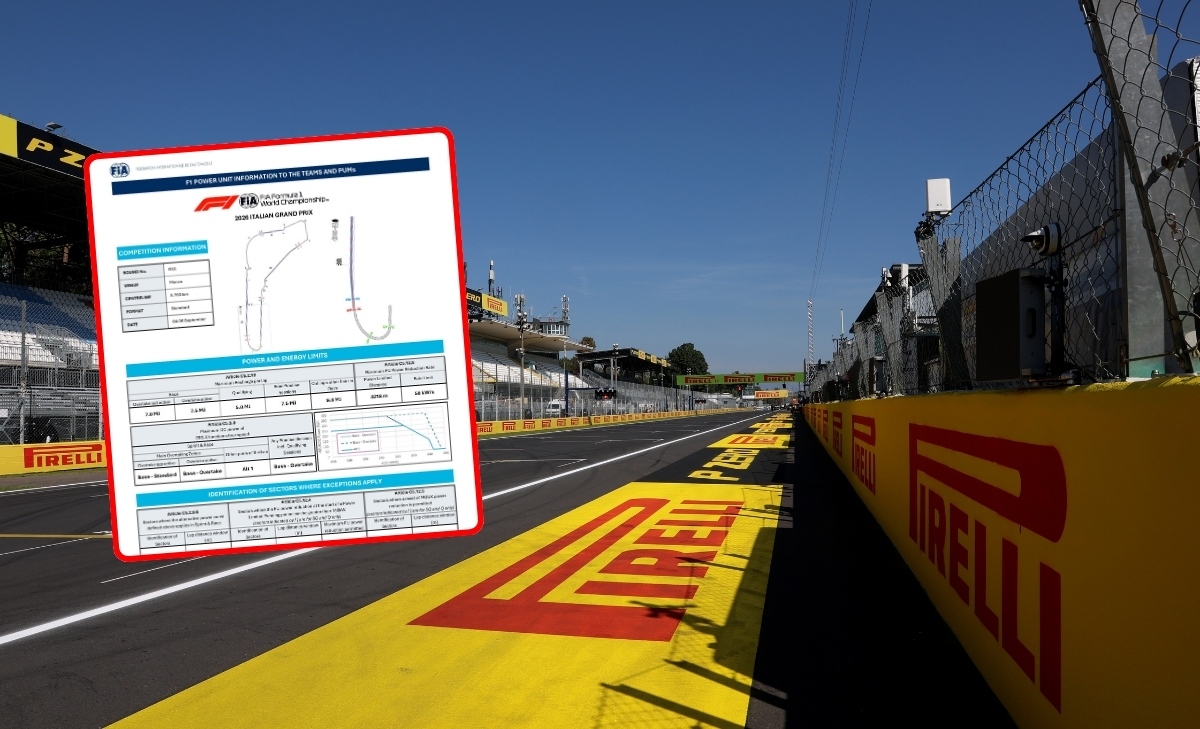
By: The Power Unit Information document published by the FIA just minutes ago for the Italian Grand Prix confirms what had already become one of the main talking points in the Monza paddock: the ‘Temple of Speed’ risks being the circuit where the troublesome compromises and some of the paradoxes introduced by the 2026 regulations become most apparent.
Before the summer break, we published an article explaining how to read this complicated document. The most significant figure concerns Maximum Recharge per Lap, namely the maximum amount of energy that can be recovered by the ERS-K over a lap. At Monza, the FIA has set just 5.0 MJ in qualifying, while 7.0 MJ will be available in the race without Overtake and 7.5 MJ with Overtake active. These are extremely low values: the qualifying limit is the lowest of all the documents published so far.
The comparison with other fast circuits makes the decision even clearer. At Silverstone, 6.5 MJ was permitted in qualifying and 8.0-8.5 MJ in the race, with a Power Limited Distance of 3,833 metres. At Spa, another circuit that is extremely demanding from an energy perspective, the limit rose to 7.0 MJ in qualifying and 8.5-9.0 MJ in the race, with a Power Limited Distance of 4,594 metres.
Monza therefore sits at an even more extreme end of the scale. The main reason for reducing the recoverable energy is precisely the attempt to contain super clipping. On a circuit where almost 80% of the lap is spent at full throttle, there are few natural opportunities to recover energy under braking. Allowing very high recovery would therefore force the power units to turn the MGU-K into a generator even during long full-throttle sections, causing speed to fall well before the braking zone.
The FIA has therefore chosen the other side of the compromise: drastically limiting how much can be recovered. Super clipping should become less extreme, but inevitably there will also be less energy available to use on the straights. And that is where the paradox arises.
The document lists a Power Limited Distance of 4,218 metres and a rate limit of 50 kW/s for Monza. The latter figure is the same as that used at Silverstone and Spa, but it is worth focusing for a moment on the Hungaroring, where the distance was only 1,885 metres and the reduction could take place at 100 kW/s. Above all, 9 MJ was available in qualifying in Hungary and up to 9 MJ in the race with Overtake. In other words, Budapest was a much more ‘energy-rich’ circuit, where the MGU-K could be supplied more consistently. At Monza, by contrast, the lack of frequent braking zones leaves the electrical system starved of energy on the very long straights where it should deliver maximum power.
And now for the paradox: McLaren simulations cited by Oscar Piastri produced an almost surreal scenario, in which the car could have reached higher speeds on the Hungaroring straight than those expected at Monza, despite using an ultra-low-downforce aerodynamic configuration and active aerodynamics in Italy. Piastri explained the problem well: increasing recovery would create too much super clipping; reducing it, as the FIA has done, instead leaves too little energy to deploy.
It is probably the most effective illustration of the problem with the 2026 rules: at the circuit historically synonymous with speed, the cars could reach lower top speeds than at a twisty track such as Budapest. And during the race, those ‘elastic-band’ overtakes could emerge again, dictated more by the differing amount of energy remaining available to the cars than by any genuine performance difference.
Finally, there is one detail that has not gone unnoticed. The FIA published the Monza document at 20:50 on Thursday, when media activity is significantly reduced. Among the documents analysed, it is the latest publication time: Spa’s arrived at 12:38, Silverstone’s at 19:00 and even Hungary’s, already rather late, at 19:35. Naturally, there is no evidence that the choice of timing was deliberate. But the timing is at the very least unusual, especially given that drivers’ criticism of energy management had dominated discussions during media day. Publishing only late in the evening the figures that show just how exceptional power-unit management will be at Monza inevitably fuels suspicions that the FIA preferred to avoid those data immediately becoming the focus of questions and controversy in the paddock.

All the news, photos, weather, session times and times from the Italian GP 2026