 By:
By: In recent days, several media outlets have reported that Scuderia Ferrari will bring a special livery inspired by that of the F310, the car that contested the 1996 World Championship, to its home race at Monza.
The suggestion appears to be confirmed by a short video published on Ferrari’s social-media channels, in which the nose of the iconic car from 30 years ago can be glimpsed.
Why is the F310 important to Ferrari?

But why is this car so important?
Why pay tribute to this single-seater now?
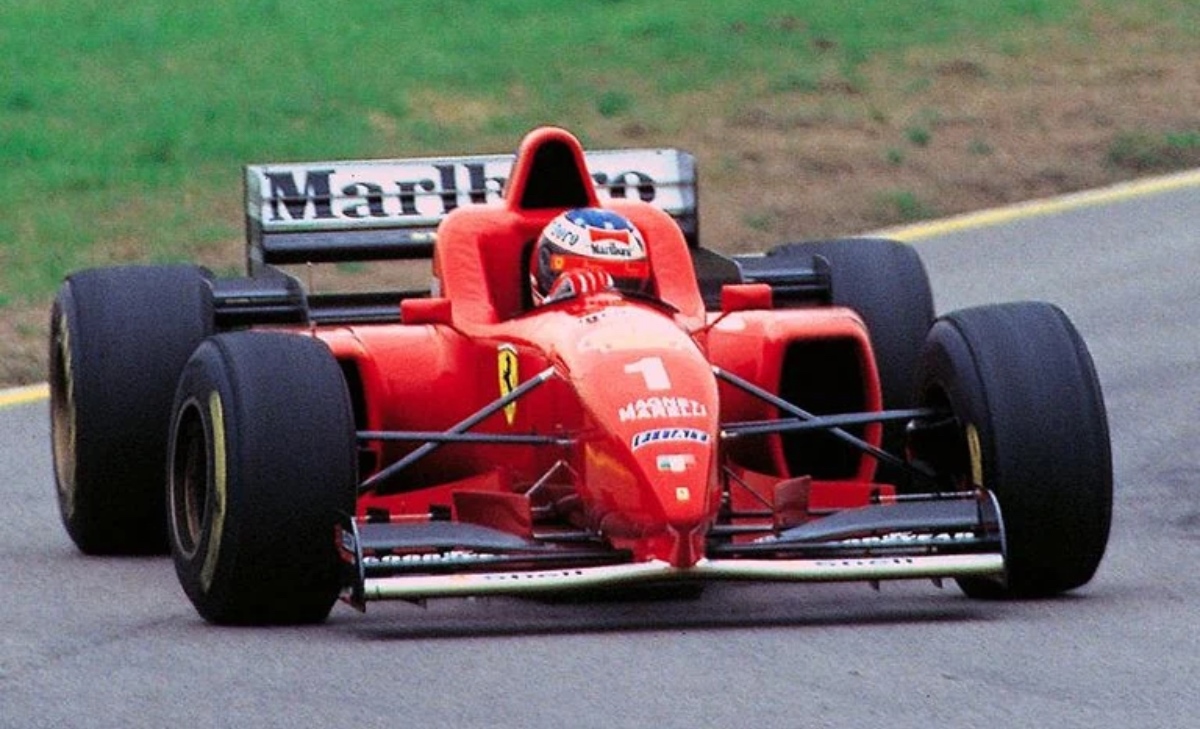
First and foremost, it should be remembered that the F310 was the car in which Michael Schumacher contested his first championship under the Prancing Horse banner, in 1996 — 30 years ago, in fact.
Moreover, Schumacher, who had won the drivers’ title with Benetton in 1995, brought with him the number 1 seen on the nose of the car in the aforementioned video — a number absent from Ferrari’s bodywork since 1990.
Given the importance the seven-time German World Champion had in Ferrari’s history, paying tribute to the beginning of one of the most compelling and successful partnerships in Formula 1 history would in itself be enough to explain the reasoning behind this nostalgic homage.
Many flaws and some major strengths
However, the F310 was a highly distinctive car, one worthy of being remembered for some of the features that made it unique... and for its flaws, too.
First of all, the car designed by the brilliant John Barnard abandoned Ferrari’s much-loved V12 architecture in favour of a more rational V10.
The 310 designation itself referred to the 3,000cc capacity mandated by the regulations and the 10-cylinder configuration of the new power unit.
The 75-degree-bank V10 designed by engineer Paolo Martinelli represented an epochal turning point, albeit a necessary one, for the Prancing Horse marque, giving it a more compact and less thirsty unit.
It should be remembered, however, that when Schumacher tested the F310’s predecessor at Fiorano, fitted with the final V12 Formula 1 racing engine developed by Maranello, he was said to have been deeply impressed and surprised that Ferrari had not won the World Championship with such an engine.
Barnard’s single-seater also stood out for its unprecedented, statuesque lines.

The highly voluminous sidepods featured two air intakes detached from the bodywork, both at the sides and underneath, with a clear aviation-inspired influence. In some respects, they echoed a concept very similar to that introduced on the ill-fated F92A a few years earlier.
Equally striking were the protective structures alongside the driver’s head, made mandatory from that season. They were so bulky that the F310 earned the unflattering nickname of the “bathtub” before it had even turned a wheel on track.
By comparison, Williams had a markedly sleeker profile in that area thanks to an intelligent interpretation of the regulations, which used the rear of the roll-hoop structure rather than its foremost point as the reference, allowing for a considerably steeper angle.
This cockpit-area configuration caused no shortage of headaches for Maranello’s engineers and even the drivers, as it prevented the V10 from being properly fed through the airbox above the driver’s head.
It was not unusual to see Schumacher and Irvine, who were entrusted with the F310, tilting their heads to one side on the straights to help airflow reach the airbox — something utterly inconceivable today.
For all that, it could not be called an ugly car, even if that may be an important criterion for a racing car; it certainly featured unconventional solutions. The nose remained low and sloping, slightly detached from the mainplane and connected to it by the suggestion of a single pillar.
Later, from the Canadian Grand Prix onwards, the F310 was converted to a high nose, forcefully blended into a chassis clearly not designed for that purpose, earning it another nickname: “the pelican”.

At the rear, it should be noted that the F310 still used a transverse gearbox inherited from its predecessors, rather than a longitudinal gearbox such as that of the dominant Williams, which would become the standard for Formula 1 cars through to the present day.
Despite its fairly traditional architecture, the gearbox proved so unreliable that the team was forced to use an interim version until the fourth race, finally switching to the definitive specification from the Belgian Grand Prix.
The car’s overall reliability was a significant issue, and retirements were numerous.
So what made such a problematic car so special?

In Schumacher’s hands, it was special because it claimed no fewer than four pole positions (Belgium, Italy, Portugal and Japan) and three victories (Spain, Italy and Portugal). The win in the Barcelona deluge demonstrated the German champion’s peerless ability, while at Monza he took Ferrari to the top step of its home podium after eight years of waiting.
With the F310, Schumacher made the seemingly untouchable Williams FW18 look far less dominant than it truly was, allowing Ferrari to finish second in the constructors’ championship.
It was the car with which Ferrari introduced its first multifunction steering wheel, which would become a formidable weapon in Schumacher’s hands. He was a driver more capable than anyone else of exploiting the ability to adjust the car’s functions while on track.
The engine dynasties that won everything between 2000 and 2008 were based on the V10 introduced back in 1996.
Finally, it was a red car.
That may sound trivial, but its colour scheme — which will be echoed by the SF-26 tribute livery — should please Sir Lewis Hamilton, who in recent months had expressed his desire to one day drive a Ferrari in its traditional all-red livery, without white.
All the news, photos, weather, session times and times from the Italian GP 2026