 By:
By: In recent years, the number of Italian drivers chasing a Formula 1 seat has grown significantly, particularly in Formula 3 and Formula 2. Alongside Andrea Kimi Antonelli, who returned the Italian flag to the paddock after several years following Antonio Giovinazzi, young talents such as Brando Badoer, Nicola Lacorte, Matteo De Palo and Gabriele Minì are waiting in the wings.
The latter has stood out during the 2026 season in one of the most competitive grids of recent years, battling drivers of the calibre of Dino Beganovic, already his rival in Formula Regional, as well as Rafael Camara and Nikola Tsolov.
In recent days, Formula1.it had the pleasure and honour of speaking exclusively with a fellow Italian who is flying the flag for Italy and Sicily around the world.
The 2005-born driver, represented by All Road Management, the same agency that represents Charles Leclerc, also has the support of the Alpine Academy. It was on this subject that we began our fascinating conversation, asking whether he had been able to speak over the years not only with the Enstone engineers but also with Pierre Gasly and Franco Colapinto, in order to gain ever more information and insights into how to drive a Formula 1 car.
“I have a good relationship with both Pierre and Franco, and I speak to them a lot. Obviously, none of the three of us has a huge amount of time to chat about different topics or consult one another, but when we see each other we talk normally, and not necessarily about motorsport-related matters.”
“Then, of course, there are people such as the academy director who come to the track specifically to follow our races, and in that case we talk in a little more detail, focusing on the aspects of the work that are going well and, above all, those that need improving. Obviously, all drivers do this work every weekend, but I do it in particular with Alpine’s experts.”
“Another fantastic opportunity we have with the Academy is being able to speak directly with the team’s engineers, also watching the races from the garage and looking at the telemetry of the two drivers, which, despite being Formula 1 and therefore a different car, always helps me to grow.”

Continuing with the French team’s young driver programme, the young Sicilian had the opportunity to make his Formula 1 debut during a private test at Silverstone this summer. The experience was repeated at Portimao just a few weeks ago.
Asked to explain, as far as possible, how it felt to climb into the cockpit, Gabriele replied: “Fortunately, it wasn’t my first time, so I more or less knew what to expect, but in general driving a Formula 1 car is always an incredible emotion. The car is absurd, truly unimaginable, even for us Formula 2 drivers. You have so much grip, so much power, and it is incredibly difficult to explain just how fast these cars are.”
He went on: “I also had the opportunity to try the previous-generation car, the 2025 one, which was even better in the corners. Something truly absurd. Overall, the feeling was really very good, both in race simulation and over a single lap, where we were competitive.”
“I think it was a very nice, exciting experience, but also a positive one from a performance point of view.”
There are still many people who believe racing drivers are not truly athletes. The reality, however, is completely different. In order to finish a race while remaining competitive and fighting for victory, the young talents we see racing in the junior categories must be well prepared both physically and mentally. Interested in this subject, particularly given the physical transformation the 21-year-old underwent last year, we asked him what matters most to him.
“I think mental training is almost more important than physical training. Managing your emotions before qualifying or a race is very important. Then, obviously, if you are not physically in good shape by the end of the race, everything becomes much more difficult, so it is important to balance both things. Once your physical condition is where it needs to be, you only have to maintain it; on the other hand, the mental side is constantly evolving and you are always being tested every weekend.”
Speaking about his physical transformation, he revealed: “I did a lot of training both with Alpine and at home, also changing my diet and trying to gain a lot of mass. In fact, I gained around 10 kilos between the winter of 2024 and the start of the 2025 season. Obviously, I have managed to maintain it, continually improving my strength, but I do not have one particular workout. When I go to the gym, I try to work all muscle groups, training around four or five times a week, and even during the summer break, honestly, I did not have much of a holiday. I was back in the gym the day after the Budapest GP.”
The first part of our fascinating interview with Gabriele Minì concluded with one very direct and specific question.
Thanks to Alpine, the Sicilian has been able to drive a Formula 1 car on track, but it was not the first single-seater beyond those he races that he had ever tried. In previous years, he had also tested the Gen3 EVO Formula E car, another very high-performance machine. However, when we asked him: “Formula 1 or Formula E?”, he answered immediately without hesitation: “Formula 1!”
“Formula E is not more or less competitive, it is simply very different. Formula 1 is in a category of its own; you cannot understand it even as an F2 driver. For me, driving a Formula 1 car and feeling the difference in how much faster it is was a real shock.”
“I tried the Gen3 EVO. I think the Gen4 will be a real monster and will get very close to, or even be better than, Formula 2 cars, especially in Monaco, but I think Formula 1 is still one step above the rest.”
We would like to thank Gabriele Minì and MP Motorsport for their kindness and availability during the interview. Partial reproduction of this exclusive content is permitted provided the author (Giuseppe Cianci) and source Formula1.it are credited with a link to the original content.
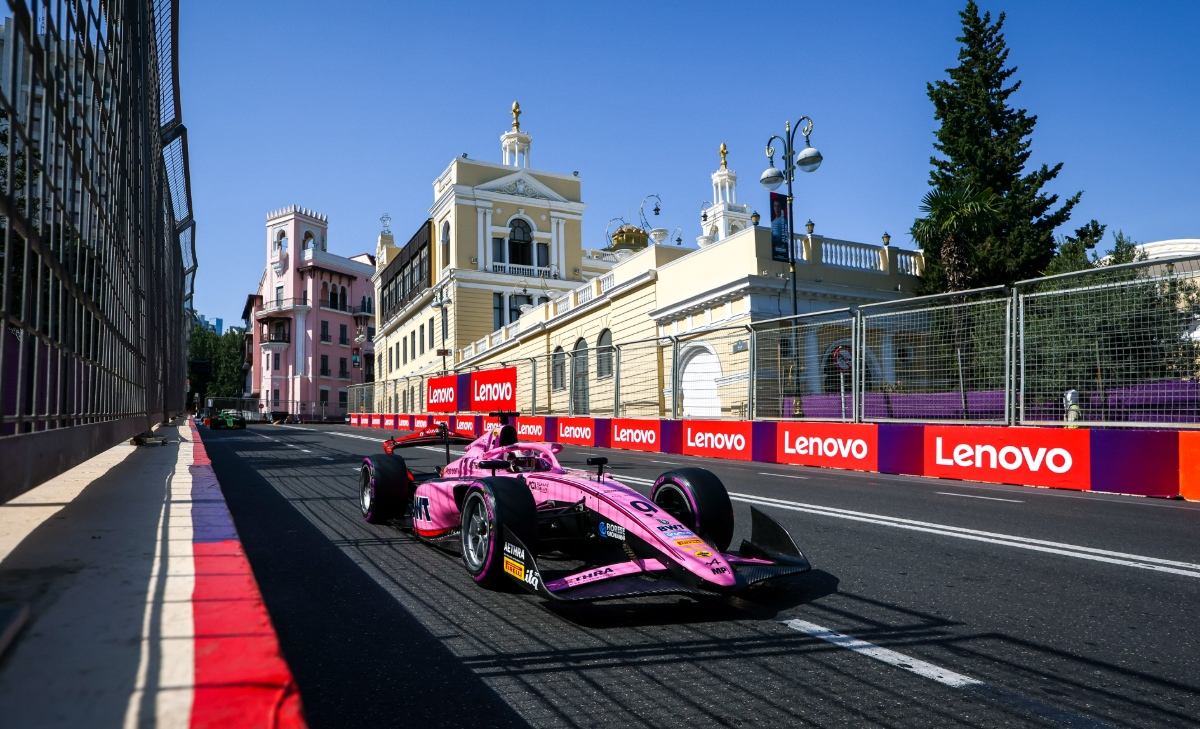
Photo: Dutch Photo Agency