 By:
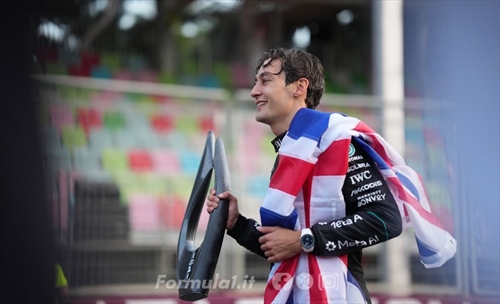
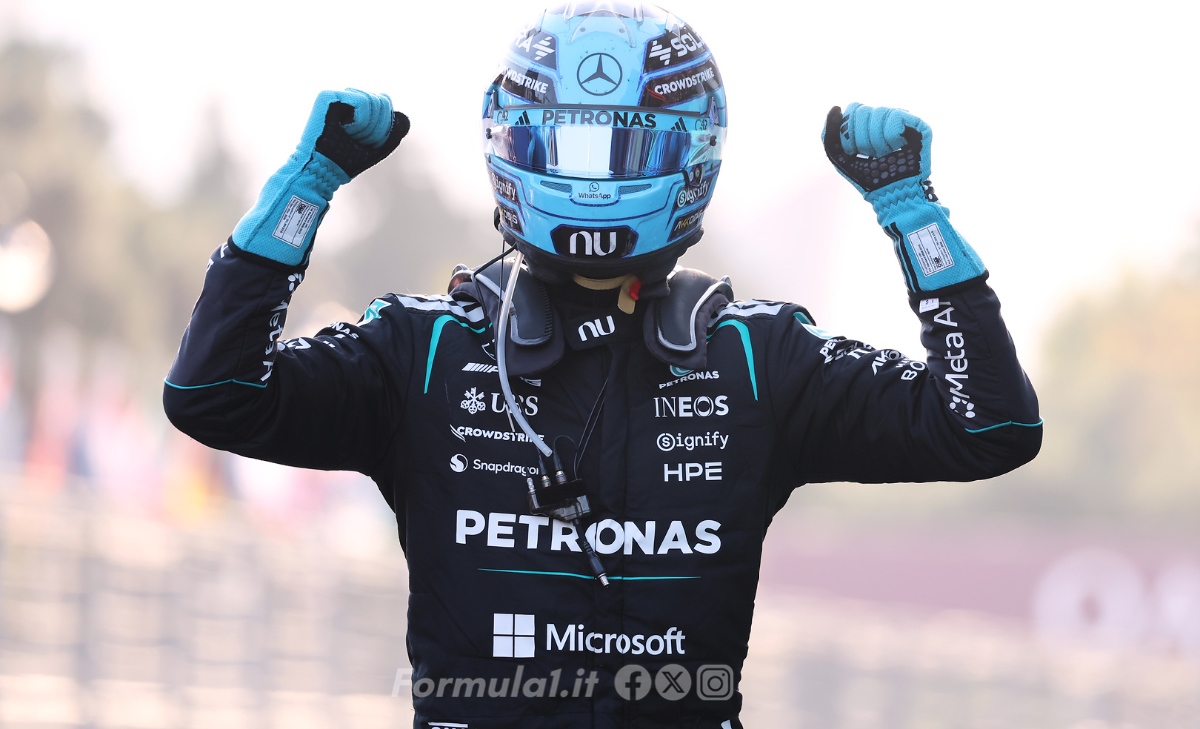
By: Some victories are measured by the points scored, while others can do more than change the standings: they can alter a driver's perception of what is possible against a team-mate who has proved stronger than expected. Viewed in that light, George Russell's victory in Baku probably belongs in the latter category, because his first Grand Chelem in Formula 1 was not only a story of a perfect weekend, but above all one of his ability to manage a situation in which even the slightest mistake could have reopened the race. Pole position, victory, fastest lap and leading every lap combined to deliver an achievement the British driver had never managed before, but the most significant aspect is not necessarily the one that appears in the statistics.
From that perspective, the true value of Russell's weekend lies in proving that he can cope with the pressure of being the driver to beat, turning a race he absolutely had to win, given the starting position of his team-mate and championship leader, into a demonstration of control and maturity. While the pace needed to fight for the title had never truly been in question, Baku added perhaps an even more important element from a championship perspective: the knowledge that he can withstand Antonelli's pressure, having managed the imposing presence of Max Verstappen behind him.
Perfection was not confined to pole position, but extended to race management

Pole position had already been an important signal, firstly because Kimi Antonelli made an error on his first run in Q1, but above all because, in a Formula 1 in which the smallest margins can decide the grid order and turn a single mistake into a lost position, Russell had put together the lap required at the decisive moment. That gave him the opportunity to approach the race from the ideal position in a Mercedes that proved stronger than its rivals. But it was Sunday that gave his performance a deeper meaning, because starting at the front is one thing; staying there for the whole race knowing that Verstappen is behind you is another.
The Dutchman was never close enough to mount a genuine attack, except in the closing stages thanks to the safety cars, but his presence in the mirrors still represented constant pressure. Russell knew he could give nothing away and, above all, could not turn a minor slip into an opportunity for his rival.
In such a situation, the difference does not necessarily come from finding a few extra hundredths, but from being able to maintain the same level of concentration for dozens of laps. Russell demonstrated that concentration by stringing together fast laps, even though they were not necessary for the race result.
It is precisely this aspect that makes the Baku result particularly interesting. Russell had already shown on several occasions that he possesses the pace needed to run at the front, just as he had already demonstrated that he can put together high-level qualifying sessions and races. The question, particularly when the stakes rise, is instead about his ability to turn that speed into a complete performance, without leaving room for mistakes or lapses in concentration — something that had characterised his weekends before Azerbaijan.
In Baku, however, none of that happened: Russell built his advantage without giving Verstappen a genuine opportunity to get back into the race, and managed every phase with a consistency that could, in the long term, be worth even more than the result itself. The Grand Chelem is therefore not merely the snapshot of a perfect Sunday, but the consequence of an entire weekend in which the Mercedes driver brought together performance, management and clarity of thought in a season that has proved the opposite of what he would have wanted.
The potential turning point is above all mental
The debate over Russell's chances of becoming world champion has long revolved around two questions: how competitive can he be when simply being quick is no longer enough, and how much Antonelli's unexpected speed has effectively put him under pressure. His talent and ability to take the car to the limit have never appeared to be the main issue. Yet, over most weekends, he has been behind Antonelli, to the point that people began to think that perhaps the Italian driver was getting more out of the car. In that sense, the next step — the one separating a driver capable of winning races from one able to sustain a title challenge — concerns managing those moments when pressure becomes an integral part of performance, and Russell has not always shown that he can handle it.
A world championship is built through dozens of situations in which it is not enough to have the most competitive car or set the fastest lap. Rather, it is about knowing when to attack and when to preserve, accepting a less favourable result when necessary and, above all, preventing pressure from turning a situation under control into a mistake. It is a dimension that often does not emerge in the numbers, but it can become decisive over the course of a season.
That is why Baku could represent an interesting stage in Russell's development, not so much because he beat both Verstappen and Antonelli over the same weekend, or because he secured a Grand Chelem for the first time, but because he handled the situation without ever giving the impression of being overwhelmed by it. Instead, he showed that he knew he had the means to win it. The Mercedes driver did not simply defend first place: he constructed a race in which his rival never truly had the opportunity to challenge him.
And this is where the meaning of the victory goes beyond the result, because there is a subtle difference between being in front and truly feeling in control of the race, but in a championship it can become enormous. In Baku, Russell gave the impression of belonging to the latter category, managing the pressure without allowing it to become a destabilising factor, but rather turning it into a source of confidence.
The title will not be won in Baku, but belief can be born here
Of course, it would be premature to turn one good weekend after difficult months into certainty for the remainder of the season, given that he is 66 points behind Antonelli. A Grand Chelem does not erase the difficulties encountered previously and, above all, does not award any world title.
Nevertheless, there is something Baku can leave behind that goes beyond the points scored: Russell's ability to be quick, precise and capable of managing the different phases of a race at the same time. Above all, he faced a situation in which the pressure was clear without allowing it to affect him. For a driver aspiring to the title, even if the gap is substantial, that is far from a secondary factor, because the knowledge that he can control a race even when the most dangerous benchmark is behind him can become an important asset in the decisive moments of the season.
The first Grand Chelem of Russell's career will therefore remain a historic achievement in his career, but it could carry even greater significance because of what it has given him. In Baku, he did not simply prove that he can win: he proved that he can carry the weight of a victory without losing his clarity. We will see whether this weekend represented a turning point for him, considering the words he used in interviews, in which he effectively maintained that he had found the key to understanding the car, something he had not had until now.
All the news, photos, weather, session times and times from the Azerbaijan GP 2026