 By:
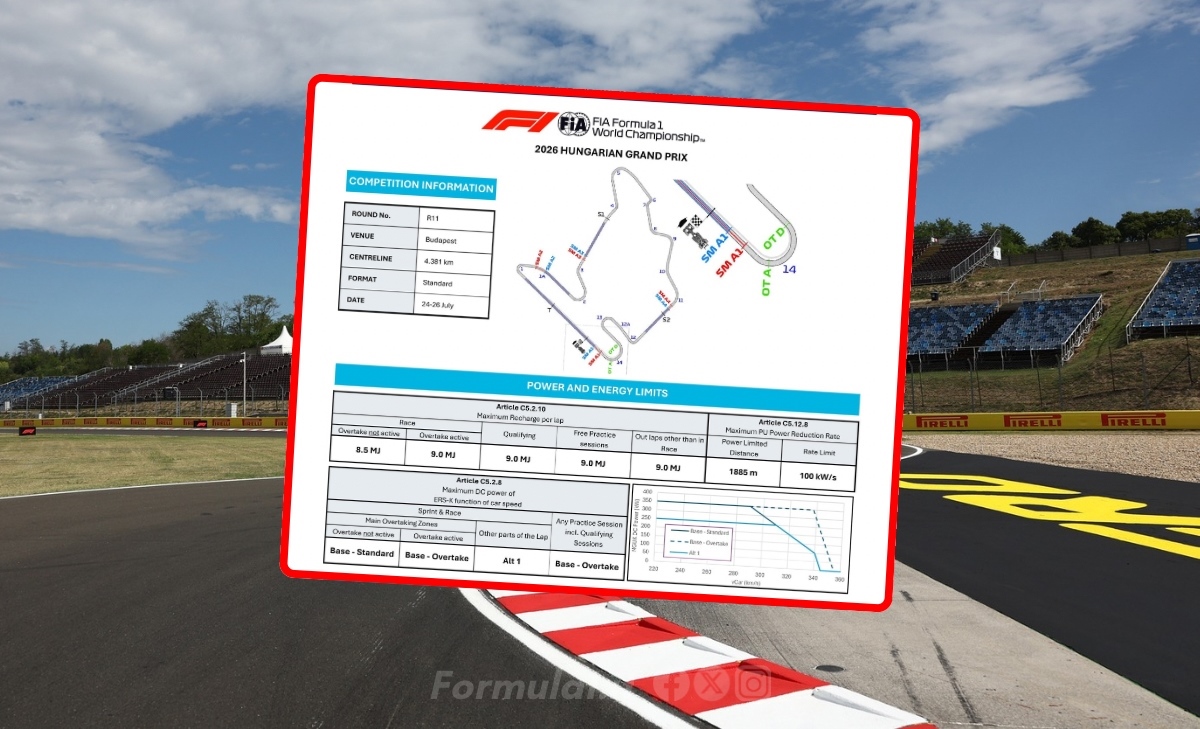
By: Power Unit Information: these are the documents published by the FIA throughout the 2026 season that set out all the management parameters for the new electrical component at each Grand Prix, beyond the general 350 kW limit of the MGU-K. For every circuit, the Federation establishes a specific energy architecture, determining the maximum amount of recoverable energy, the power delivery curves according to speed and the areas in which alternative configurations are applied.
These documents, which are made available to the teams well before their public release, therefore define the electrical power parameters that can be used in significantly different ways from one circuit to another.
Energy recovery limits for each Grand Prix
First of all, the energy recovery limit is established. This parameter has become crucial following the widespread criticism of this generation of Formula 1 cars, which have been forced to recover energy on full-throttle sections because of the much-discussed phenomenon known as super clipping. A lower limit generally reduces the clipping problem, but it also reduces the electrical energy available to the drivers over a lap. It is a compromise designed to protect the spectacle, although it comes at the expense of lap time. Overall, the drivers would have recorded faster times despite the straight-line clipping, but nobody appreciated the sudden loss of power.
| Grand Prix | Standard race | Race Overtake | Qualifying | PLD | Rate limit |
|---|---|---|---|---|---|
| Australia | 8.0 MJ | 8.5 MJ | 7.0 MJ | 3,518 m | 50 kW/s |
| China | 8.5 MJ | 9.0 MJ | 9.0 MJ | 3,125 m | 100 kW/s |
| Japan | 8.5 MJ | 9.0 MJ | 8.0 MJ | 3,472 m | 100 kW/s |
| Miami | 8.5 MJ | 9.0 MJ | 8.0 MJ | 3,346 m | 100 kW/s |
| Canada | 8.0 MJ | 8.5 MJ | 6.0 MJ | 2,682 m | 100 kW/s |
| Monaco | 8.5 MJ | 9.0 MJ | 9.0 MJ | 1,388 m | 100 kW/s |
| Barcelona | 8.5 MJ | 9.0 MJ | 7.0 MJ | 2,440 m | 100 kW/s |
| Austria | 8.0 MJ | 8.5 MJ | 6.0 MJ | 2,923 m | 100 kW/s |
| Great Britain | 8.0 MJ | 8.5 MJ | 6.5 MJ | 3,833 m | 50 kW/s |
| Belgium | 8.5 MJ | 9.0 MJ | 7.0 MJ | 4,594 m | 50 kW/s |
| Hungary | 8.5 MJ | 9.0 MJ | 9.0 MJ | 1,885 m | 100 kW/s |
The energy recovery limit is certainly related to the length of the circuit, but several other parameters also come into play. Monaco, China and Hungary allow the maximum of 9.0 MJ per lap in qualifying, while Canada and Austria are limited to 6.0 MJ. Despite Spa being 7,004 metres long, it allows 7.0 MJ over a qualifying lap.
The value must therefore be considered alongside the distribution of braking zones, average speed, the duration of full-throttle sections and the actual opportunities to recover energy without making excessive use of clipping.
Base curves: Standard and Overtake
We can now examine how the use of energy is regulated, both in standard conditions and when drivers are using Overtake mode, which is available when they are less than one second behind the car ahead. At almost every circuit, the Base-Standard curve keeps the usable MGU-K power at around 350 kW up to approximately 290 km/h. Above that speed, electrical power is progressively reduced: the FIA graph shows it falling to around 100 kW near 340 km/h before reaching zero shortly afterwards.
Overtake mode radically changes this phase. The full 350 kW is maintained up to approximately 340 km/h, with a much later reduction bringing the power down towards zero at around 355 km/h. The main advantage of Overtake mode is therefore the ability to extend maximum electrical assistance at higher speeds.
This explains why the system is particularly valuable on long straights. While Standard mode has already begun to reduce the electrical contribution, Overtake mode can continue to provide almost all the available MGU-K power, provided the drivers still have enough energy available, potentially saved in other sections of the lap by not using boost mode.
Alt 1 mode
From Miami onwards, in an attempt to address the problems surrounding the spectacle, particularly in qualifying, the FIA has also introduced the Alt 1 configuration at several circuits. This is represented by a virtually constant limit of around 250 kW, significantly lower than the 350 kW permitted by the Base curves. Its purpose is to limit electrical deployment in specific sections of the lap, preserving energy for areas in which performance or overtaking is more important. The FIA precisely defines the sectors in which the alternative curve must be applied.
| Grand Prix | Alt 1 sectors | Approximate length |
|---|---|---|
| Miami | T1-T8; T11-T16 | 1,600 m |
| Canada | T1-T6 | 980 m |
| Barcelona | T1-T5; T7-T9; T10-T12 | 2,000 m |
| Austria | T4-T7; T9-T10 | 1,510 m |
| Great Britain | T1-T4; T15-T16 | 1,150 m |
| Belgium | T5-T14 | 2,500 m |
| Hungary | T4-T9; T12-T14 | 1,420 m |
The combination of these limits affects the Power Limited Distance, a summary parameter that identifies the distance of the lap over which the power unit operates in power-limited conditions, meaning that MGU-K power is progressively reduced according to speed and the curves defined by the FIA. In practical terms, the longer the Power Limited Distance, the greater the proportion of the circuit over which the electrical system can no longer deliver the maximum 350 kW and must gradually reduce its contribution.
Monaco is the only document in this group to feature Rev 1-Standard and Rev 1-Overtake curves. The technical reason can be seen directly in the graph: the characteristic speeds of the circuit are too low for the normal Base curves to be genuinely selective.
Power reduction begins at around 200 km/h. In Standard mode, the MGU-K output progressively decreases until reaching zero at around 300 km/h, while in Overtake mode it retains more power and reaches zero just above 300 km/h.
Monaco also has no Alt 1 sectors. Energy management is primarily controlled through this specific curve and through the windows in which exceptions to the power reduction are permitted.
Hungary: plenty of energy, but its use is heavily regulated by the FIA
We now come to the next Grand Prix. For Budapest, the FIA allows 8.5 MJ of recoverable energy in the race without Overtake, 9.0 MJ with Overtake and 9.0 MJ in both qualifying and free practice. The regulatory energy recovery limit is therefore set at the maximum level seen during the opening 11 Grands Prix.
The most significant figure, however, is the Power Limited Distance of 1,885 metres. Among the races considered, this is the second-shortest PLD, behind only Monaco’s 1,388 metres. Relative to the length of the circuit, it corresponds to approximately 43% of the lap, compared with 41.6% in Monaco and 65.6% at Spa.
The Hungaroring features two major Alt 1 windows:
- from Turn 4 to Turn 9, between 1,780 and 2,700 metres;
- from Turn 12 to Turn 14, between 3,500 and 4,000 metres.
Overall, the alternative curve is used for approximately 1,420 metres, equivalent to just over 32% of the circuit. In these sections, the electrical power indicated by the Alt 1 curve remains at around 250 kW. The full potential of the MGU-K is instead preserved for the most strategic areas, particularly the exit of the final corner, the main straight and the opening part of the lap.
The FIA also allows a higher speed threshold of 240 km/h in the section between Turn 2 and the exit of Turn 3. There are also several windows in which the initial power reduction may exceed 150 kW, concentrated between Turns 4 and 5, Turns 8 and 9, Turns 12 and 14 and at the exit of the final corner.
Comparison with Monaco and Spa


Budapest is often compared with Monaco because of its sequence of slow and medium-speed corners, but from an energy perspective it is not Monaco. Both circuits allow 9.0 MJ in qualifying and have a relatively short Power Limited Distance, but their power management systems are different.
In Monaco, the FIA uses a specific Rev 1 curve, bringing forward the power reduction dramatically so that it begins at around 200 km/h. In Hungary, the normal Base curves remain in use because the main straight and certain faster sections allow the cars to reach speeds high enough to make the distinction between Standard and Overtake meaningful.
Budapest also requires Alt 1 mode in two extensive sections. Monaco, by contrast, has no sectors in which this alternative curve is imposed.
To understand the expected behaviour of the cars, we compared the energy management limits with those used at the previous round at Spa, a profoundly different circuit. The contrast with Belgium is much more pronounced. At Spa, the Power Limited Distance reaches 4,594 metres, almost two and a half times the Hungarian figure. The maximum power reduction rate is also limited to 50 kW per second, compared with the 100 kW per second permitted in Budapest.
Spa features one extremely long Alt 1 zone from Turn 5 to Turn 14, covering approximately 2,500 metres. This is the consequence of a circuit where prolonged high-speed sections make it impossible to maintain maximum electrical deployment continuously without prematurely exhausting the available energy.
Energy management in Hungary appears far less severe than at Spa. The challenge is not to sustain electrical power over kilometres of straights, but to decide precisely where to use it. The FIA permits a high amount of energy recovery, but imposes the Alt 1 curve in the middle and final sections of the lap to concentrate the maximum electrical contribution in the most important acceleration zones.
What to expect at the Hungarian Grand Prix
The FIA data suggests that the Hungaroring should not be one of the most critical circuits of the season in terms of the overall energy balance. The 9.0 MJ recovery ceiling and the relatively short Power Limited Distance reduce the risk of the extreme management required at circuits such as Spa or Silverstone.
However, this does not mean that energy will be irrelevant. On the contrary, Budapest will require extremely precise calibration between the Alt 1 zones, the use of Overtake mode and preparation for the exit of the final corner. The difference may be determined not by the absolute amount of energy available, but by the ability to preserve it and distribute it in the few areas where it can genuinely be converted into lap time or an overtaking opportunity.
The FIA document therefore describes a circuit where energy recovery is relatively favourable, but deployment remains highly selective: energy is available, but it cannot be wasted.
The article in 2 minutes
Every weekend, the FIA publishes a document of fundamental importance to the teams: the Power Unit Information. This document establishes how power unit energy must be managed around the Grand Prix circuit, directly affecting performance, strategy and overtaking opportunities.
It defines the limits on the energy that can be recovered by the MGU-K in the different operating modes—race, qualifying, free practice and Overtake—which vary from circuit to circuit according to the characteristics of the track. This is why some circuits allow significantly more energy recovery than others.
The document also contains the electrical power delivery curves. In Standard mode, the MGU-K progressively reduces its output above a certain speed, while in Overtake mode it maintains the full 350 kW for longer, providing an advantage under acceleration and on the straights. Some circuits also feature Alt 1 mode, which deliberately limits power in specific areas to preserve energy for use in more advantageous sections of the lap.
One of the most important parameters is the Power Limited Distance, meaning the distance of the lap over which the MGU-K operates with progressively reduced power. The higher this value, the greater the proportion of the circuit over which the electrical contribution cannot be maintained at its maximum level.
For the Hungarian Grand Prix, the FIA has adopted a configuration that is very different from Spa. Budapest offers the maximum permitted energy recovery in qualifying and one of the shortest Power Limited Distances of the season. This means that the main challenge is not recovering energy, but using it at the right moment.
For this reason, the document introduces two extensive areas in which Alt 1 mode is applied, preserving energy for the most important acceleration zones, such as the main straight and the exit of the final corner.
The comparison with Monaco highlights certain similarities in energy availability, but also substantial differences in how the MGU-K is managed. Compared with Spa, however, the Hungaroring represents almost the exact opposite: on the Belgian circuit, the challenge is to have enough energy available throughout kilometres of full-throttle running, while in Budapest the difference will be made by the ability to distribute it in the decisive areas.
In brief: the Power Unit Information is one of the most important FIA documents of the weekend. Learning how to read it makes it possible to understand why certain circuits favour particular cars and what role energy management will play in the performance of each Grand Prix.
All the news, photos, weather, session times and times from the Hungarian GP 2026

